
Collecting Signers of the Declaration - Pennsylvania
by Elizabeth Fuller, Librarian
When Dr. A.S.W. Rosenbach popularized the collecting of American historical manuscripts in the early 20th century, he built on a practice initiated much earlier. As the Revolutionary generation was dying in the 1810s, biographers and historians began collecting documents written or signed by significant people involved in the conflict. Among the most sought-after subjects were individuals closely associated with great events, like the Declaration of Independence. Some collectors have attempted to acquire documents from each of its 56 signers, and about 40 such “Signers Sets” are known to exist today, mostly in institutions. Intimately familiar with the completist impulse of collectors, Dr. Rosenbach helped a number of his customers build their own sets and assembled one of his own. The Rosenbach Museum & Library now preserves a “Signers Set,” along with additional Revolutionary-era documents collected by our founder and other material acquired since his death.
In this 250th anniversary year, the Rosenbach brothers’ Partner Desk will host a changing selection of Signers’ documents, state by state. Together these documents offer glimpses not only of great Revolutionary events, but also of routine public and private business and the writers’ personal lives.
Nine signers represented Pennsylvania, the most of any state. Five manuscripts are on view, but documents for all 9 can be found below. Visit the website of the National Constitution Center for useful biographies of all 56 signers.
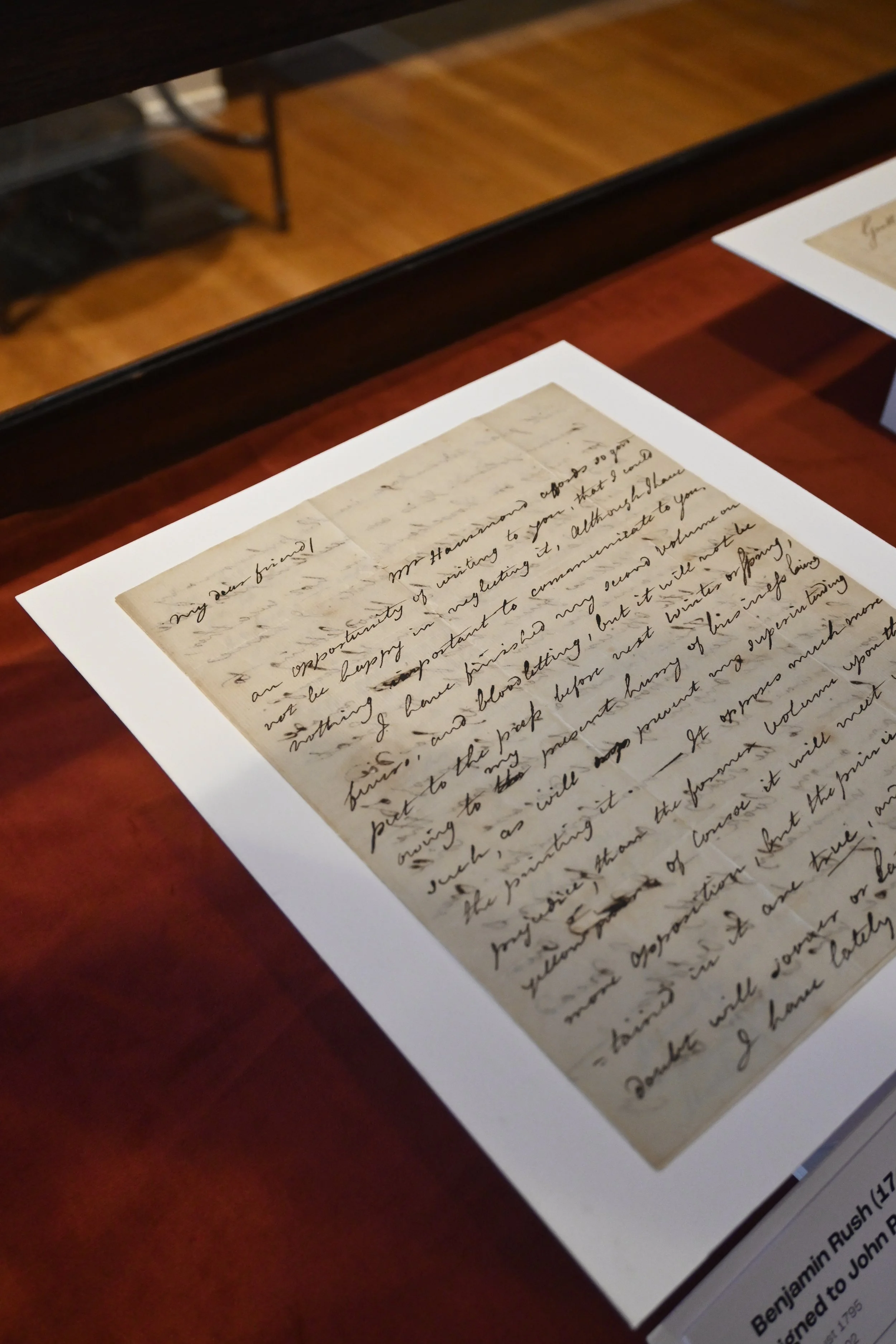
Autograph letter by Benjamin Rush. Image credit Bryn Michelson-Ziegler
Benjamin Rush (1746-1813), Autograph letter signed to John Redman Coxe
12 August 1795
RUSH I:02:02
Rush combined his political activism with promotion of a number of social reforms and a distinguished career as a physician. Genuinely concerned for poor patients and exhibiting personal bravery in providing direct care during the 1793 yellow fever epidemic, he also held a stubborn belief in the superiority of systematic theory over empirical evidence, which led him to advocate treatments like bleeding and purging that often did patients more harm than good. He argued publicly with others about both the treatment and the cause of the disease. In this letter to a fellow physician he writes about a forthcoming book that will reiterate his views.
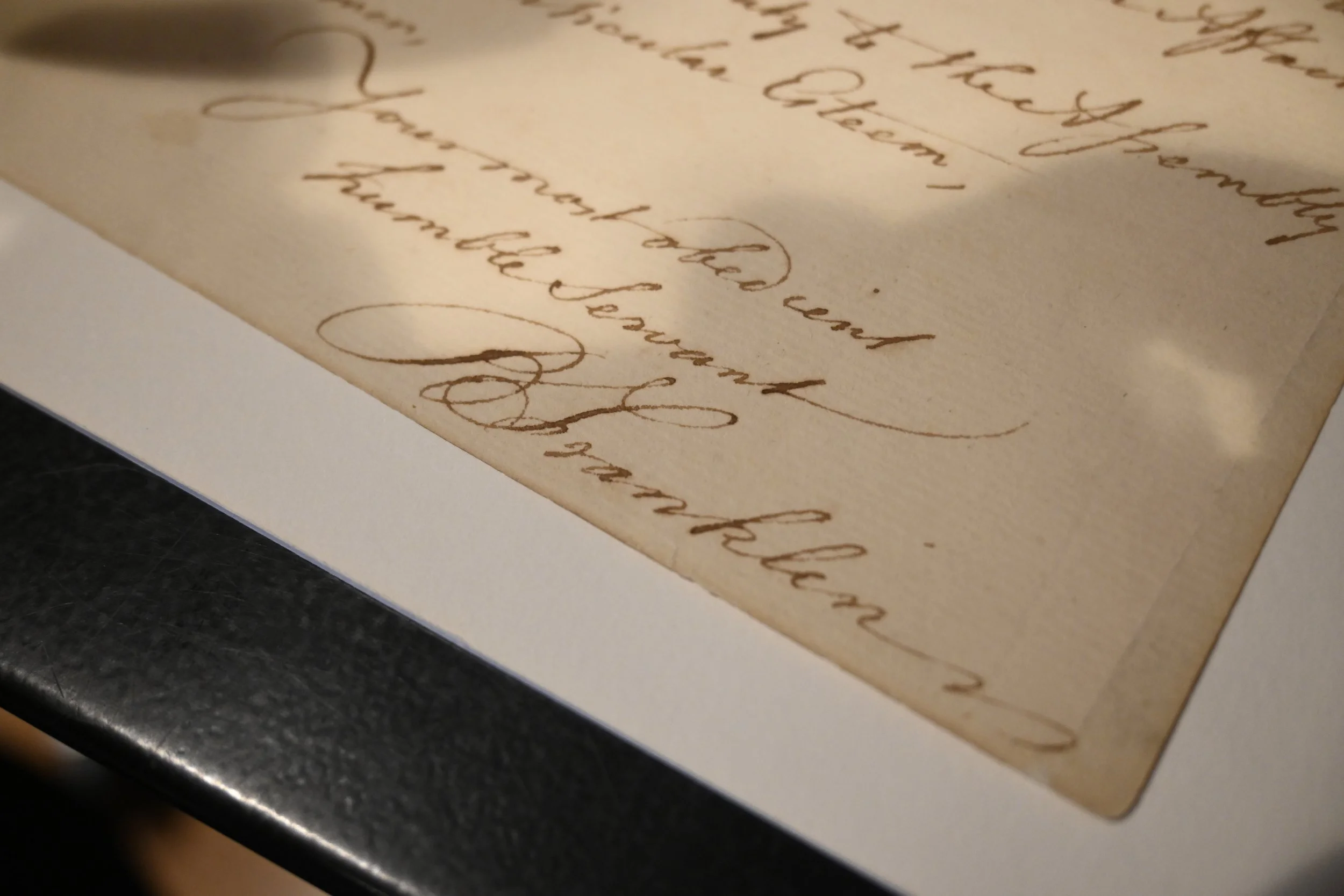
Signature of Benjamin Franklin. Image credit Bryn Michelson-Ziegler
Benjamin Franklin (1706-1790), Autograph letter signed to the Pennsylvania Committee of Correspondence
London, 12 April 1766
AMs 1078/28
Active as Franklin was in the civic life of Philadelphia, he actually spent 17 of the 20 years immediately prior to independence in England. Originally sent by the Pennsylvania legislature to negotiate limits on the power of the Penn family proprietors, he stayed to work against the Stamp Act and other taxes levied by Parliament immediately after the French and Indian War, which became one of the immediate causes of the Revolution. His testimony in Parliament succeeded in repealing the Stamp Act, but Parliament expressly reserved the right to impose further taxes. In this letter he writes about some of those planned taxes and his negotiations with allies and opponents in the British government.
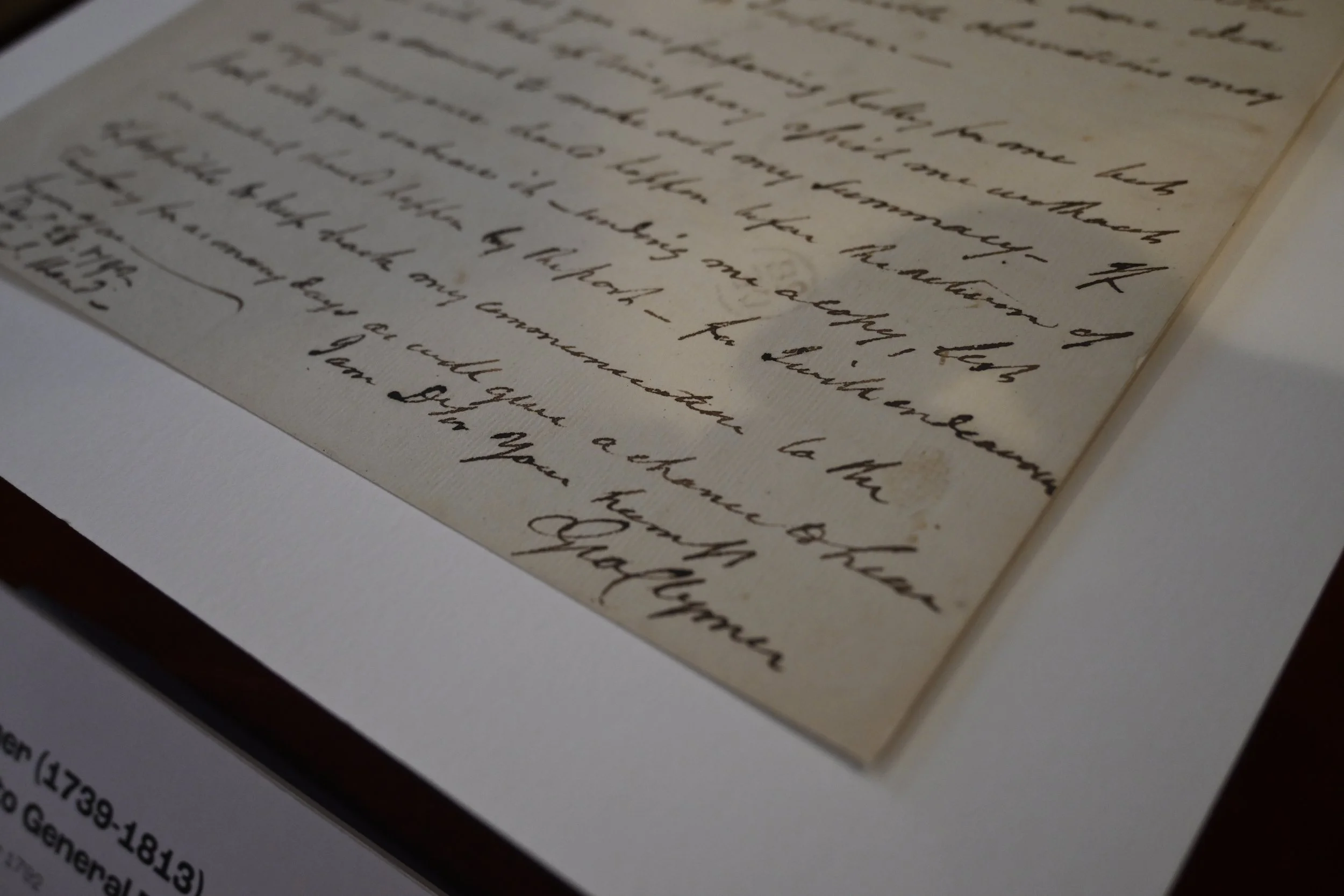
Signature of George Clymer. Image credit Bryn Michelson-Ziegler
George Clymer (1739-1813), Autograph letter signed to General Edward Hand
Philadelphia, 28 December 1792
AMs 364/29
Although few of us have worked as customs inspectors, much less been in charge of a state’s excise department at the moment that Congress imposed the first federal tax on a domestic product, many of us can relate to the predicament described in this letter. Clymer, as head of the Pennsylvania excise, needs to report to Congress on the collection of the new tax on distilled spirits. Collection has not gone smoothly (the tax was so unpopular that it eventually led to the violent protest known as the Whiskey Rebellion), so Hand has been slow to send the necessary information. Although Clymer understands the predicament and is giving Hand as much time as he can to send the details, he requests “a summary at least”, since “I am told ... that if I do not furnish some idea of the revenue obtained disagreeable observations may be expected”.
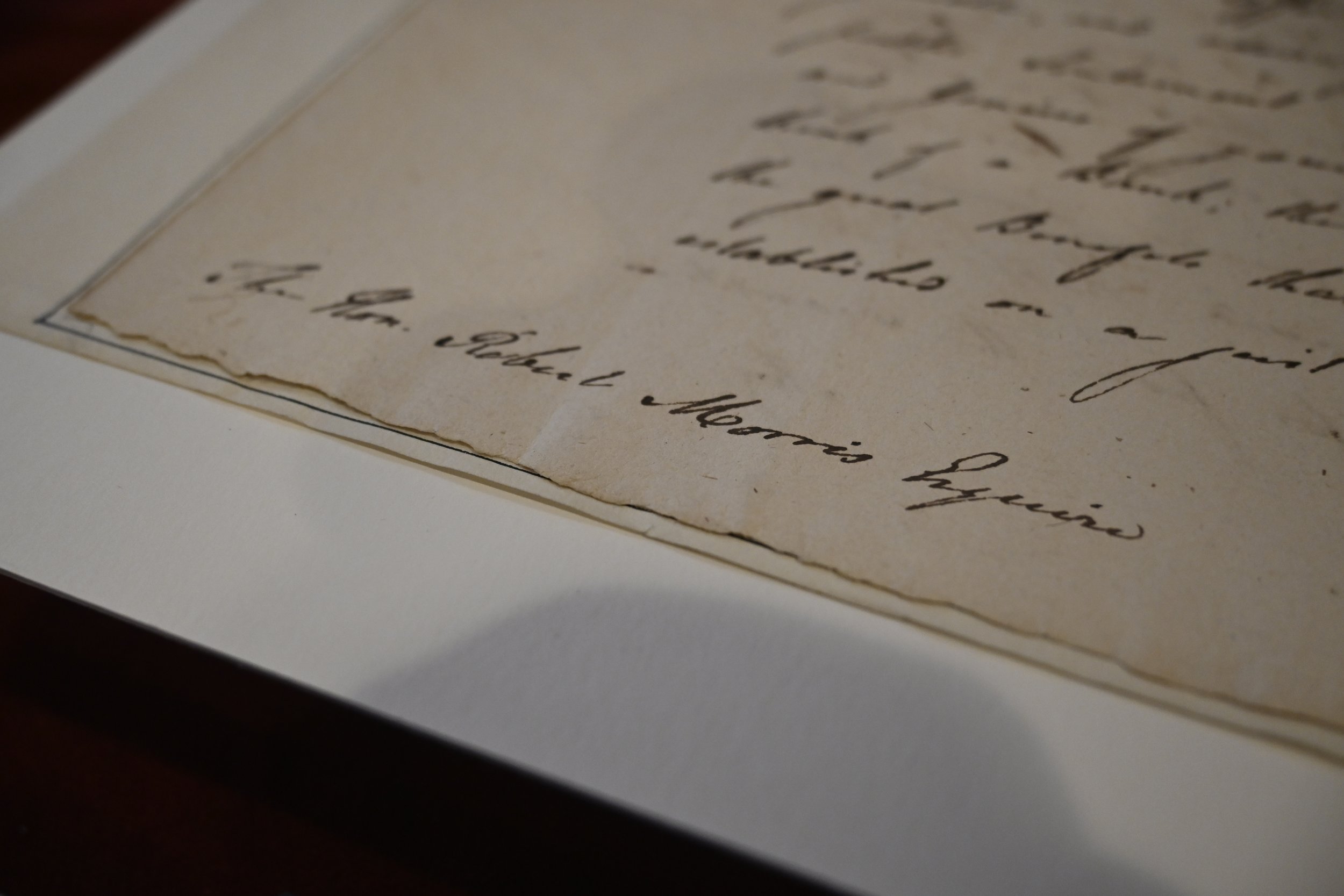
Autograph letter by James Wilson to Robert Morris. Image credit Bryn Michelson-Ziegler
James Wilson (1742-1798), Autograph letter signed to Robert Morris
York, Pa., 24 May 1781
AMs 781/27
Wilson was one of the foremost legal minds of the new nation, having published arguments against Parliament’s authority to tax the colonies and advocated some of the most significant features of the Constitution, including direct election of representatives, a single executive, and the Electoral College, as well as the deeply problematic Three-Fifths Compromise. He was also involved in the daily business of the Continental Congress and as an officer of the Pennsylvania militia. Here he writes to congratulate his fellow delegate Robert Morris on being appointed Congress’s Superintendent of Finance, supports Morris’s plan for the first national bank, and reports on the execution of mutineers in the militia.
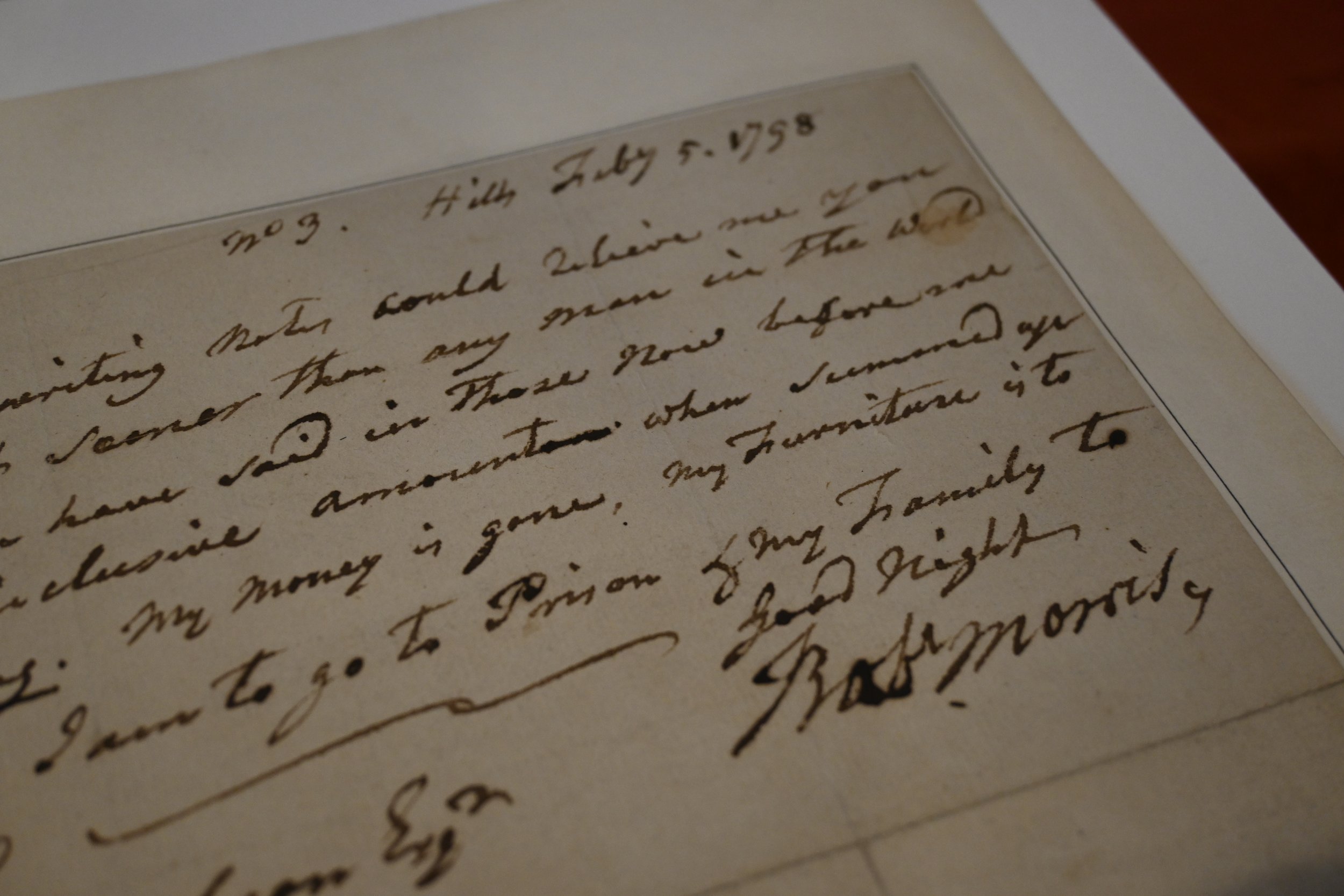
Autograph letter by Robert Morris. Image credit Bryn Michelson-Ziegler
Robert Morris (1734-1806), Autograph letter signed to John Nicholson
Philadelphia, 5 February 1798
AMs 1059/13
Morris, a successful merchant and the richest man in America at the outbreak of the Revolution, worked while in the Continental Congress on committees procuring military supplies as well as overseeing the Navy and foreign affairs. In 1781 he was appointed to the new position of Superintendent of Finance, to regularize Congress’s accounting procedures, control expenses, and secure funding from the states and foreign governments. Although he was permitted to continue with his own extensive business interests, he contributed large amounts of his own funds and used his personal credit to secure loans. After the war he was one of the leading speculators in western lands, until his North American Land Company collapsed as many such businesses did in the 1790s. Here he writes to his business partner John Nicholson that his last efforts to save his fortune have failed: “My money is gone, my furniture to be sold, I am to go to prison & my family to starve.” He spent the next three years in debtor’s prison.
The following documents, not in the Partner Desk, represent the other four Pennsylvania signers.
Pennsylvania (Colony), Bank note
Philadelphia, 3 April 1772
[John Morton]
AMs 778/15
By the time he was elected to the Continental Congress, Morton had held office in Pennsylvania for two decades, including as Speaker of the Assembly and associate justice of the Supreme Court. He was one of several officials to sign this bank note issued by the colony in 1772.
Petition by citizens of New Jersey to the Governor, Council, and Assembly
16 January 1775
[George Ross]
AMs 366/9
Ross, a lawyer and judge, held a number of offices in Pennsylvania and helped to draft the state’s first constitution and declaration of rights. In this petition he joins with a number of citizens of New Jersey to request the legislature to reopen a public road that had been closed by a recent law.
James Smith (approximately 1719-1806), Letter signed to Benjamin Franklin, Owen Biddle, and the Pennsylvania Committee of Safety
York, Pa., 4 October 1775
AMs 540/4
Smith, a lawyer, surveyor, and member of the Pennsylvania Assembly, was a member of the state’s first volunteer militia. In this letter he reports on York County’s supplies of ammunition and election of officers for the county’s militia battalion.
Pennsylvania (Colony). Supreme Court, Writ
Philadelphia, 14 October 1769
[George Taylor]
AMs 807/20
Taylor came to Pennsylvania from England as an indentured servant and became the successful owner of an iron foundry. He also had a long career in the pre-Revolutionary government as a justice of the peace and member of the Pennsylvania assembly. He was one of three Northampton County officials to approve this 1769 writ naming a number of defendants in eviction cases to be tried at the next session of the Supreme Court, a court still constituted by the authority of George III.
In July, the Rosenbach’s Partner Desk will showcase signers from Delaware.