
New Acquisition: The Grave of Shelley by Oscar Wilde
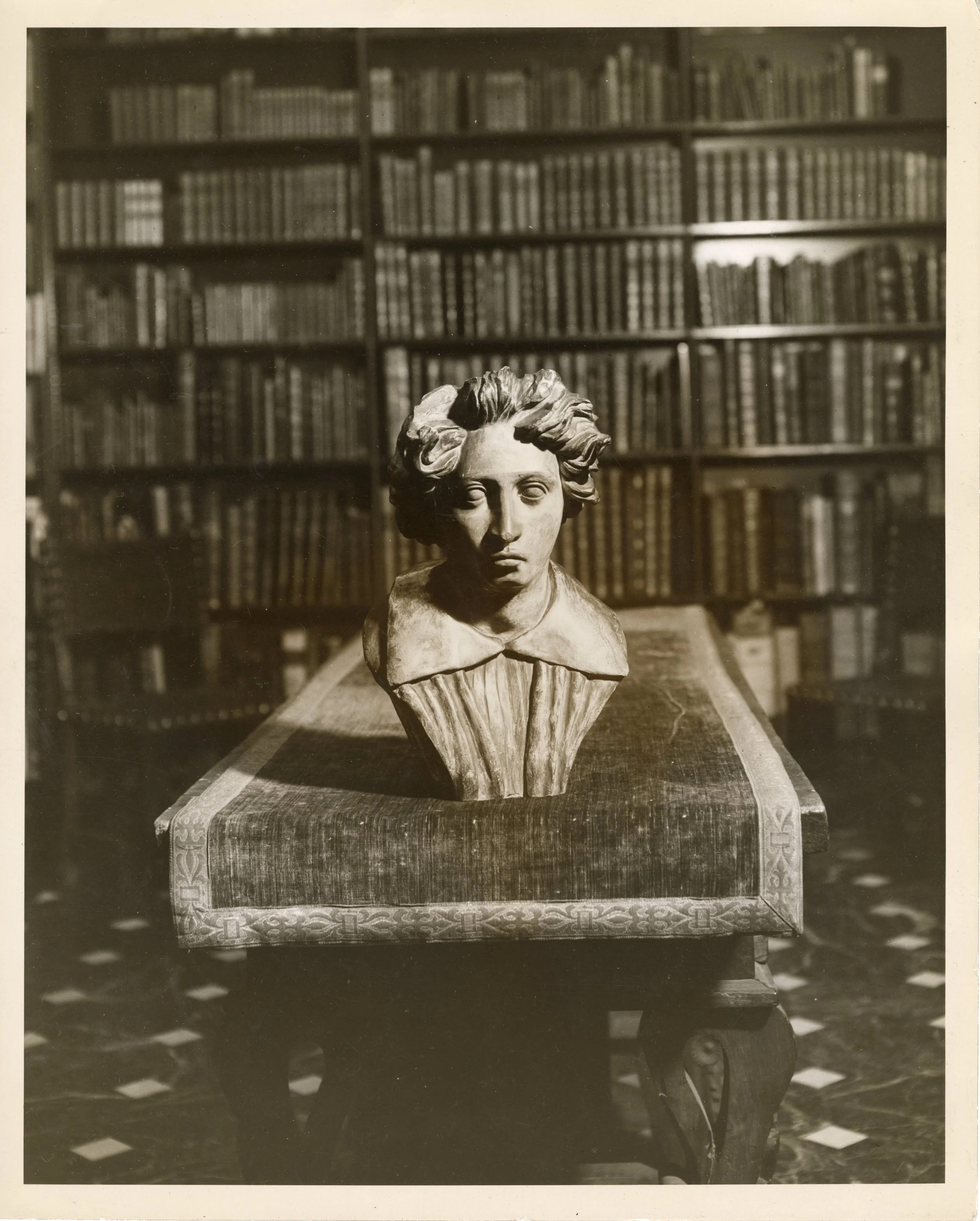
D. Jay Culver. Photograph of a bust of Percy Bysshe Shelley. New York City, [1920-1928]. RCo XIII:05:03, 2006.2340
by Kelsey Scouten Bates, John C. Haas Director
Imagine a young Oscar Wilde reading the poet Percy Bysshe Shelley, who had died just thirty-two years before Wilde’s birth. Only slightly older than Wilde’s own parents, Shelley must have loomed as a near-mythic figure—his reputation growing brighter with each passing year after his death in a boating accident in 1822.
The Rosenbach recently acquired, with the support of a grant from the Wyncote Foundation, two drafts of “The Grave of Shelley,” a poem Wilde wrote in response to Shelley’s death [EL3 .W672 MS2]. Though formally an elegy, Wilde’s poem is less mournful than it is empathetic. It reads:
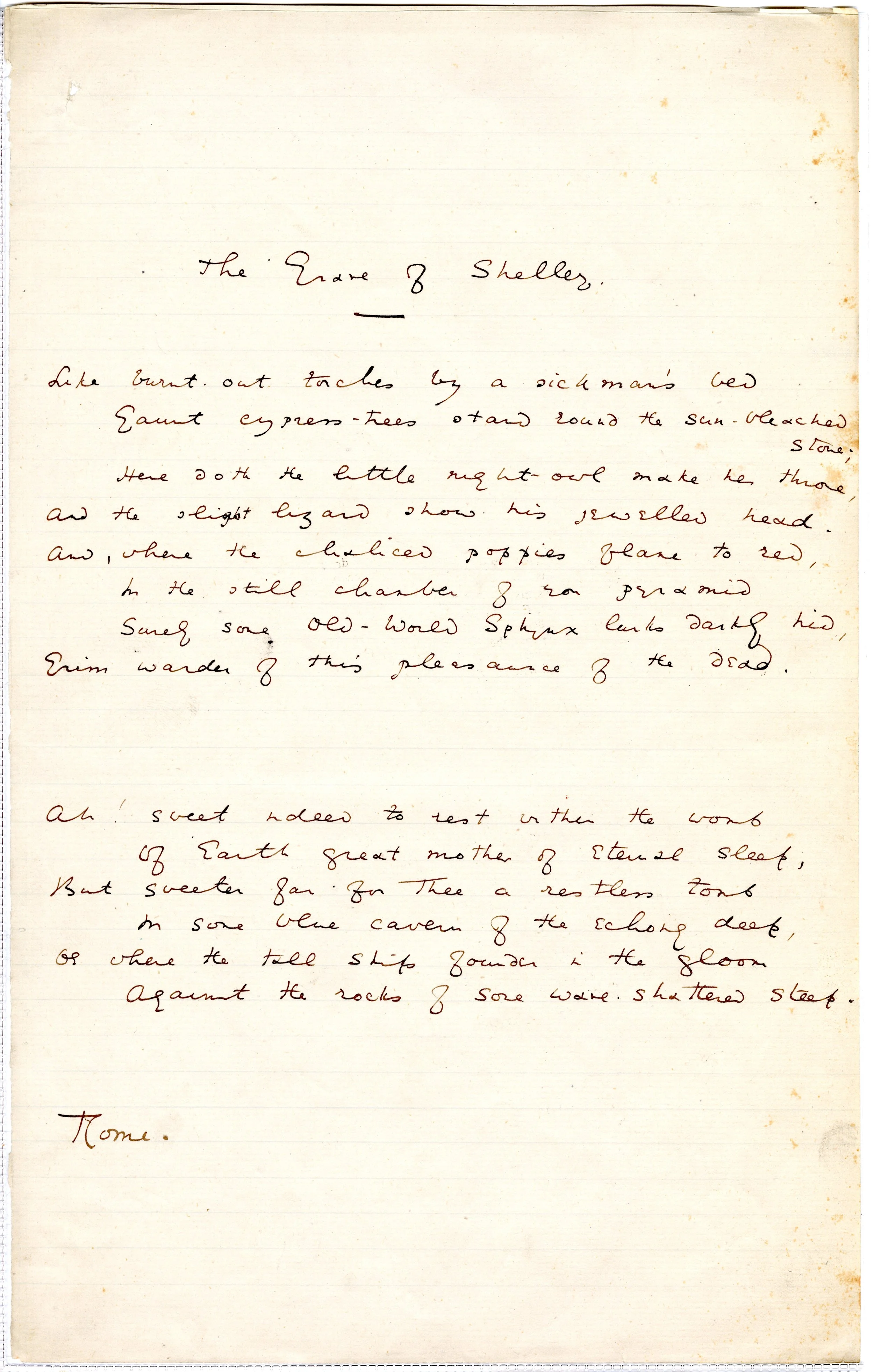
Oscar Wilde (1854-1900). The grave of Shelley: autograph manuscript, fair copy [ca. 1881]. EL3 .W672 MS2
LIKE burnt-out torches by a sick man's bed
Gaunt cypress-trees stand round the sun-bleached stone;
Here doth the little night-owl make her throne,
And the slight lizard show his jewelled head.
And, where the chaliced poppies flame to red,
In the still chamber of yon pyramid
Surely some Old-World Sphinx lurks darkly hid,
Grim warder of this pleasaunce of the dead.
Ah! sweet indeed to rest within the womb
Of Earth, great mother of eternal sleep,
But sweeter far for thee a restless tomb
In the blue cavern of an echoing deep,
Or where the tall ships founder in the gloom
Against the rocks of some wave-shattered steep.
One word in particular stands out: Wilde’s use of “pleasaunce,” meaning a place of beauty or delight—an almost paradoxical description of a grave. Yet the term softens and balances the poem’s otherwise Gothic atmosphere. Notably, Wilde omits the more macabre details of Shelley’s death: the washing ashore of his body and the famous accounts of his heart resisting the funeral pyre.
“The Grave of Shelley” reads as though Wilde recognized in Shelley a kindred restlessness—a spirit ill-suited to containment, even in death. Wilde wrote the poem around 1881, at about twenty-seven years old. He had not yet married Constance Lloyd, nor begun his relationship with Lord Alfred Douglas (a.k.a. Bosie). He was on the cusp of international fame, preparing to depart for a tour of North America—including a visit to Philadelphia, where he would meet Walt Whitman.
Both Shelley and Wilde made their private lives a visible challenge to social norms. Shelley rejected traditional marriage and embraced atheism, while Wilde not only cultivated a deliberately Decadent persona but also pursued relationships with men—choices that placed him in direct conflict with Victorian society and ultimately led to his imprisonment.
It is difficult to overstate how fully this new acquisition resonates within the Rosenbach’s collections. The poem does not stand alone; rather, it participates in an ongoing conversation across generations of writers and collectors. Consider, for example, the letter shown below, written by Shelley’s friend Edward Trelawny to Lord Byron, describing Shelley’s disappearance [EL3 .T788 MS1]. Trelawny expresses cautious optimism that Shelley might yet be found, noting that the Don Juan—the ship named for Byron’s poem—had been discovered intact.
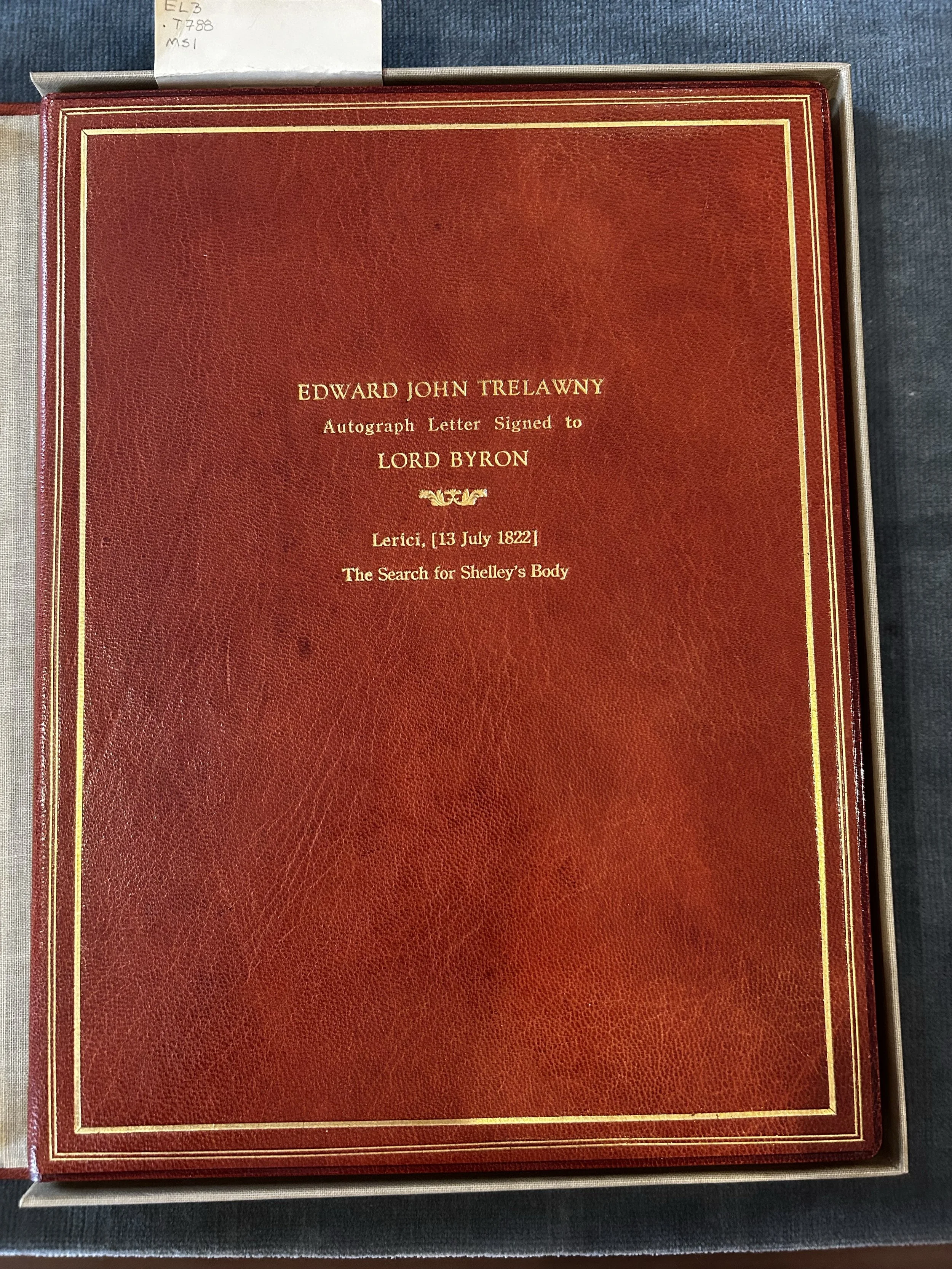
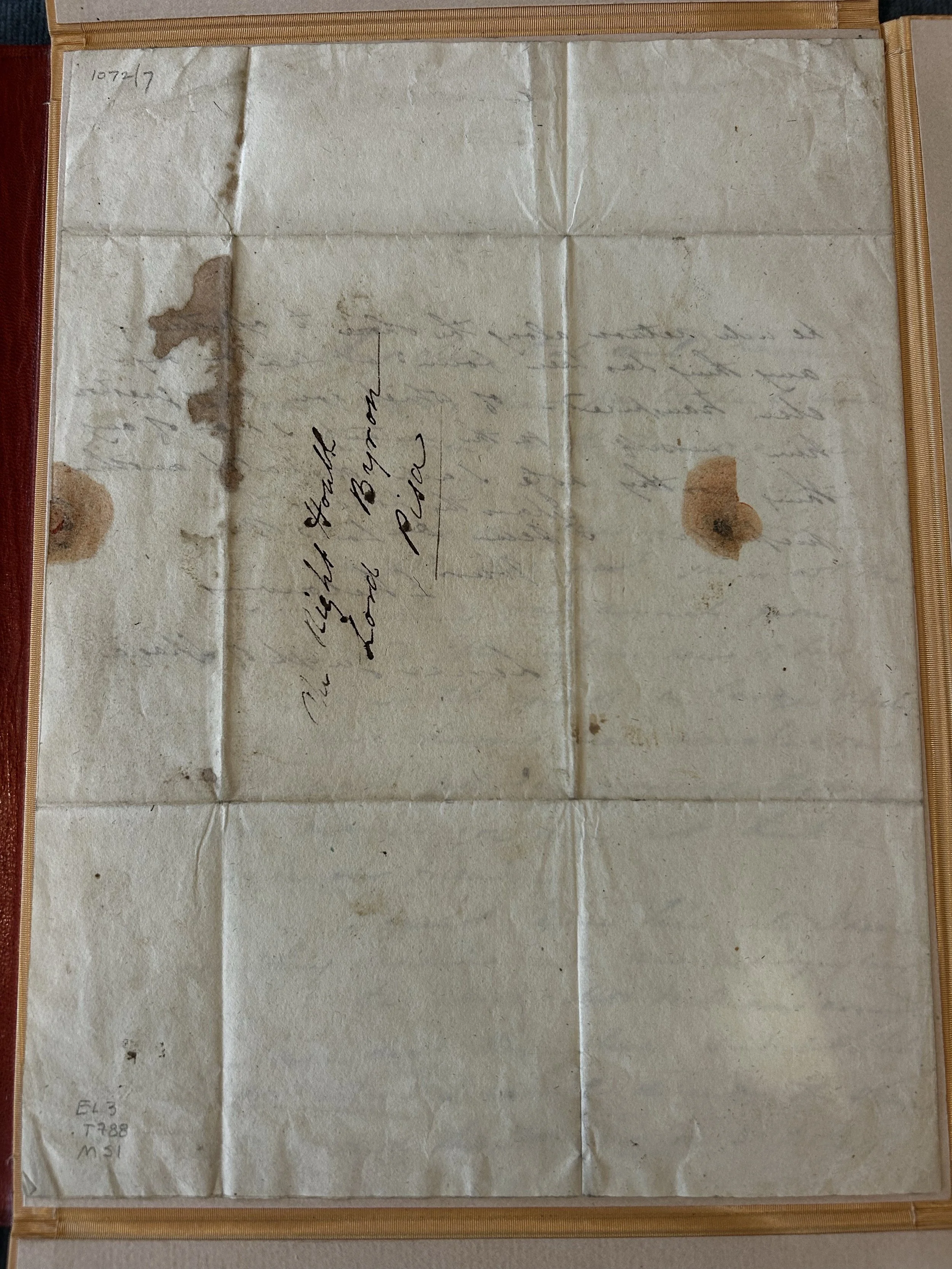
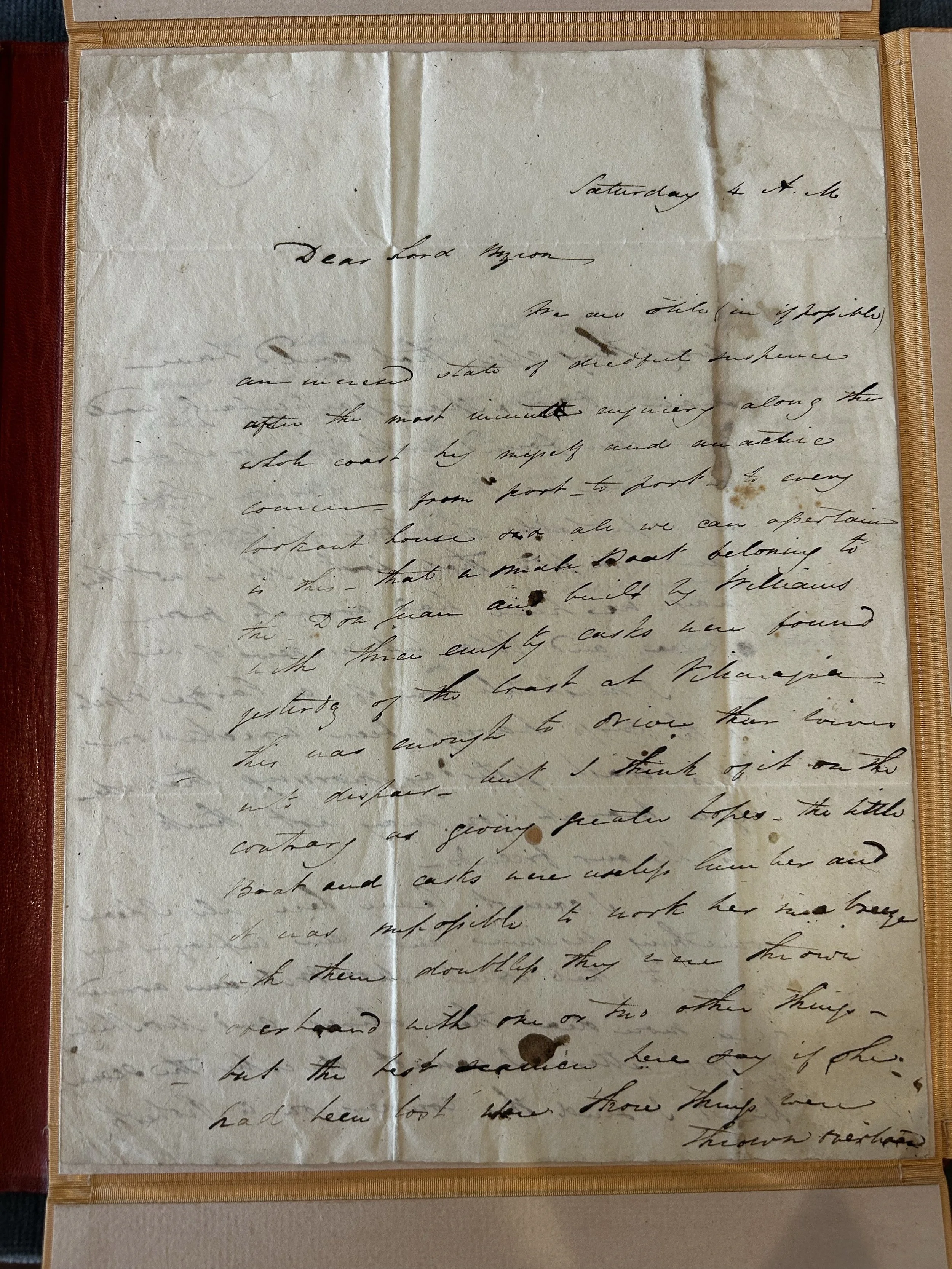
Edward John Trelawney (1792-1881), Autograph letter signed to Lord Byron, Lirici, Italy, [1822 July 13]. EL3 .T788 MS1
As Rosenbach Librarian Elizabeth Fuller observes, Wilde’s poem “looks back to Shelley’s “Adonais,” itself an elegy for John Keats—another central figure in the Rosenbach’s holdings.” It also looks forward. Decades later, A.S.W. Rosenbach would acquire one of Keats’s love letters to Fanny Brawne, the original sale of which Wilde had protested in his sonnet “On the Sale by Auction of Keats’ Love Letters”. When Rosenbach eventually acquired it, Christopher Morley also wrote a poem, this one tongue-in-cheek, commemorating Rosenbach’s purchase and quoting both Shelley and Wilde.
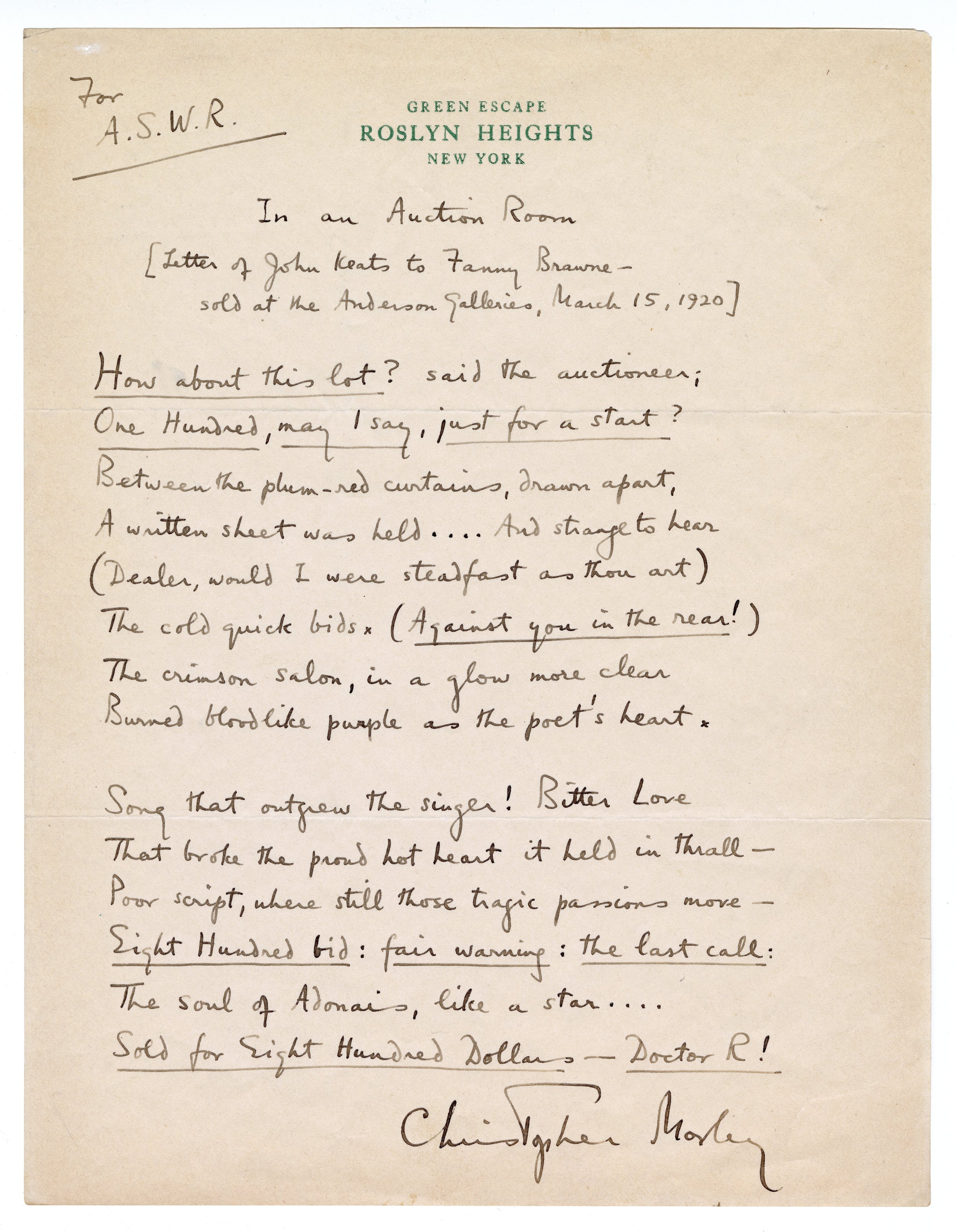
Christopher Morley (1890-1957), In an Auction Room: Autograph manuscript signed. Rosenbach Museum & Library, RoMs 1071/26
IN AN AUCTION ROOM
(Letter of John Keats to Fanny Browne, Anderson Galleries, March 15, 1920.)
How about this lot? said the auctioneer;
One hundred, may I say, just for a start?
Between the plum-red curtains, drawn apart,
A written sheet was held.... And strange to hear
(Dealer, would I were steadfast as thou art)
The cold quick bids. (Against you in the rear!)
The crimson salon, in a glow more clear
Burned bloodlike purple as the poet's heart.
Song that outgrew the singer! Bitter Love
That broke the proud hot heart it held in thrall;
Poor script, where still those tragic passions move—
Eight hundred bid: fair warning: the last call:
The soul of Adonais, like a star....
Sold for eight hundred dollars—Doctor R.!
The connections multiply: between Shelley, Keats, and Wilde; between poets and collectors; between England and America; between the nineteenth and twentieth centuries. This single manuscript becomes a kind of hub, radiating outward into a network of literary relationships.
It reminds us that great writing is never static or self-contained. It is built over time—shaped by those who inherit it, interpret it, and answer it with new work of their own.