
Notes from the Reading Room: Collecting Cervantes
by David Rhys Owen, Manager of Collections Stewardship & Engagement
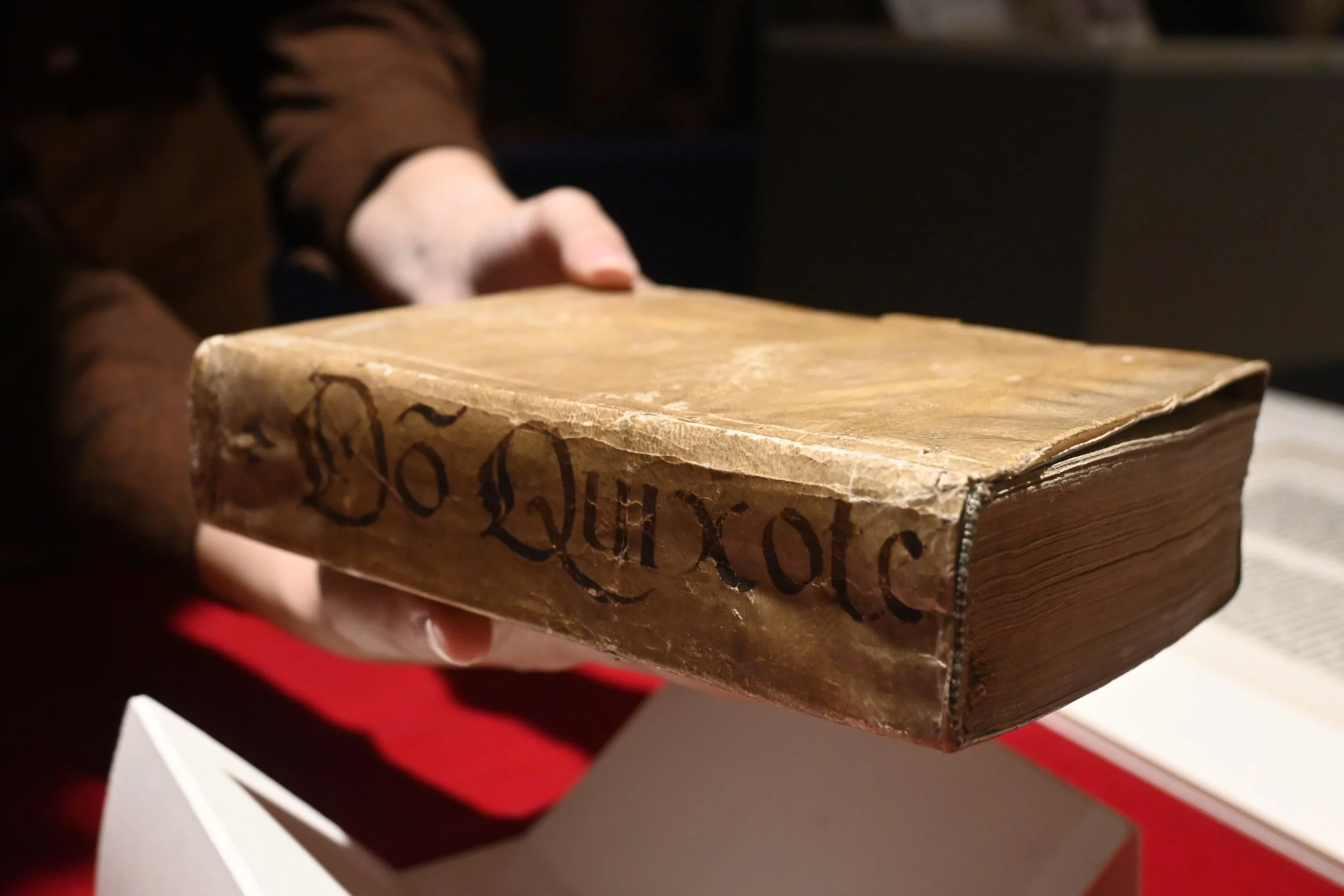
Miguel de Cervantes Saavedra (1547–1616), [Don Quixote. Part 1]. El ingenioso hidalgo don Qvixote de la Mancha ... Madrid: Por Iuan de la Cuesta, vendese en casa de Francisco de Robles, librero, 1605. Rosenbach Museum & Library, C2 .C419d 605
Dr. A. S. W. Rosenbach valued books as objects, and literature as art.
No other novel seems to embody this intersection of literary greatness and bibliographic desirability as clearly as Don Quixote. Miguel de Cervantes’s masterpiece is often considered the first modern novel, with its pioneering blend of social realism, satire, and broader cultural critique. At the same time, the book is a cornerstone of European printing history, and its earliest editions are wildly collectable. In fact, in his lifetime, Dr. Rosenbach would pursue Don Quixote with obsessive zeal. He stretched budgets and outbid competitors, all to collect early and significant editions, as well as rare manuscripts in the hand of Cervantes (Rosenbach 28).
The Rosenbach Museum & Library holds Dr. Rosenbach’s prized first edition of the first part of Don Quixote, published in Madrid in 1605 [C2 .C419d 605], and one of only 22 copies known to survive. The first part ends with Cervantes's promise of a sequel, eventually published in 1615 [C2 .C419d 608 item 2]. In the interim, however, readers’ impatience was answered by a spurious second part, issued by Alonso Fernández de Avellaneda in 1614 [C2 .F363s].
Our collections include copies of all three works in first edition, as well as several important translations, including the first editions of the first three English translations [C2 .C419d.En], the first edition of the first Italian translation [C2 .C419d.It 622], and several 18th-century French illustrated editions [C2 .C419d.Fr]. We also hold three documents in Cervantes’s own hand, all relating to his appointment as royal commissioner of supplies for the Spanish fleet [C2 .C419 MS]. These are thought to be the only Cervantes manuscripts presently located in the Western Hemisphere.
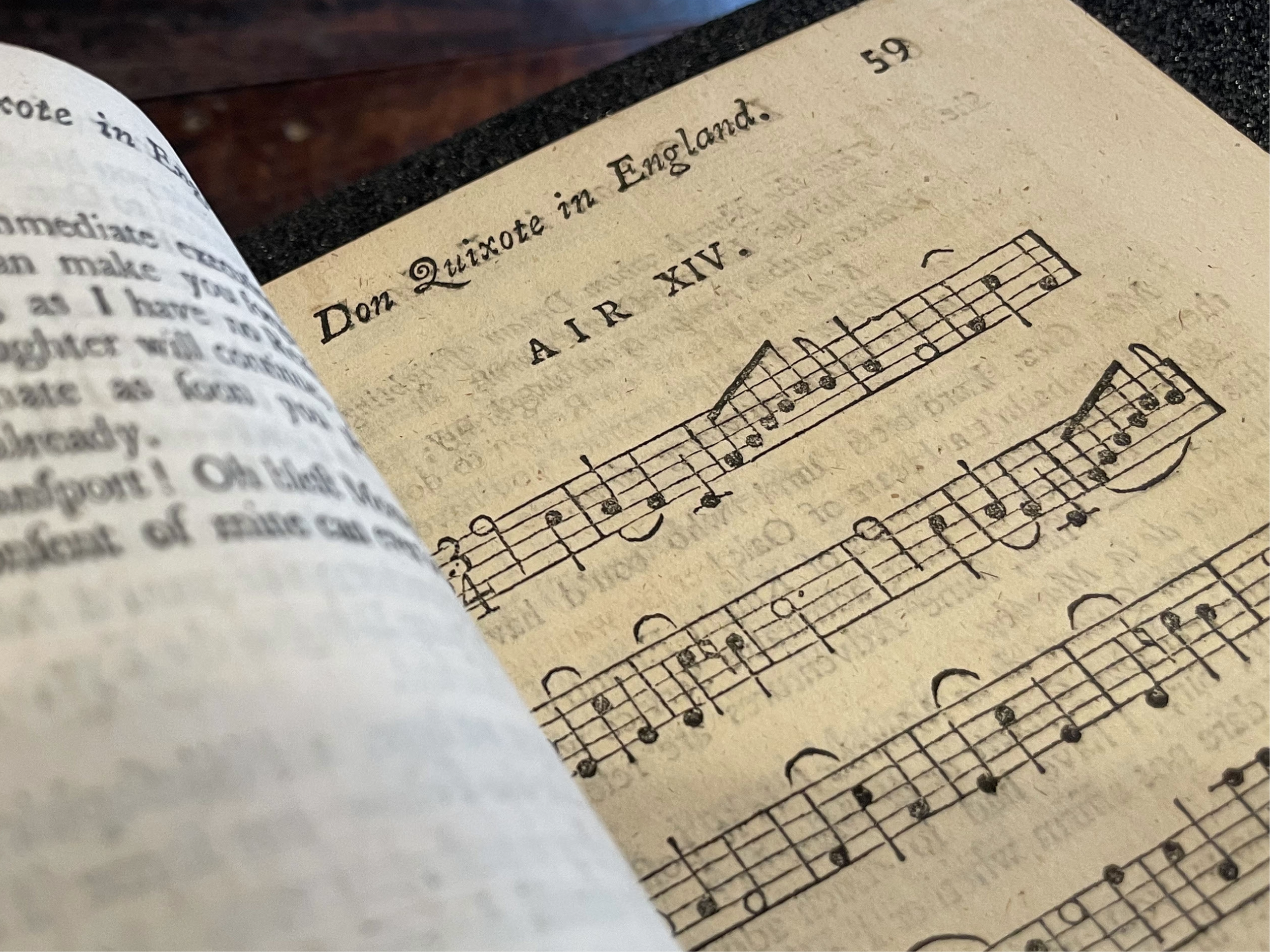
Henry Fielding (1707-1754). Don Quixote in England. A comedy. As it is acted at the New Theatre in the Hay-Market. London, J. Watts, 1754. Rosenbach Museum & Library, EL2 .F459.0d v.3 item 2
The Rosenbach is currently updating and expanding our online library catalog, Rosy, to include records for these holdings and to increase access to information about our collections. In the process, staff and researchers have made a few unexpected discoveries, including an edition of the dramatic adaptation, Don Quixote in England, by the novelist and playwright Henry Fielding [EL2 .F459.0d v.3 item 2].
Fielding’s adaptation belongs to the broader eighteenth-century afterlife of Don Quixote, in which Miguel de Cervantes’s narrative was reimagined for new literary and theatrical contexts. During this period, the figure of Don Quixote became a flexible vehicle for satire and social observation, adapted to address contemporary concerns. This trend intersected with the Licensing Act of 1737, which imposed strict censorship on London stages and banned unlicensed or smaller venues where political satire often circulated (Hume 1985). Like many of his contemporaries, Fielding turned away from the theater in response and instead channeled the “manner of Cervantes” into his prose fiction, most notably in The history of the adventures of Joseph Andrews [EL2 .F459j 742] and The History of Tom Jones, a Foundling [EL2 .F459t 749].
Included in a multi-volume 1754 edition of Fielding’s dramatic works, Don Quixote in England is now discoverable via the Rosenbach’s online catalog and available for programs, exhibitions, and research, further improving access to our significant Cervantes-related holdings. These holdings also include more than 250 paintings, prints, and drawings in our fine and decorative arts collection, accessible through our object database, Phil. Of particular interest is a 17th-century miniature attributed to Joos van Craesbeeck [1954.0630.115], which depicts a masquerade ball with figures evocative of Don Quixote and Sancho Panza amongst the costumed participants (Brown). The Rosenbach also holds several 20th-century responses to Don Quixote, including a bound volume of ink and watercolor illustrations by the Belgian artist Jean de Bosschère [2005.0210], and a stunning suite of lithographs by the surrealist painter and printmaker, Salvador Dalí [C2 .C419d.FR 957], the latter acquired in 2014.
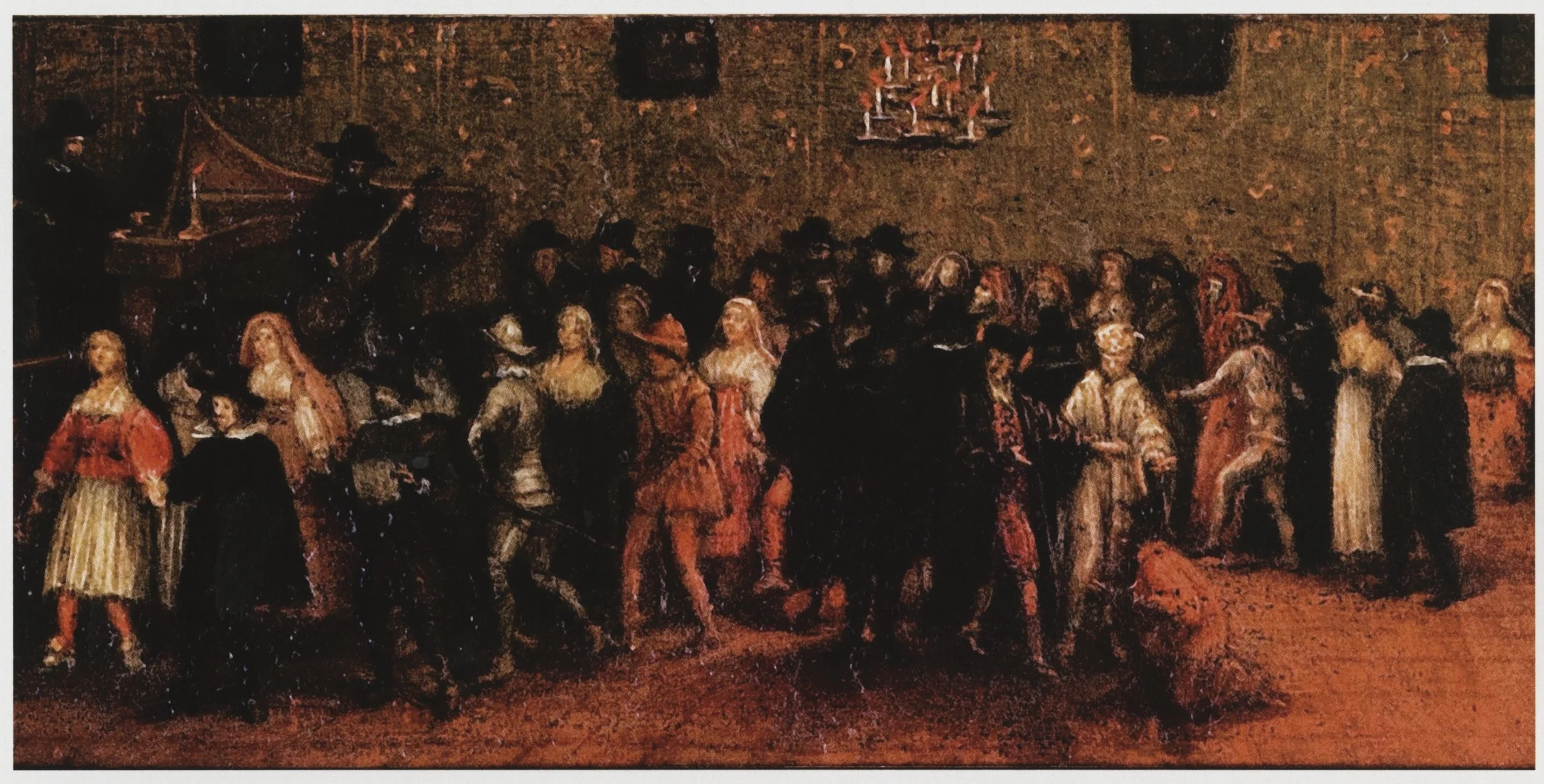
Attributed to Joos van Craesbeeck (approximately 1605-approximately 1661), [Dancing scene]. Oil paint on copper. Netherlands, between 1640 and 1650. Rosenbach Museum & Library, 1954.0630.115. Image courtesy of Douglas A. Lockard.
Building upon the interests of our founders, the Rosenbach Museum & Library's holdings trace the evolution of Don Quixote across text, performance, and image, from the novel’s 17th-century origins to its Art Nouveau and Surrealist re-imaginings in the mid-20th. These rare editions, manuscripts, paintings, prints, and drawings speak to the enduring appeal and adaptability of Miguel de Cervantes’s work and reveal how Don Quixote has been reimagined across centuries, cultures, and artistic forms. Taken together, they embody the core principle that guided Dr. A. S. W. Rosenbach: that great literature should not only be read but also experienced through the book as a physical object and work of art. Search Rosy and Phil to make your own discoveries and then book a research appointment to enjoy a personalized experience with objects from the Rosenbach’s collections.
References
Brown, K. “Dos «nuevos» cuadros artísticos en colecciones estadounidenses inspirados en el Quijote...” Anales Cervantinos, no. 41, 2009, pp. 83–104.
Hume, Robert D. “Henry Fielding and Politics at the Little Haymarket, 1728–1737.” The Golden and the Brazen World: Papers in Literature and History, 1650–1800, edited by John M. Wallace. University of California Press, 1985, pp. 79–124.
Rosenbach, A. S. W. Books and Bidders: The Adventures of a Bibliophile. Little, Brown & Co., 1927.
Notes from the Reading Room is a monthly segment on the Rosenblog. Learn about our efforts to manage and care for some of the best-known literary and historical objects in the world, and to make our collections available to researchers and other audiences around the globe.