
Ann Yearsley: the Poetical Milkwoman of Bristol
by Emilie Parker, Hirsig Director of Education and Community Engagement

Hannah More (1745-1833), “A prefatory letter to Mrs. Montagu” in Ann Yearsley (1753-1806), Poems, on several occasions. London: Printed for T. Cadell, in the Strand, [1785]. EL2 .Y39p 785 item 1. Image credit: David Rhys Owen.
The Rosenbach has recently expanded its poetry collection by acquiring the groundbreaking first British editions of Ann Yearsley’s poetry collections: Poems on Several Occasions (1785) [EL2 .Y39p item 1] and Poems on Various Subjects (1787) [EL2 .Y39p item 2].
In the late 18th century, Yearsley emerged as a powerful voice among working-class writers while leading a life as a milkwoman, just like her mother before her. Although she didn’t have a formal education, her brother taught her to write, which allowed her to discover her passion for poetry and catch the eye of playwright and philanthropist Hannah More. After facing a decade of struggles, Yearsley, her husband, and their young family received vital financial support from More, marking a turning point in her life and helping her gain recognition as "the poetic milkwoman of Bristol."
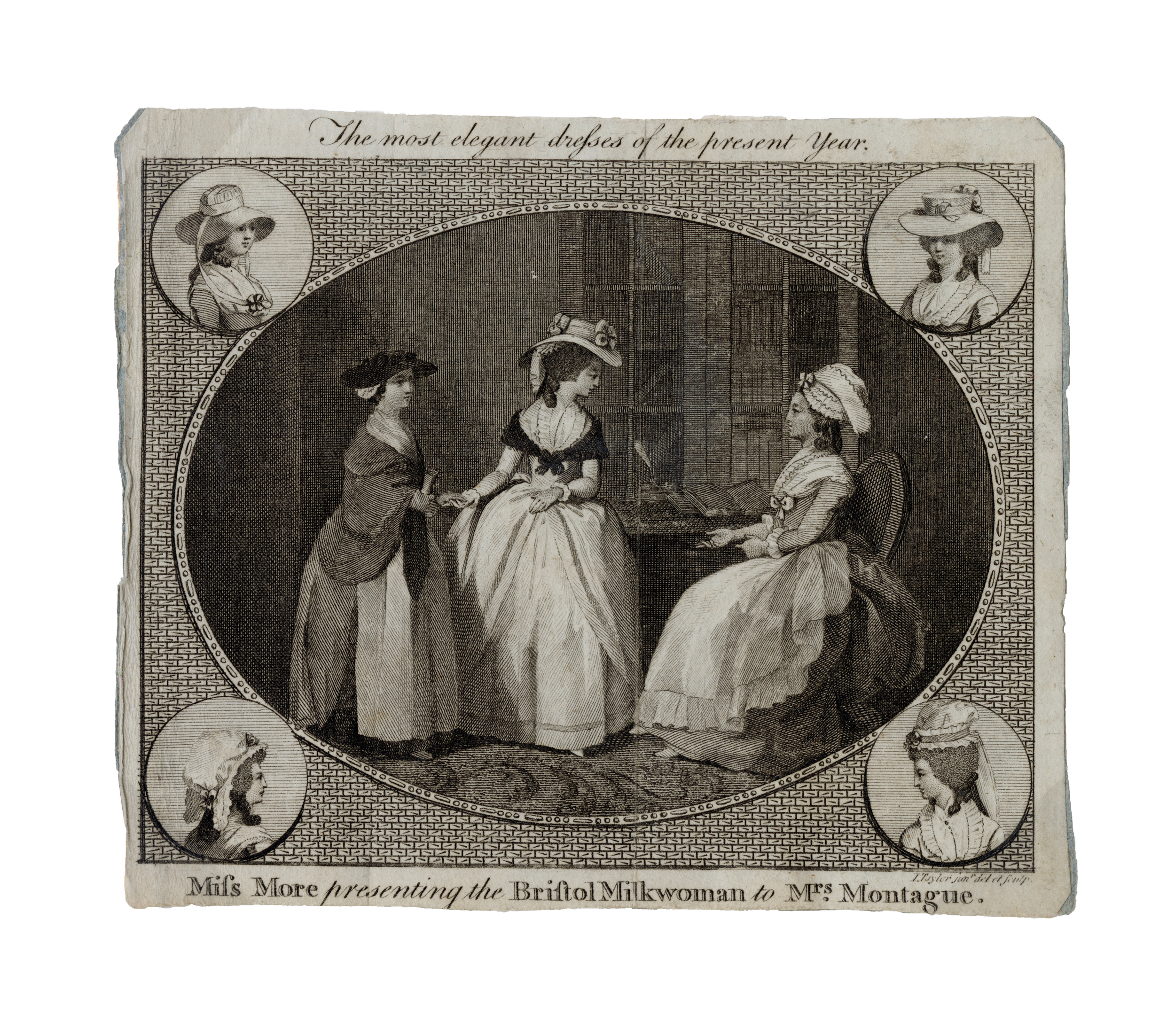
Isaac Taylor, Jr. (1759-1829), artist and engraver, Miss More presenting the Bristol Milkwoman to Mrs. Montague. Engraving. London, circa 1785. 2005.0004.
Yearsley’s poetry, influenced by Milton’s Paradise Lost, one of her favorites from her neighborhood library, often explored religious and domestic themes while also speaking out against the slave trade. Yearsley and More shared a commitment to abolitionism, which brought her closer to her patron, as both women felt a strong moral duty to fight against slavery. The abolitionist movement allowed women like Yearsley and More to engage politically, stepping out of their traditional roles and into the public sphere, even if it went against the societal norms of the time. Although men frequently garnered greater public recognition, women played a significant role in the abolitionist movement, greatly surpassing men in endeavors such as advocating for petitions and establishing anti-slavery organizations.
Yearsley’s literary journey began with her first collection, Poems on Several Occasions, which was funded by subscribers organized by More and published in 1785. “Clifton Hill,” thought to be the last poem she wrote before the publication of the collection, shows us the natural world through the milkmaid Lactilla’s eyes as she tends to her cow in the bitter cold, out of necessity rather than leisure, as demonstrated in this stanza:
She asks no warmth — but from the kitchen fire;
Love seeks a milder zone; half sunk in snow,
Lactilla, shivering, tends her fav'rite cow;
The bleating flocks now ask the bounteous hand.
And chrystal streams in frozen fetters stand.
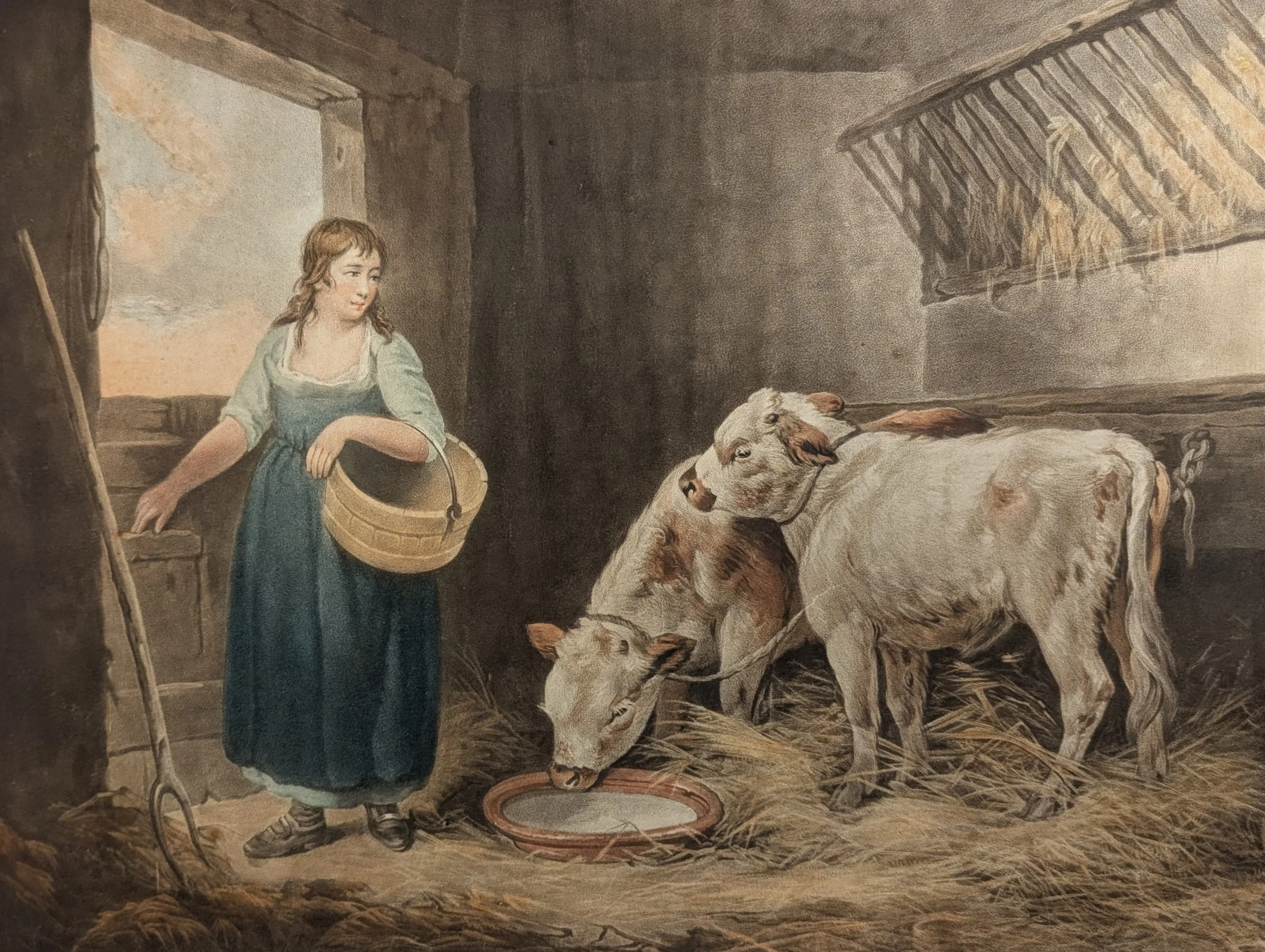
George Morland (1763-1804), painter, William Ward (1766-1826), engraver, Girl and Calves. Mezzotint. London, 1797. 1954.0958.
Poems on Several Occasions quickly brought Yearsley success but also led to tensions over money with her patron. What began as a supportive relationship turned into a public dispute over funds, artistic control, and reputation. Eventually, the socially active Earl of Bristol, who also served as a bishop, stepped in to support the production of Yearsley’s next collection, Poems on Various Subjects, in 1787.
At the Rosenbach, Yearsley will keep company with one of her favorite works: Milton’s Paradise Lost. Her work will also share space with two writers with whom she was not acquainted. In this new acquisition, her collections of poetry are bound with two shorter texts: "The Graces: A Poetical Epistle from a Gentleman to his Son" by William Woty (1774) [EL2 .Y39p item 3] and "A Letter to Her Grace the Duchess of Devonshire" by William Combe (1777) [EL2 .Y39p item 4]. In the 18th century, it was common to combine several books within one binding. By putting these smaller pamphlets alongside Yearsley’s poetry in a single volume, a former owner ensured that the additional works wouldn’t easily get lost among the many titles in a large library.
So, let’s invite the Poetical Milkwoman of Bristol to set aside her winter farm duties for a moment, allowing us to extend a warm welcome to her! And if you are yearning to bestow an even more radiant welcome upon Ann Yearsley, we invite you to join us for the enchanting "Yours Forever” Behind the Bookcase tour on Thursday, February 12, 2026, at 6:00 p.m. ET, where we will attempt to determine, as Yearsley proposed, whether “friendship alone” is truly the “design in this officious Valentine.”
To a FRIEND;
ON VALENTINE's DAY.Ann Yearsley
Tho' blooming shepherds hail this day
With love, the subject of each lay,
Yet friendship tunes my artless song,
To thee the grateful themes belong.
Strephon, I never will repine,
Tho' destin'd not thy Valentine;
O'er friendship's nobler heights we'll rove,
Nor heed the soft'ning voice of love.
Strangers to Passion's tyrant reign,
Careless, we'll range the happier plain
Where all those calmer joys we'll prove,
Which wait sublime platonic love.
Yet I'll allow a future day,
When friendship must at last give way;
When thou, forgetful, shalt resign
The maid who wrote this Valentine.
Think not, my friend, I dream of love,
That with some happier maid thou'lt prove;
Friendship alone is my design
In this officious Valentine.
Yet, when that victor God shall reign,
And conquer'd Friendship quits the plain,
This gentle whisperer captive take,
'T will all thy former kindness wake.
But if its pleadings you deny,
And fain wou'd have remembrance die,
Then to devouring flames consign
My too ill-fated Valentine.