
New Acquisition: Les VI Poèmes des Fleurs du Mal Condamnées en 1857 / Pointes sèches en couleur de Dominique Jouvet-Magron
by Bryn Michelson-Ziegler, Associate Curator & Manager of Public Programs
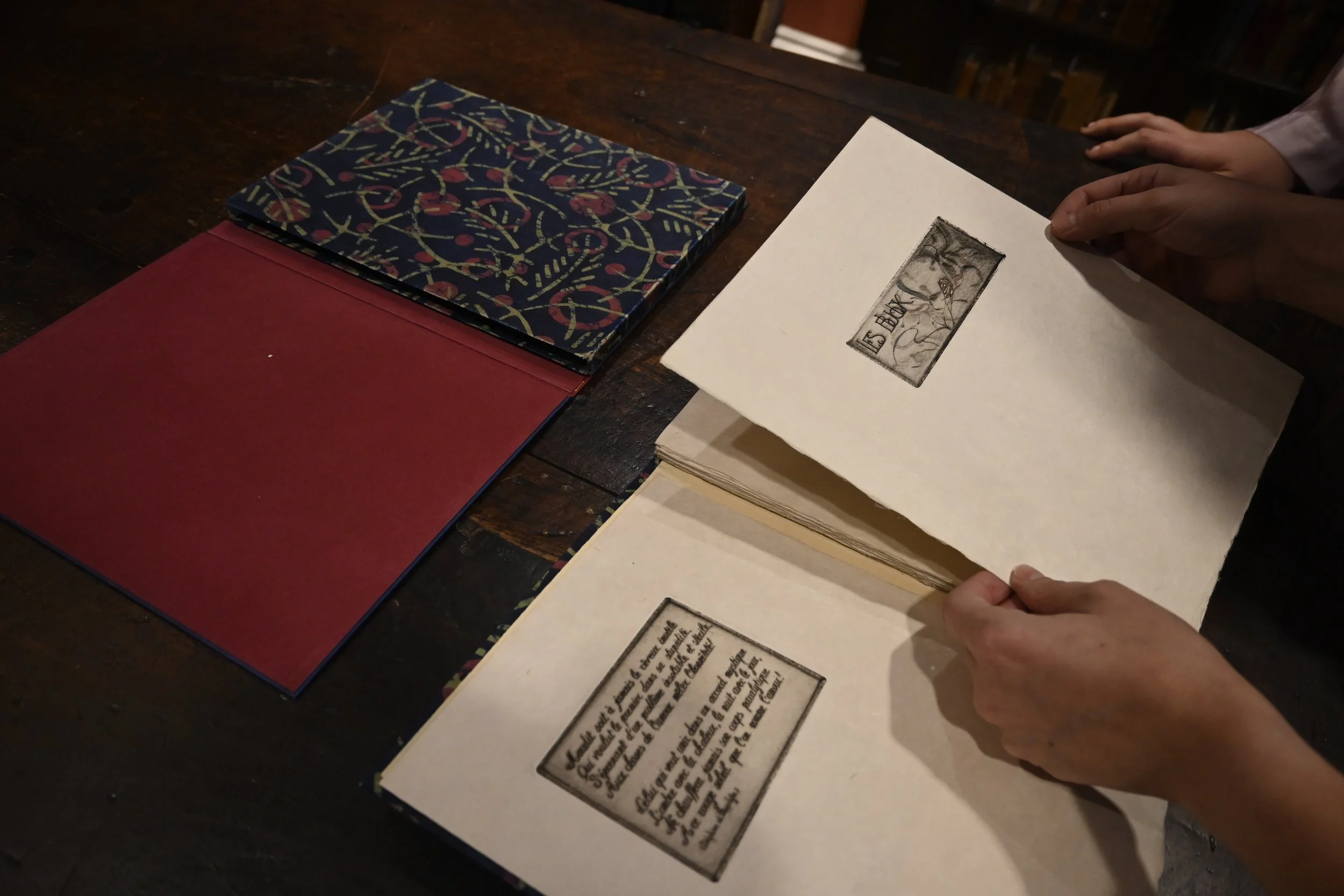
Associate Curator Bryn Michelson-Ziegler and Visitor Experience Coordinator Shoshana Bockol look at new Rosenbach acquisition. Image credit David Rhys Owen.
On May 11, 1949, a 92-year-old court case was overturned, and Charles Baudelaire’s Les Fleurs du Mal could once again be whole.
Shortly after Baudelaire first published his influential work of lyric poetry in 1857, he, his publisher, and the printer who produced the volume were criminally prosecuted for “outrage à la morale publique” (outrage against public morals). The trial focused on the lesbian and sado-masochistic erotic content of six poems in the collection: “Les Bijoux,” “Le Léthé,” “A Celle qui Est Trop Gaie,” "Lesbos,” “Femmes Damnées,” “Delphine et Hippolyte,” and “Les Métamorphoses du Vampire.” These poems were banned from legal publication in France for nearly a century.
But while these six poems were excised from future editions of Les Fleurs du Mal, censorship could not stop their covert circulation or prevent artists from finding inspiration in les pièces condamnées (the banned poems). Belgian artist Félicien Rops created a frontispiece for Les Épaves (The Scraps), an edition of 23 Baudelaire poems published in Brussels in 1866, including the denounced works. In 1917, printmaker Jean Gabriel Daragnès carved woodcut images for a fine press edition of the six suppressed poems. And in 1931, an enigmatic Parisian printmaker named Dominique Jouvet-Magron produced a new kind of illustrated interpretation of les pièces condamnées.
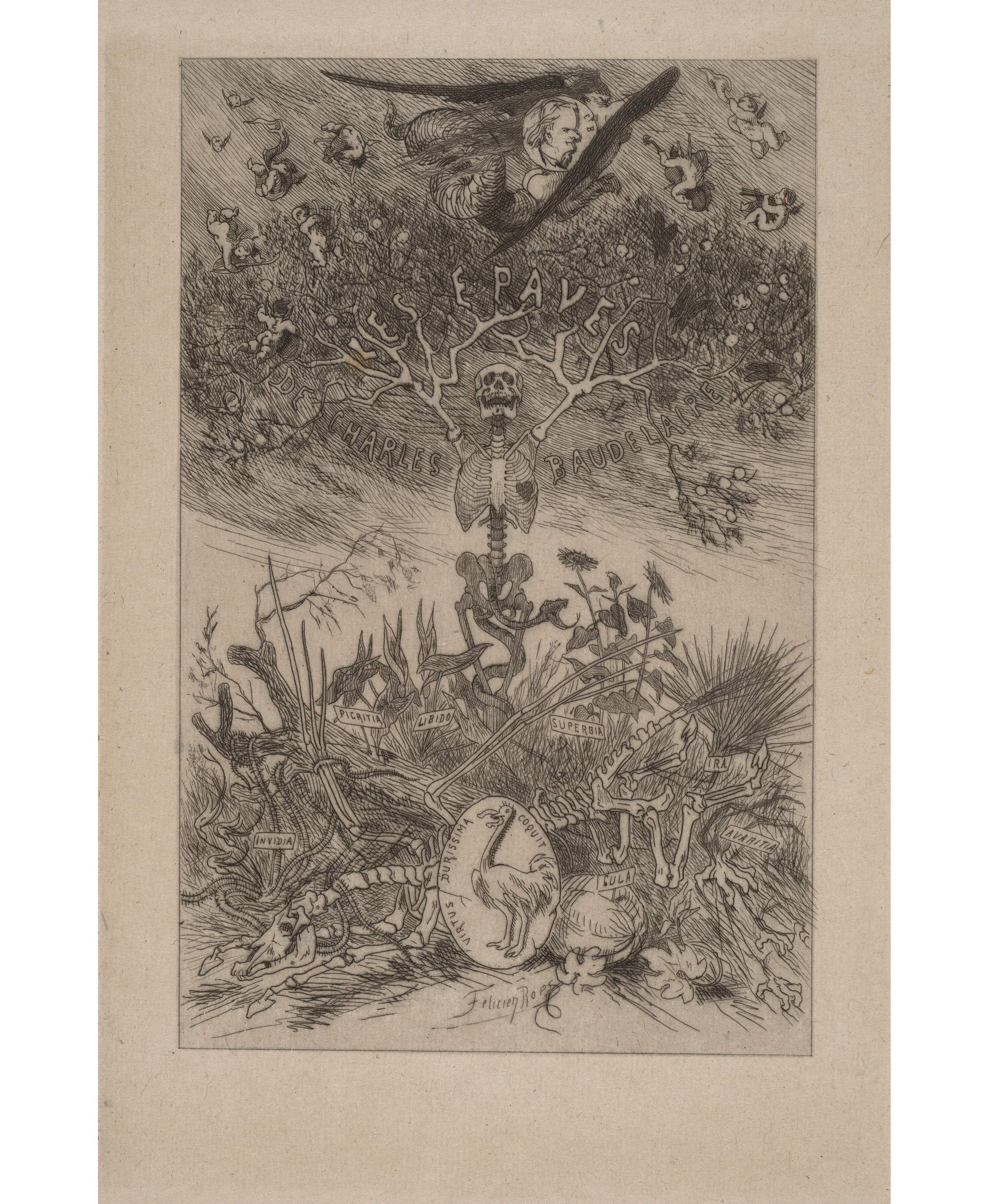
Félicien Rops (1833-1898), Frontispiece: The Waifs (Les Epaves). Drypoint Intaglio. 1868. Courtesy of National Gallery of Art, Washington
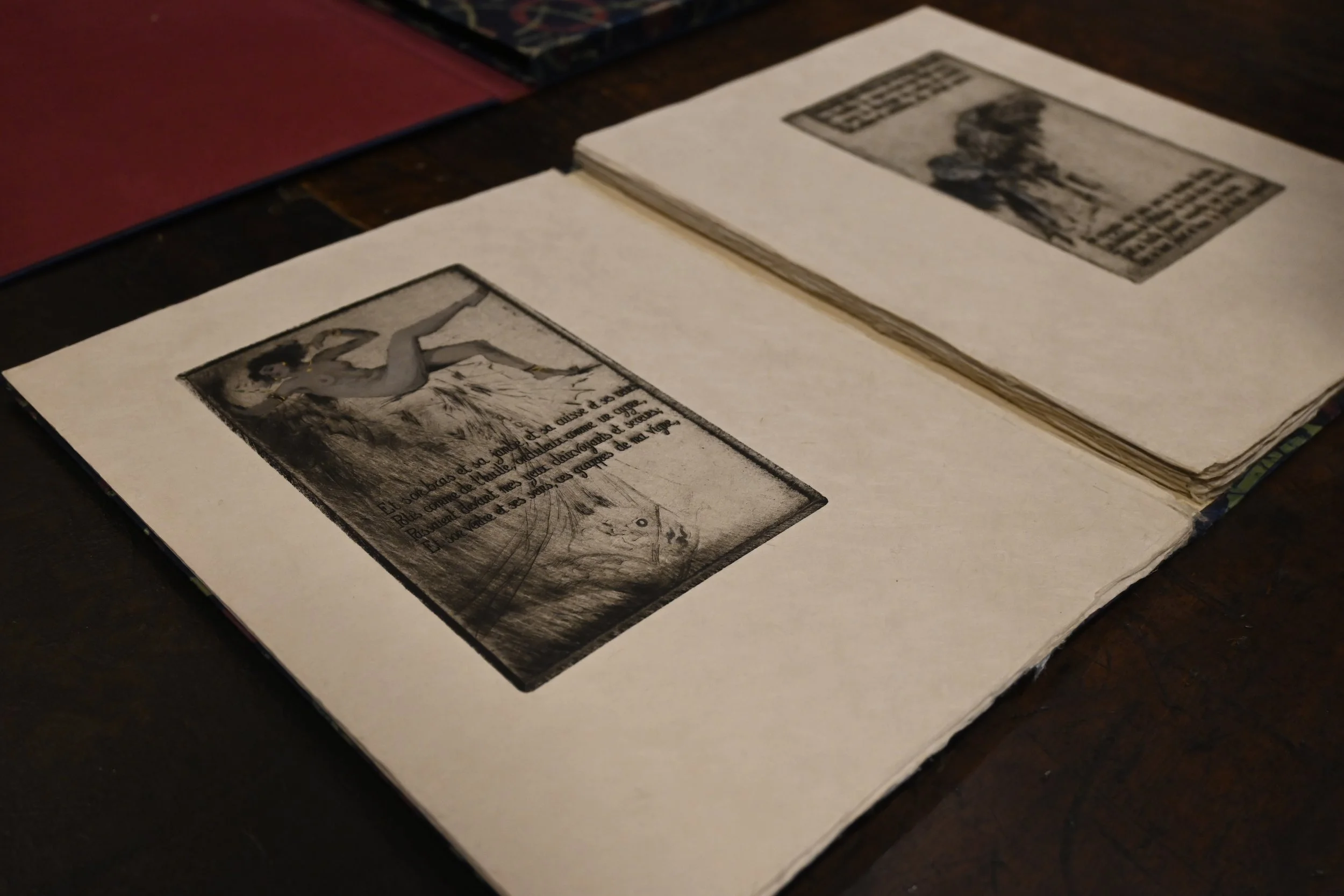
Charles Baudelaire (1821-1867) [author], Dominique Jouvet-Magron [illustrator], Les VI Poèmes des Fleurs du Mal Condamnées en 1857. Les Bijoux. Le Léthé. A Celle qui Est Trop Gaie. Lesbos. Femmes Damnées. Delphine et Hippolyte. Les Métamorphoses du Vampire. / Pointes sèches en couleur de Dominique Jouvet-Magron. Paris: 1931. Rosenbach Museum & Library, C4 .B338fl 931. Image credit David Rhys Owen
Who is Dominique Jouvet-Magron? She’s a challenging figure to track down. Her name surfaces in La Revue de l'Art Ancien et Moderne in 1911, and again in The Print Connoisseur: A Quarterly Magazine for the Print Collector, a periodical published by Winfred Porter Truesdell throughout the 1920s and early 1930s. Each Print Connoisseur was issued with one original artist’s print. In April 1923, that print was by Jouvet-Magron, and the accompanying edition includes several reproductions of her artwork and two short reviews, both of which praise her skill effusively but mistakenly refer to her as a man.
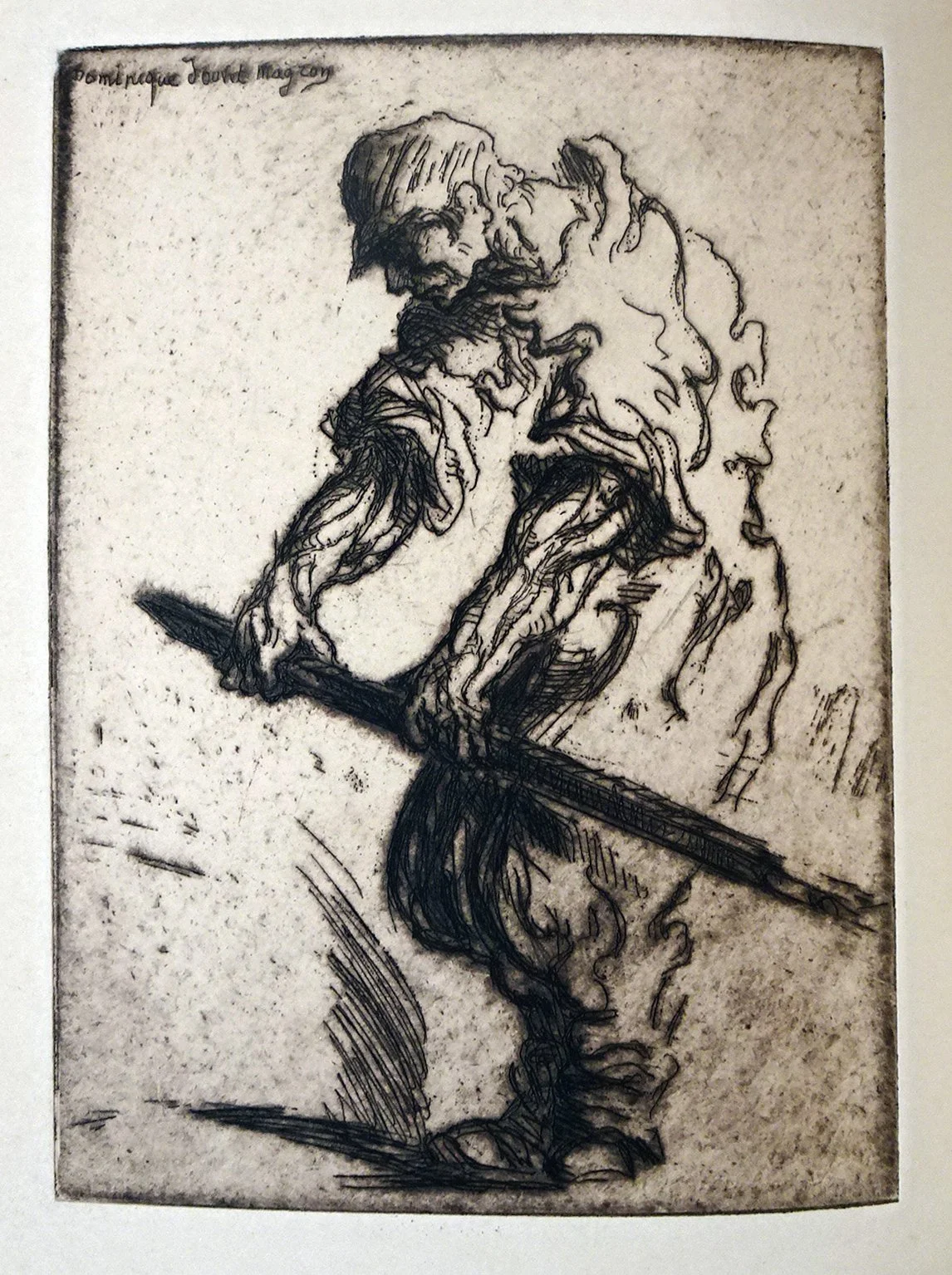
Dominique Jouvet-Magron, Le Manoeuvre au Levier. Original copperplate etching. The Print Connoisseur: April 1923. Image courtesy of Princeton Graphic Arts collection. Check out their blog!
Print Connoisseur also tells us that, prior to the emergence of her ambitious Baudelaire illustrations, Dominique Jouvet-Magron was particularly known for depictions of a rapidly industrializing Paris. Reviewer Clement-Janin writes:
“The already considerable work of Dominique Jouvet-Magron reveals an exceptionally modern temperament which has found the secret of discovering in those temples of labor–the factories–the elements of picturesqueness contained in them.”
Reviewer G. Desdevises du Dezert writes: “To escape from the cathedrals where once one has taken delight in their shadows, to steal away from the almost fatal charm of the vaulting ... to go back to the factory and to find in the dynamos the same picturesqueness as in the ogive, is a feat for whose execution one certainly needs a mind of a very special suppleness.”
The tiny reproductions of Jouvet-Magron’s prints scattered throughout Print Connoisseur indeed depict, in the same soft-edged, graphic style, a massive kiln emanating harsh light and belching smoke, enormous equipment that throws its human operators into indistinct gray shadow, and the haunting beauty of an ancient crypt below an abbey.
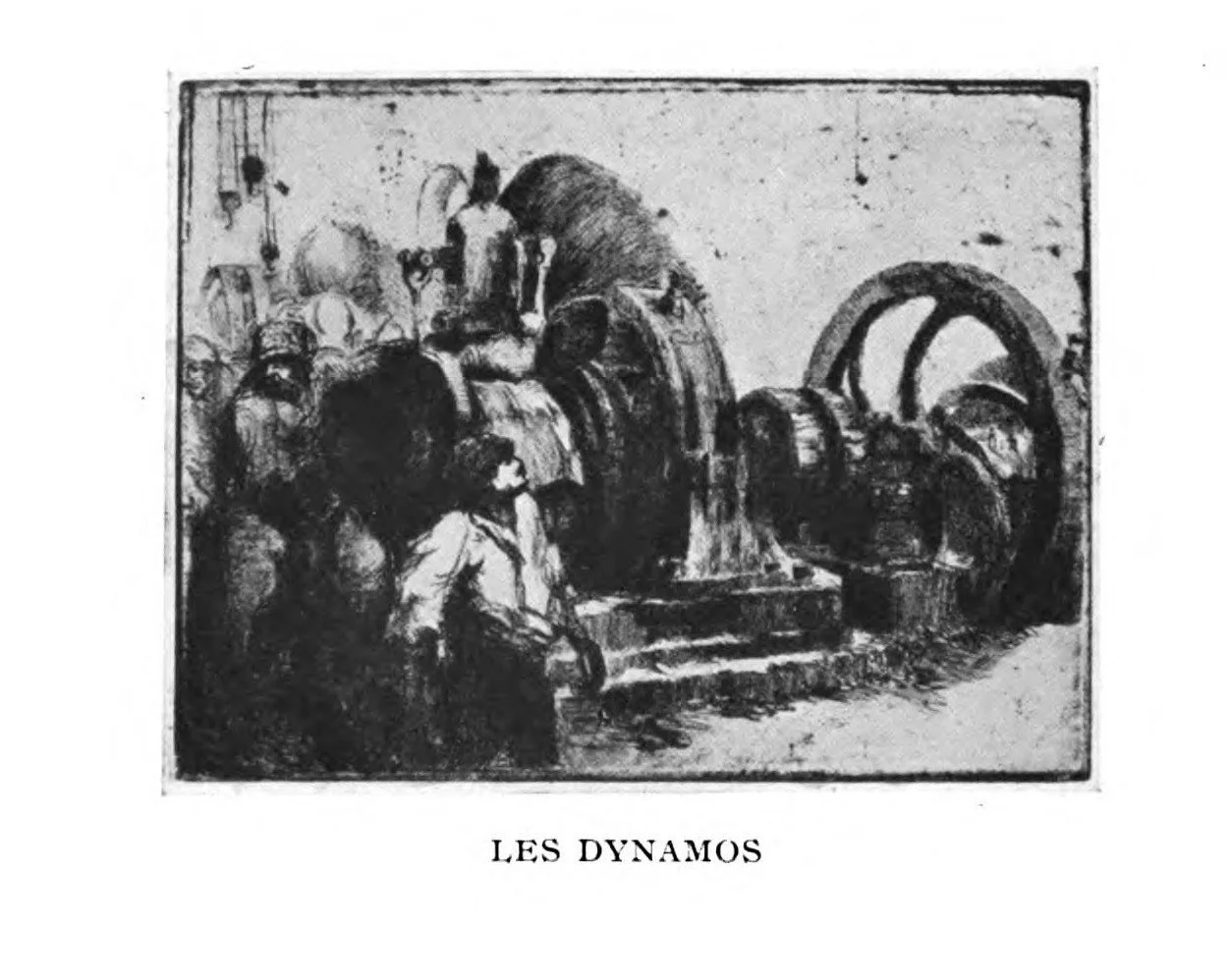
Dominique Jouvet-Magron, Les Dynamos. Reproduction of copperplate intaglio. The Print Connoisseur: April 1923.
This body of Jouvet-Magron's work reminds me strongly of Baudelaire’s Tableaux Parisiens, and particularly Le Cygne (The Swan), a poem that first appeared in the 1861 second edition of Les Fleurs du Mal.
Paris changes! but naught in my melancholy
Has stirred! New palaces, scaffolding, blocks of stone,
Old quarters, all become for me an allegory,
And my dear memories are heavier than rocks.
I wonder if this convergence is what first drew Jouvet-Magron to the poetry of Baudelaire. Whatever her reason, in May of 1931, the Salon International du Livre d'Art (International Art Book Fair) catalog includes two listings for “pointés-sèches en couleurs” (color drypoints) by “JOUVET Magron (Mme), avenue Le Corbeiller, Meudon.” Both are illustrations of Baudelaire’s Les Fleurs du Mal. The second, Pièces Condamnées en 1857, is the book acquired by the Rosenbach last November. In a mirror of the first edition of Les Fleurs du Mal, Jouvet-Magron's provocative artwork, which depicts a cast of racially diverse characters, lesbian sexual acts, and gender-queer presentation, was removed from the exhibition after public outcry. Jouvet-Magron also reproduced the text of the six suppressed poems in their entirety, despite the ban, raising interesting questions about the line between a piece of visual art and a literary publication.
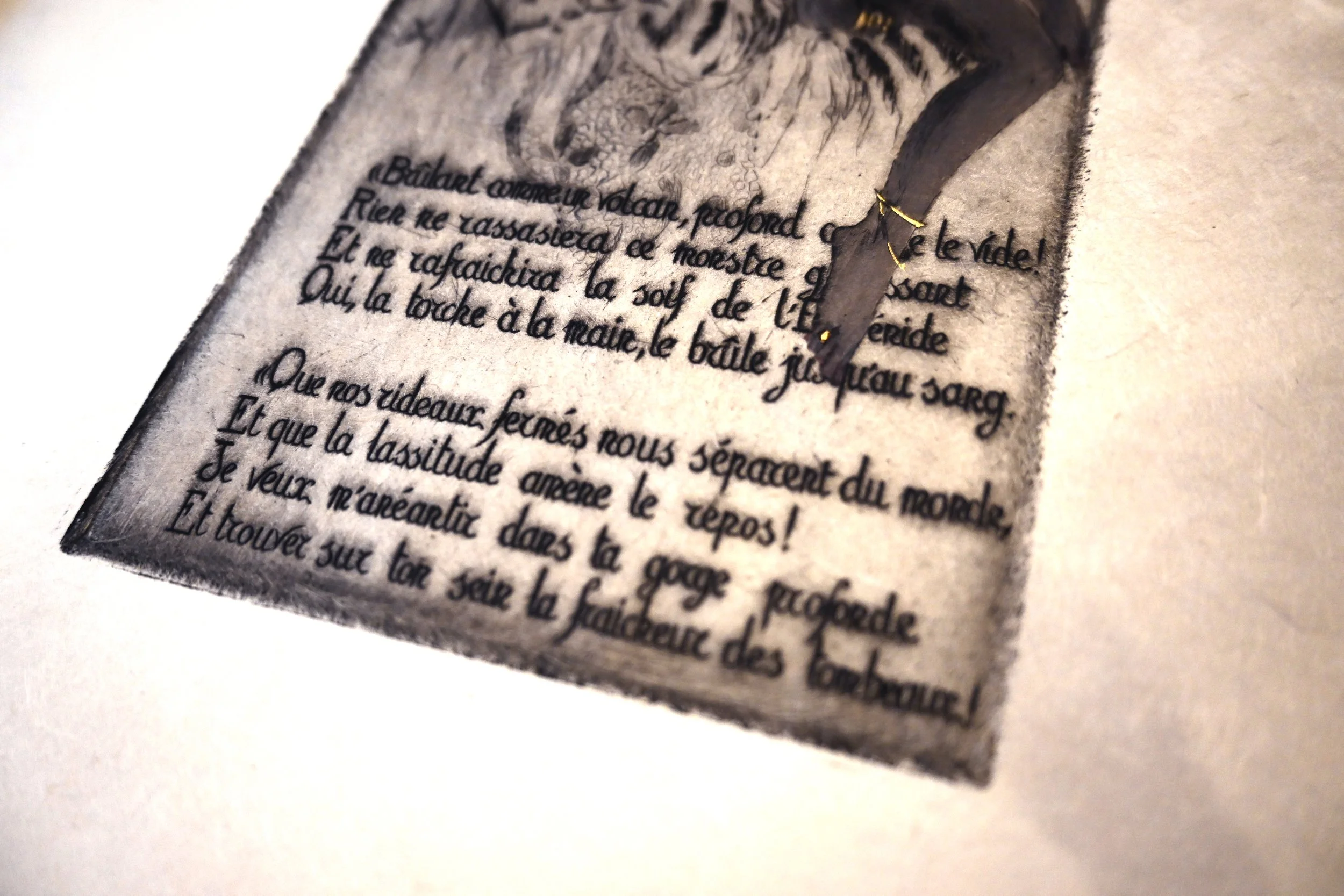
Charles Baudelaire (1821-1867) [author], Dominique Jouvet-Magron [illustrator], Les VI Poèmes des Fleurs du Mal Condamnées en 1857. / Pointes sèches en couleur de Dominique Jouvet-Magron. Paris: 1931. Rosenbach Museum & Library, C4 .B338fl 931. Image credit Bryn Michelson-Ziegler
The definition of “book” is fluid and often debated. Though unbound, this print portfolio, which first appeared in a book-themed exhibition and is composed of elegantly folded leaves of soft paper that mimic the pages of a codex, fits the bill for me. The 30 full-size prints are wonderful to behold. Jouvet-Magron transcribed Baudelaire’s language within, and sometimes interacting with, the illustrations. The visuals retain both the striking contrast and the subtle softness of Jouvet-Magron's earlier output, but the addition of text and sparing, hand-applied pops of color introduce a liveliness, and the sequential nature of the artwork gives the impression that each print is a small snippet of a full black-and-white film.
Drypoint is a printmaking technique that closely mimics drawing. It’s achieved by scratching directly into the surface of a polished metal plate (some printmakers today use plexiglass) using a pointed tool, then forcing ink into those indentations and running the plate, along with a sheet of dampened paper, under a high-pressure printing press roller. The lines produced by drypoint are characteristically fuzzy, similar to a charcoal drawing, and the print runs must necessarily be small: drypoint plates are not as sturdy as engraved or acid etched plates. The Rosenbach’s book is one of only 30 produced. What Jouvet-Magron has accomplished within the limitations of the medium is an incredible feat, from the dynamism of the images to the bold, consistent text (which must be painstakingly incised into the plate backwards to print right-reading).
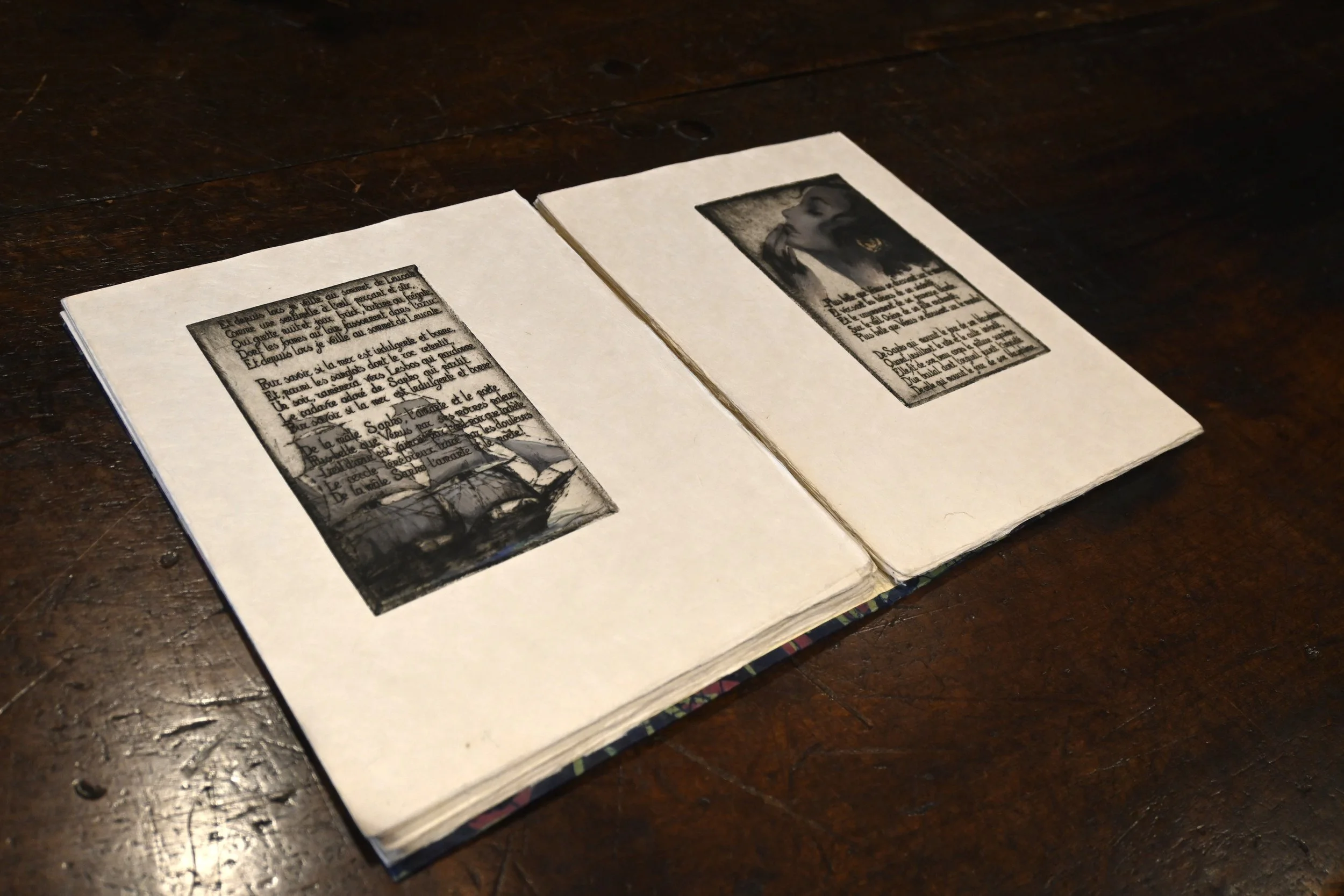
Charles Baudelaire (1821-1867) [author], Dominique Jouvet-Magron [illustrator], Les VI Poèmes des Fleurs du Mal Condamnées en 1857. / Pointes sèches en couleur de Dominique Jouvet-Magron. Paris: 1931. Rosenbach Museum & Library, C4 .B338fl 931. Image credit Bryn Michelson-Ziegler
How did this book come to be here at the Rosenbach?
Dominique Jouvet-Magron crossed our path at a perfect moment for such a dynamic visual book object to join the Rosenbach’s collection. In 2025, the Rosenbach hosted 11 hands-on book arts programs, from making book jewelry to recreating early American bookbinding. Dominique’s arrival was foreshadowed by the arrival of an antique printing press for the newly conceptualized Rosenbach Book Arts Center, where we celebrate the artistry of bookmaking and how craft intersects with and amplifies significant literary works. Just as Dominique Jouvet-Magron arguably does for les pièces condamnées.
Jouvet-Magron's Pièces Condamnées en 1857 also has strong connections to other meaningful Rosenbach objects. There are many, but I’ll detail just two. The first is a translation of Les Fleurs du Mal titled Flowers of Evil / from the French of Charles Baudelaire, by George Dillon [and] Edna St. Vincent Millay; with the original texts and with a preface by Miss Millay [C4 .B338fl.En 936]. This 1936 volume translates the 100 poems of the first edition of Fleurs du Mal, including the six suppressed poems in their original order. In her preface, poet and playwright Edna St. Vincent Millay writes: “Let a poem of Baudelaire be filled with the most rarefied and ethereal sentiments toward some woman, with the deepest and most tender sympathy for the afflicted and the poor, with the most fervent and ecstatic religious ecstasy–no, no; walk all around it carefully! Prod it with a stick at arm’s length and be ready to jump! If you pick it up at all, pick it up by the tail.” Our copy of Flowers of Evil is notable for being previously owned by renowned writer and Queer figure of the Harlem Renaissance, Countee Cullen.
The second is the work of William Blake. In the 18th century, Blake invented a technique known as “illuminated printing” which allowed him to print both text and image from a metal plate in one pass (one of the challenges of printing illustrated books at the time was that detailed intaglio prints–etchings, engravings, and drypoints–had to be printed on a separate press from the text). Like Baudelaire and Jouvet-Magron, Blake was responding to the proliferation of mass production and the horrible labor conditions of what he called the “satanic mills.” Though Blake’s illuminated prints have a more pastel quality and were achieved through heavy acid etching as opposed to the more delicate linework of drypoint (see this video recreation for more details), the link to Jouvet-Magron's later print series is evident and exciting.

William Blake (1757-1827), Visions of the Daughters of Albion / printed by Willm. Blake, 1793. Boissia, Clairvaux, Jura, France: Trianon Press, 1959. Rosenbach Museum & Library, EL3 .B636v 793 facsim
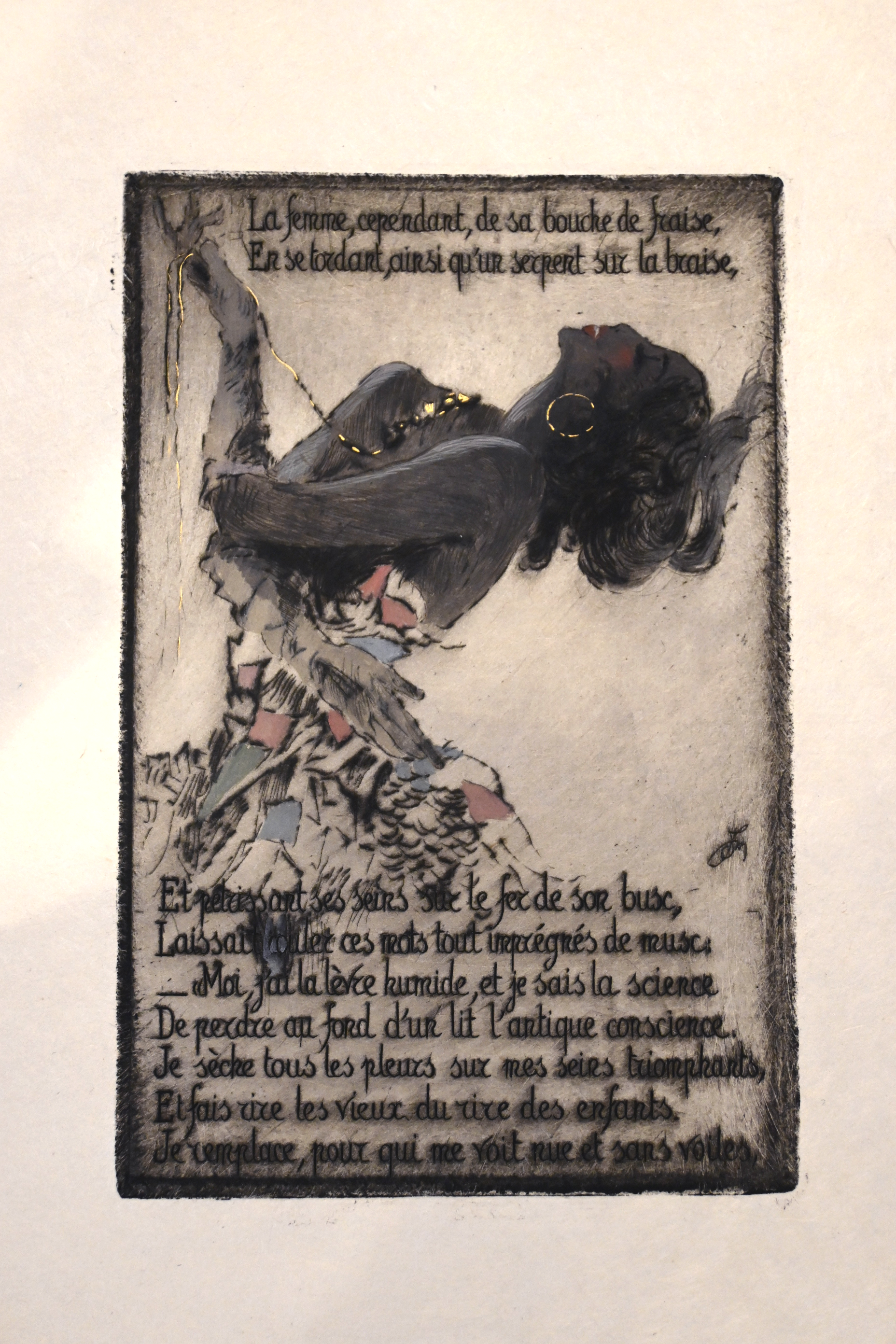
Charles Baudelaire (1821-1867) [author], Dominique Jouvet-Magron [illustrator], Les VI Poèmes des Fleurs du Mal Condamnées en 1857 / Pointes sèches en couleur de Dominique Jouvet-Magron. Paris: 1931. Rosenbach Museum & Library, C4 .B338fl 931. Image credit Bryn Michelson-Ziegler
Where can you see the prints of Dominique Jouvet-Magron at the Rosenbach? Keep an eye out for the next Behind the Bookcase tour, Rebellious Love: Exploring Queer History, Art, and Literature at the Rosenbach, or visit our exhibition, Treasures: History of the Material Text, after April 14, 2026.
References and further reading
Abbot, Helen. “Should feminists read Baudelaire?” Baudelaire Song Project, 6 September, 2018.
Baudelaire, Charles. Flowers of Evil / from the French of Charles Baudelaire, by George Dillon [and] Edna St. Vincent Millay; with the original texts and with a preface by Miss Millay. Harper & Brothers Publishers, 1936. C4 .B338fl.En 936. Rosenbach Museum & Library, Philadelphia PA.
Baudelaire, Charles [author], Dominique Jouvet-Magron [illustrator]. Les VI Poèmes des Fleurs du Mal Condamnées en 1857. Les Bijoux. Le Léthé. A Celle qui Est Trop Gaie. Lesbos. Femmes Damnées. Delphine et Hippolyte. Les Métamorphoses du Vampire. / Pointes sèches en couleur de Dominique Jouvet-Magron. Paris: 1931. C4 .B338fl 931. Rosenbach Museum & Library, Philadelphia PA.
Borsuk, Amaranth. The Book. MIT Press, 2018.
Clément-Janin, Noël. Catalogue du Salon International du Livre d’Art, 20 mai-15 août. Petit Palais des Beaux-Arts de la ville de Paris, 1931.
Comte, Jules [fondateur]. “La Vieille Dame: Eau-Forte Originale de Mme Jouvet-Magron.” La Revue de l’Art Ancien et Moderne, vol 29, 1911, pp. 124-125.
Lloyd, Rosemary, editor. The Cambridge Companion to Baudelaire. 1st edition. Cambridge University Press, 2005.
The Print Connoisseur: A Quarterly Magazine for the Print Collector. New York City: Winfred Porter Truesdell, vol.3 1923, pp. 90-98.