
“Poor Doleful Pilgrim:” David Evans and Welsh identity in Colonial America
by David Rhys Owen, Manager of Collections Stewardship & Engagement
In the summer of 1964, poet and academic Gareth Alban Davies visited the Rosenbach Museum & Library. Davies was a prominent Hispanist and no doubt felt drawn to our founder, Dr. A.S.W. Rosenbach, whose research had also focused on literature of the Spanish Golden Age. Yet, raised in the Rhonda Valley with a strong connection to Welsh culture, Davies was sure to ask then-director William H. McCarthy Jr. whether the collections included any material in his native language (Davies 1965, 74). By all accounts, McCarthy Jr. had an uncanny familiarity with the contents of the library and quickly found a volume to satisfy the request, a unique work of autobiography written by a Welsh migrant to the Americas in the 18th century. Davies would have opened the book and found the first lines written in neat manuscript: “Clywch hanes ymdaith faith drafferthus/ Hên bererin gwael galarus…” (Evans 1747-48, verse 1). Translated into English, the introduction to the poem reads: “Hear the story of the long tedious journey of a poor doleful pilgrim…”
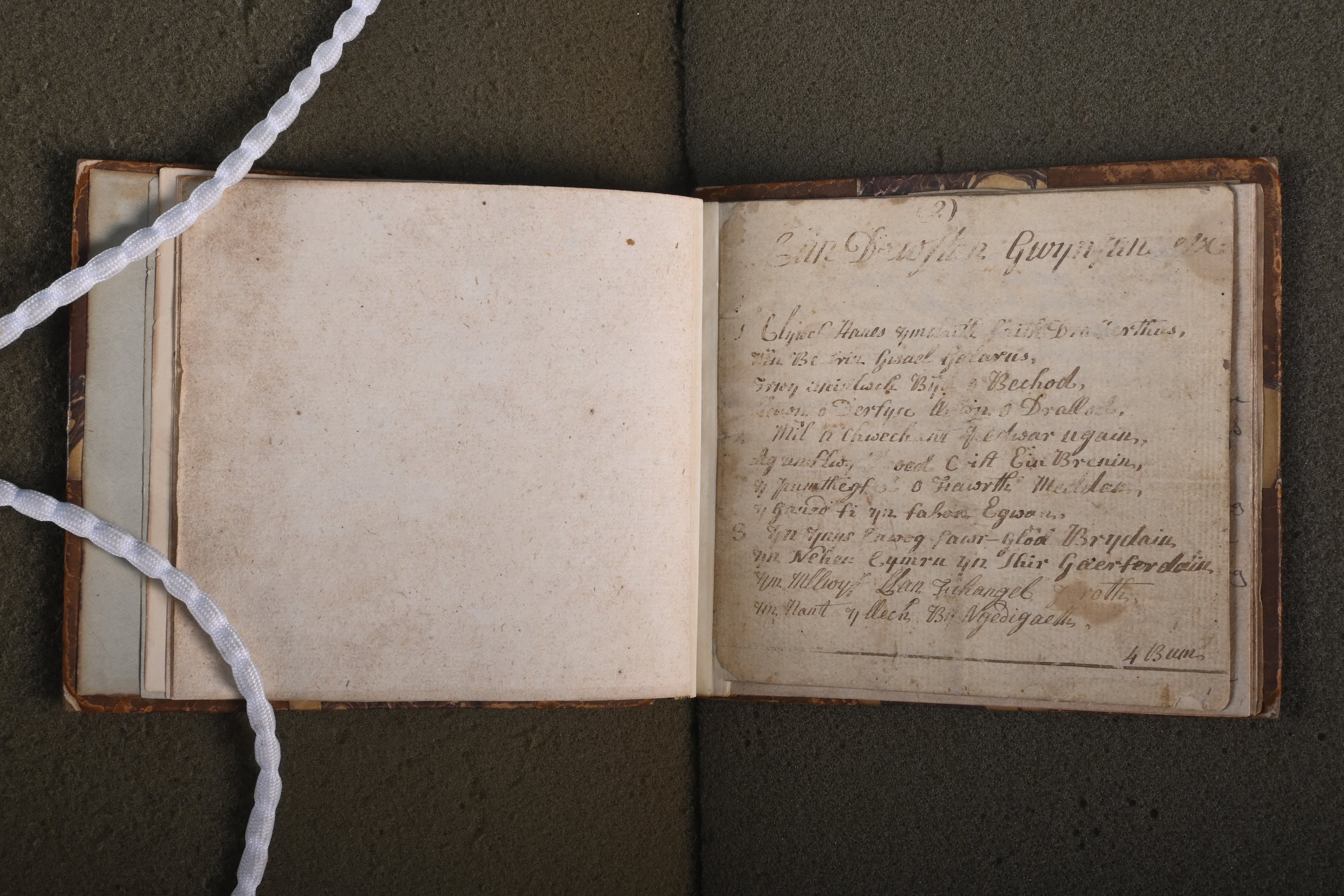
David Evans (1681-1751), Cân drwstan gwynfan [aneglur]: AMs: Pilesgrove, N.J., [1747 or 8]. Rosenbach Museum & Library, AMs 44/8
The long tedious journey…
David Evans was born in Carmarthenshire on March 15, 1681 and died in the Province of New Jersey, one of the Middle Colonies of Colonial America, in 1751. Near the end of his life Evans composed an autobiographical poem in an anachronistic Welsh [AMs 44/8] that spoke to his experiences as a European migrant and to the ethnic and religious divisions shaping the American experiment in the century before the Revolution. In the poem, Evans recalls youthful travels around southwest Wales that culminated in an apprenticeship with a weaver. While learning the craft, he was quickly distracted as an idea took hold: “After this happy sojourn, I sailed across the wide ocean... to earn money so that I could purchase plenty of books” (1747-48, verse 15).
The earliest Welsh migrants had settled in Merion, an area west of Philadelphia, almost two decades before Evans sailed for Pennsylvania in 1701. Yet, by the time Evans arrived, attempts to defend Welsh identity against Anglo-American assimilation had all but failed. William Penn did not honor the earlier promise of a “Welsh Tract,” administered by Welsh settlers in the Welsh language, and by the early-18th century the Welsh were scattered across disparate settlements. Evans arrived in Colonial America, and after four years of back-breaking work as an indentured servant, he fell into an itinerant existence in search of employment and kinship.
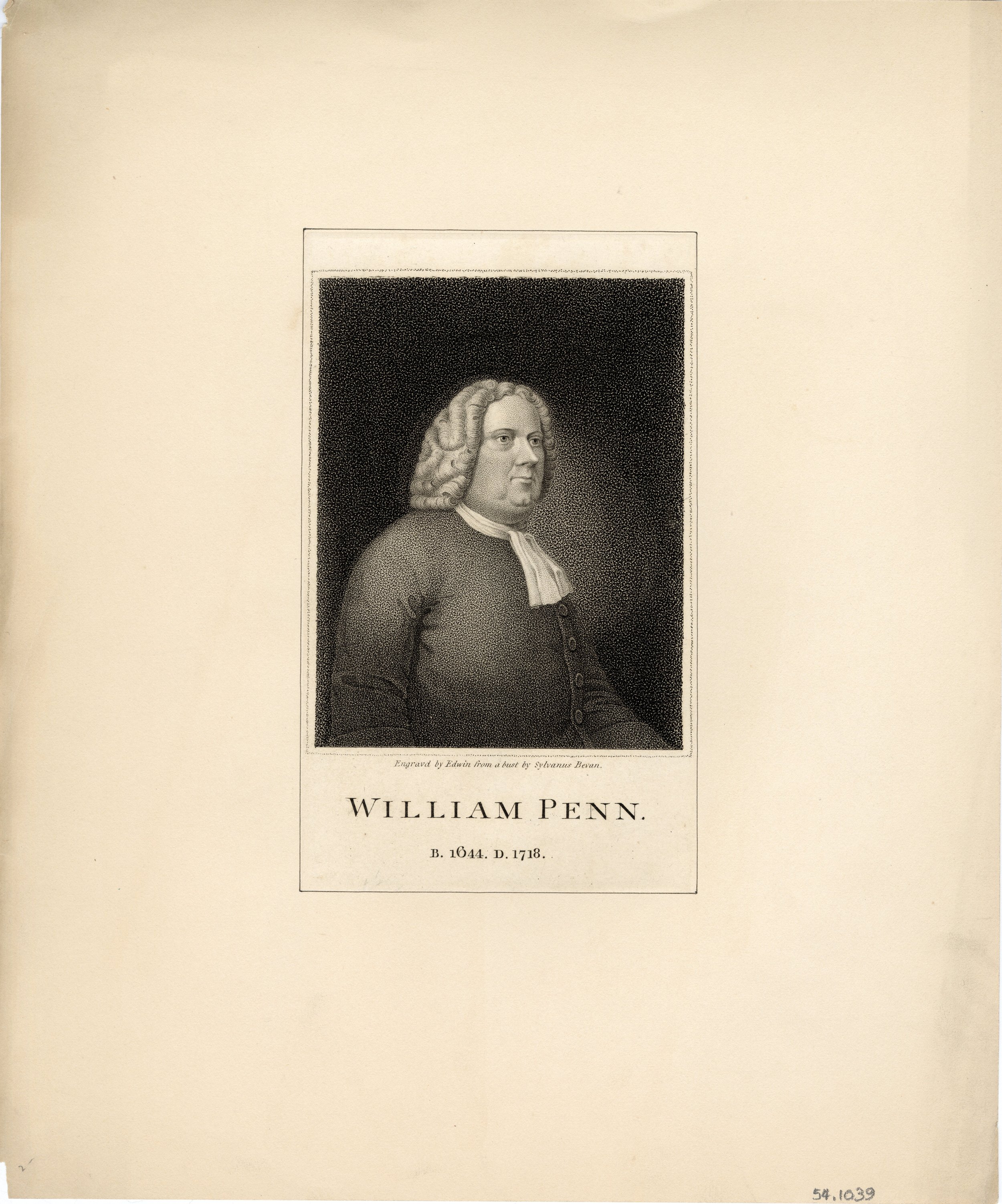
David Edwin (1776-1841), William Penn b. 1644, d. 1718 Engravd by Edwin from a bust by Sylvanus Bevan. Stipple engraving. Philadelphia, 1813. Rosenbach Museum & Library, 1954.1039
It would not be until 1707 that Evans achieved enough financial stability to dedicate time to study. He left “prosperous Philadelphia” for Tredyffrin (1747-48, verse 21), a Welsh-speaking township, where many of the colonists did not understand English and he could supplement earnings as a carpenter by leading religious services in his native language. This brought him to the attention of the administrative body of the Presbyterian church in America, who soon issued a censure: “a lay person had taken upon him publickly to teach or preach among the Welch... Evans had done very ill and acted irregularly” (Klett, ed. 1976, 9). He accepted the judgment, and the presbytery agreed to support more formalized study; in 1713 he was awarded a degree from Yale College and a year later, he was ordained as minister to a congregation at Pencader, in present-day Glasgow, Delaware.
In the decade after Evans’s ordination, American Presbyterianism experienced internal divisions related to its organizational structure but also to more fundamental expressions of belief within the Reformed Protestant tradition. To guarantee more conformity between different communities, often separated by national identity and language, the presbytery pushed clergyman to subscribe to basic doctrinal statements or teachings of belief. However, as the historian Boyd Stanley Schlenther notes, Welsh Presbyterians, “dissenters from the established Church of England in their homeland, generally reacted negatively to any sort of subscription to a creed or a written constitution” (1990, 210). These debates were the early stirrings of the First Great Awakening, a revival movement that pitted personal religious experience against strict adherence to religious doctrine and ritual and individual accountability to God against the authority of the established church. It is not difficult to detect echoes of these same debates about individual freedom against arbitrary authority in the social and political climate of the American Revolution, only a few generations later.
Still, Evans sits uneasily amidst a thinly sketched outline of the Great Awakening. In 1732, a young Benjamin Franklin printed two texts by Evans, the first a catechism for the instruction of children and the second a sermon pushing against the overreach of the presbytery in attempts to consolidate authority over communities of disparate ethnic and linguistic backgrounds. However, Evans would ultimately take a strong position against the revivalists and argued for the necessity of an educated church polity to lead the (supposedly) unsophisticated masses towards religious salvation.
The poem quoted above betrays some of these tensions and disagreements, as Evans addresses the “infallible divine preachers who granted me permission,” and then bemoans the disagreements with congregants that undermined his ministry at Pencader: “For a short while God prospered my Ministry wonderfully, until the Devil by crooked means kindled a blaze of devilish plots” (1747-48, verse 28, 31). He was pushed from congregation to congregation, accused of teaching unorthodox principles and then, ironically, of not preaching enough in the Welsh language. Shortly after a vicious disagreement in 1740, he was called to resettle in Pilesgrove, New Jersey and left his congregation with a brief but memorable sermon: “Goats I found you, and goats I leave you” (Harries 1908, 279).
Evans spent the rest of his life in Pilesgrove. Beset by personal tragedies, he outlived five of six children. The sixth, Samuel Evans, fled back across the Atlantic Ocean in disgrace. Yet David Evans lived his final decade in quiet obscurity and managed to avoid the discord and controversy of his earlier years. He served as minister to a congregation of Dutch, English, German, French, and Irish migrants, who had achieved a semblance of social and religious equilibrium in New Jersey. Evans preached in English and like other Welsh migrants in Colonial America, assimilated to an Anglo-American identity that would become dominant by the time of the Revolution, a quarter century later.
The short imperfect story…
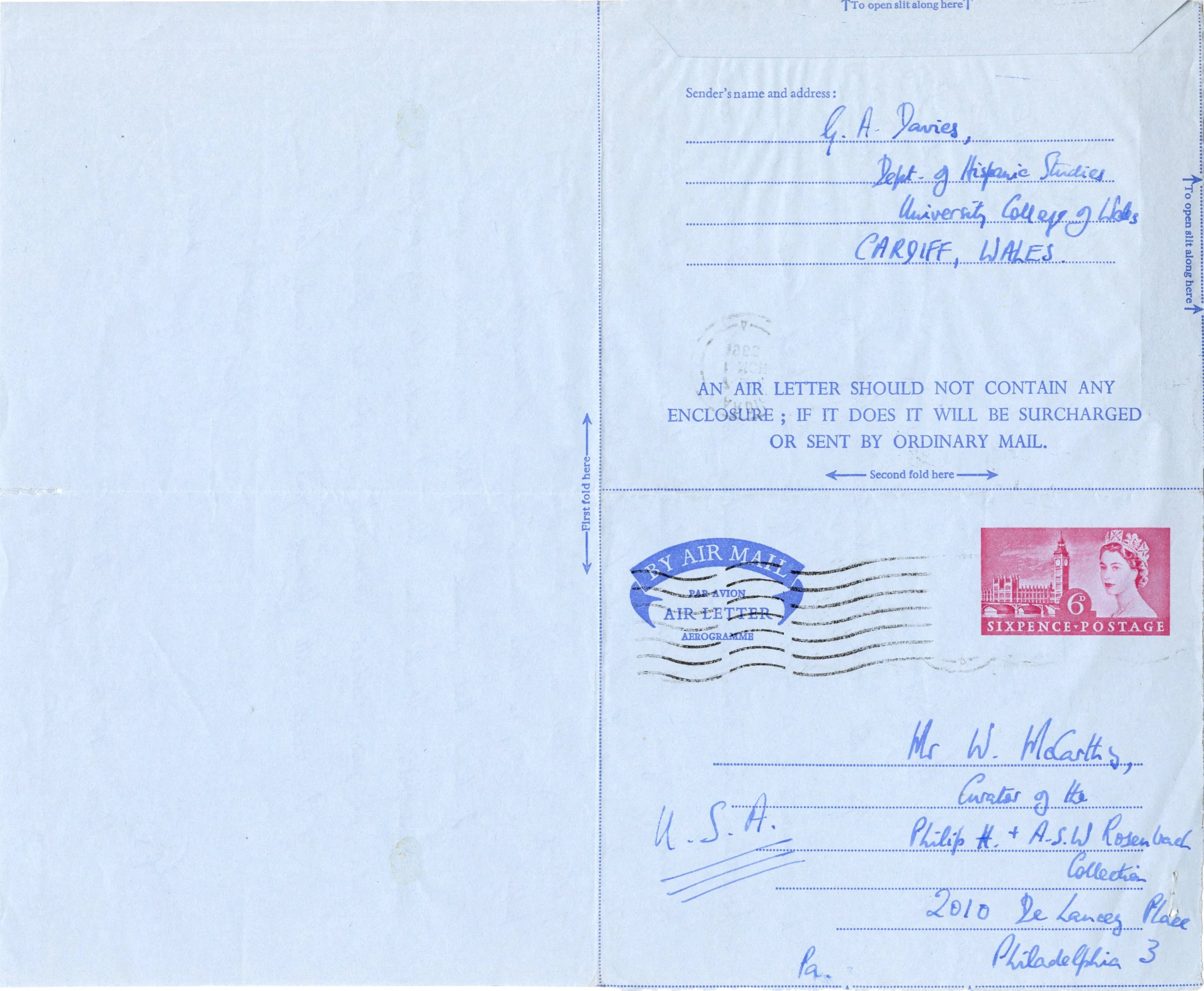
Gareth Alban Davies (1926-2009), autograph letter signed to Mr. W. McCarthy. Cardiff, Wales, [1964-5]. Rosenbach Museum & Library, Collection File: Evans, David
At the same time, David Evans spent his final years in a contemplative and reminiscent mood. It is surely significant that in writing “the short imperfect story of [his] pilgrimage… in a weary, tumultuous, restless world” (1747-48, verse 58), he returned to the Welsh language. He documented a life punctuated by professional disappointment in an autobiographical poem “so personal and painful that he would feel it necessary to ensure confidentiality” by concealing its contents in a language his congregants would not be able to read or understand (Schlenther 1990, 222).
When he died in 1751, the contents of Evans’s study purportedly included three pairs of shears and a box of carpenter’s tools, reminders of the journey he had made from a weaver’s apprentice in Carmarthenshire to an indentured servant, carpenter, and then embittered Presbyterian minister in Colonial America. His estate also listed an enslaved woman, “the Negro wench,” amongst “goods & Chattels,” another indication of Evans’s incorporation into the economic systems of the mid-18th-century colonies (1749).
It is unclear what immediately became of the autobiographical poem, now in the Rosenbach’s collections. In fact, after Evans’s death, the manuscript is not documented again until April 1906, when it appeared in the Philadelphia auction of the library of Samuel W. Pennypacker (Henkels, ed., lot 148). Pennypacker, a Pennsylvanian judge, politician and historian, likely bound the poem in in the late 1880s and added an English-language summary of Evans’s life and career as its appendix. Annotations in a copy of the auction catalog held by the Huntington Library confirm that the poem was purchased by “Rose” [sic], after which it languished with Rosenbach Company stock until Dr. Rosenbach, and then his brother Philip, died in the early 1950s. At this point, it passed into the possession of the Rosenbach Museum & Library, amongst curiosities including the second Welsh-language book printed in the American Colonies [A 730cy], and a 1688 Welsh translation of John Bunyan’s Pilgrim’s Progress [EL2 .B942p.We].
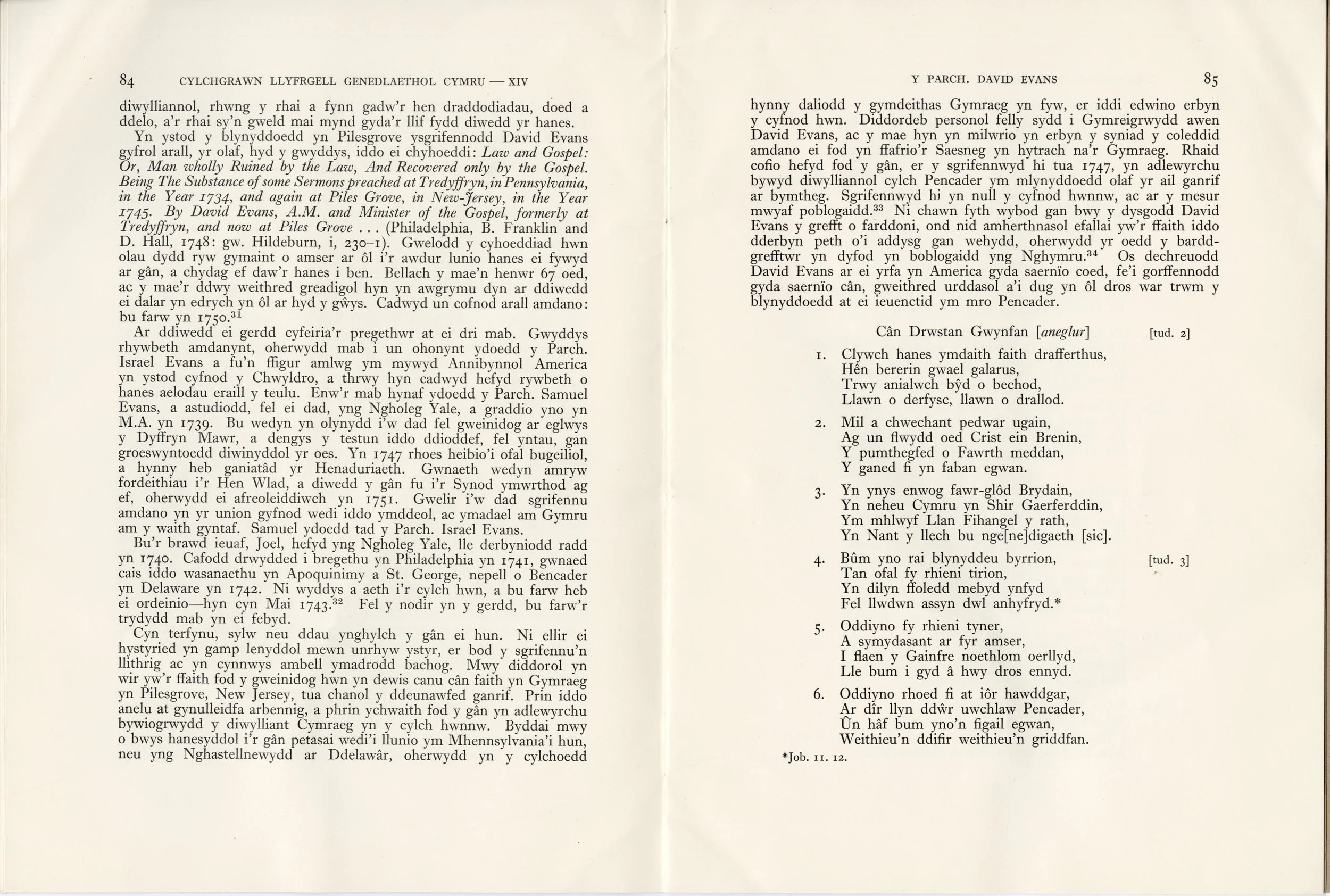
Gareth Alban Davies (1926-2009), "Y Parch. David Evans, Pencader—Ymfudwr Cynnar I Pennsylvania." National Library of Wales Journal, 1965. Rosenbach Museum & Library, Collection File: Evans, David.
It is only possible to speculate how long the manuscript might have sat on the shelves at the Rosenbach, if Gareth Alban Davies had not visited Philadelphia in 1964, or if William H. McCarthy Jr. had reached for Bunyan or the Biblical concordance instead of the autobiographical poem. Yet Davies was intrigued by the tale of David Evans and stayed in contact with the Rosenbach. In a wonderfully mid-century workflow, McCarthy Jr. sent a photostatic copy of the manuscript by airmail, which Davies then transcribed and published in the National Library of Wales Journal the following year. Davies also included an introductory essay (in Welsh) that provided additional context and biographical detail.
Nearly two decades later, John van der Zee was researching a book on indentured servitude in the American Colonies (1985) and followed the trail from the Pennypacker auction catalog at the Huntington in San Marino, California, to the manuscript in Philadelphia, in search of more information about the elusive Evans. While staff initially could not find the misfiled manuscript, the Rosenbach was able to share the transcription with van der Zee, who then commissioned the Welsh scholar and playwright Elwyn Jenkins to translate the poem into English. The Rosenbach now holds Davies’s journal article and Jenkins’s translation, as well as the original manuscript.
In the 21st century, it requires somewhat less ingenuity to find and research Evans’s manuscript; instead of relying on happenstance and airmail, researchers can simply search Rosy, the Rosenbach’s online library catalog. The Rosenbach makes its collections freely available for research and progress continues to be made in increasing access to information about the collections. Via Rosy, you’ll find records for most uncollected manuscripts and 2,500 records from the largest collecting area, printed Americana, as well as records from collecting areas including English and American literature, Incunabula, and the Marianne Moore Library. The entire manuscript has also been digitized on People’s Collection Wales, a website that brings together collections from both individuals and institutions to celebrate the history, culture and people of Wales.
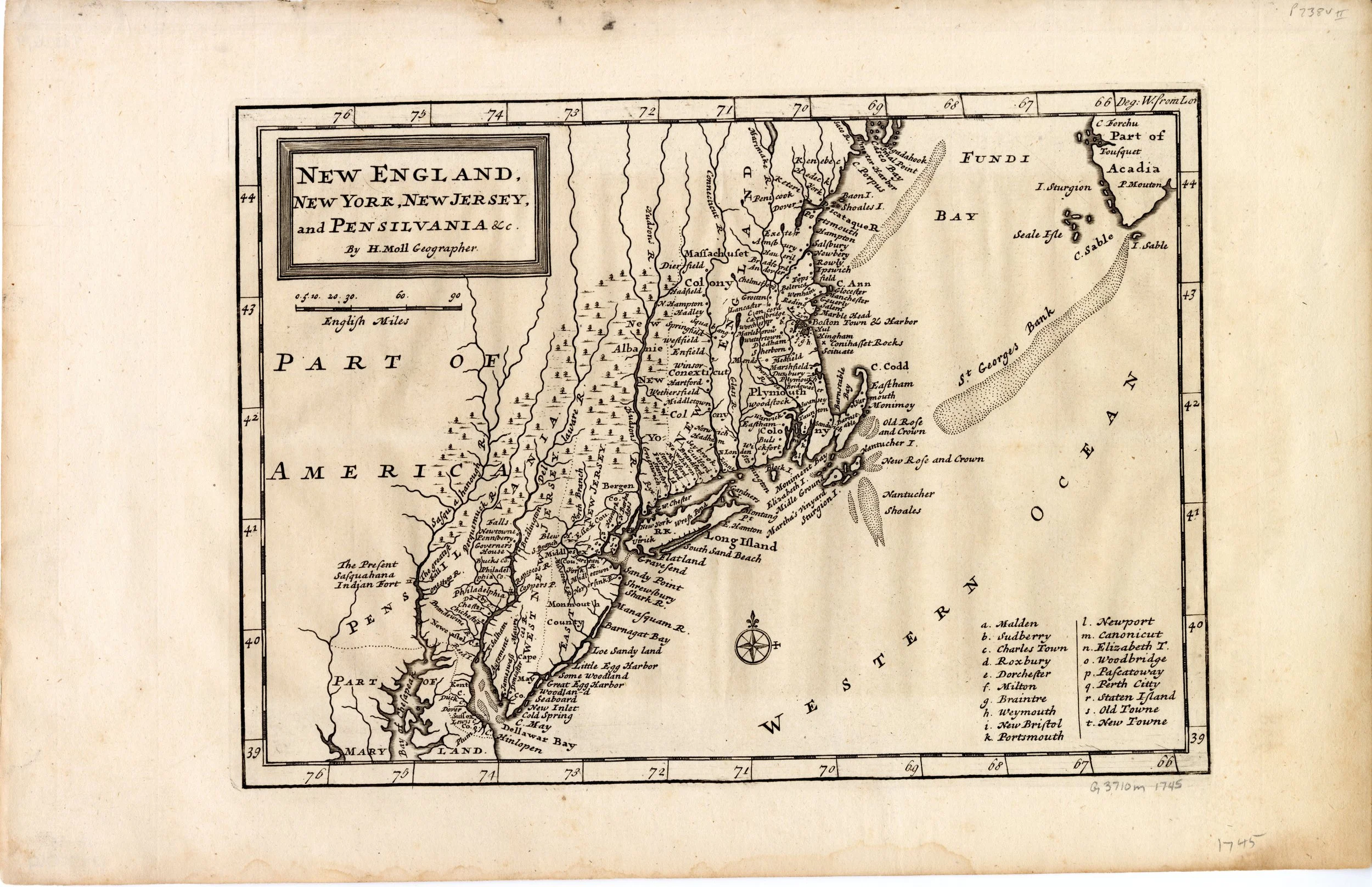
Herman Moll (-1739). New England, New York, New Jersey and Pennsylvania / H. Moll, geographer. 1745. Bequest of Lee Breckenridge. Rosenbach Museum & Library, Map G3710m 1745
I left the United Kingdom and immigrated to Philadelphia in late 2022. I started working at the Rosenbach the following spring and like both David Evans and Gareth Alban Davies, sought the comfort of the familiar; one afternoon, I asked Librarian Elizabeth E. Fuller whether the collections included any material in the language of my childhood, and just as William H. McCarthy Jr. had reached for the manuscript, Fuller mentioned the “short imperfect story” of an early 18th-century Presbyterian who had “sailed across the wide ocean… so that [he] could purchase plenty of books” (1747-48).
History is complex and impersonal, and it can be difficult to comprehend the nuances of Welsh migration to Colonial America or the theological implications of a three-hundred-year-old religious schism. It is even harder to understand how people lived through, felt about, and then remembered these historical moments. Evans was a man with strong theological convictions and a resistance to arbitrary authority. He was also a slaveholder. He was habitually incapable of building and maintaining relationships with the congregations he was sent to oversee. It might ultimately be argued that his objection to the autocratic rule of the presbytery had less to do with its centralized leadership and more to do with the “infallible divine preachers who granted [him] permission” and who constantly challenged his authority and expertise (1747-48).
Evans’s manuscript autobiography may not be the most significant or showstopping object on our shelves, but it speaks to these uniquely interpersonal tensions at the heart of the First Great Awakening and to the ideological debates that would eventually erupt into the American Revolution by the end of the century. The Rosenbach’s collection of nearly 400,000 rare books, manuscripts, and fine and decorative arts objects, including some of the best-known literary and historical objects in the world, provide countless opportunities to engage with these complex histories of the United States and with the stories of the people and communities that shaped the country we live in today.
References and further reading
“Will and Inventory of David Evans, Salem County.” July 25, 1749. Item 1007Q. New Jersey State Archives, Trenton, NJ.
Davies, Gareth Alban. "Y Parch. David Evans, Pencader—Ymfudwr Cynnar I Pennsylvania." National Library of Wales Journal, vol. 14, no.1, 1965, pp.85-92.
Evans, David. “Cân drwstan gwynfan [aneglur]:” AMs: Pilesgrove, N.J., [1747 or 8]. AMs 44/8. Rosenbach Museum & Library, Philadelphia, PA.
Evans, David. “A Song of Lament and Ill-luck.” Translated by Elwyn Jenkins. Collection File: Evans, David. Rosenbach Museum & Library, Philadelphia PA.
Harries, Joseph S. “Church in Tredyffrin.” Journal of the Presbyterian Historical Society, vol. 4, no. 6, 1908, pp.273-283.
Henkels, Stan V., editor. The Valuable Library of the Hon. Samuel W. Pennypacker Governor of Pennsylvania... April 26, 1906. Davis & Harvey, 1906.
Klett, Guy S., editor. Minutes of the Presbyterian Church in America, 1706-1788. Presbyterian Historical Society, 1976.
Schlenther, Boyd. S. “The English is Swallowing up their Language:” Colonial Ethnic Ambivalence in Colonial Pennsylvania and the Experience of David Evans.” The Pennsylvania Magazine of History and Biography, vol. 114, no. 2, 1990, pp.201-228.
Van der Zee, John. Bound Over: Indentured Servitude and American Conscience. Simon and Schuster, 1985.