
New Acquisition: In a Glass Darkly & Carmilla by Joseph Sheridan Le Fanu
by Edward G. Pettit, Sunstein Senior Manager of Digital Initiatives
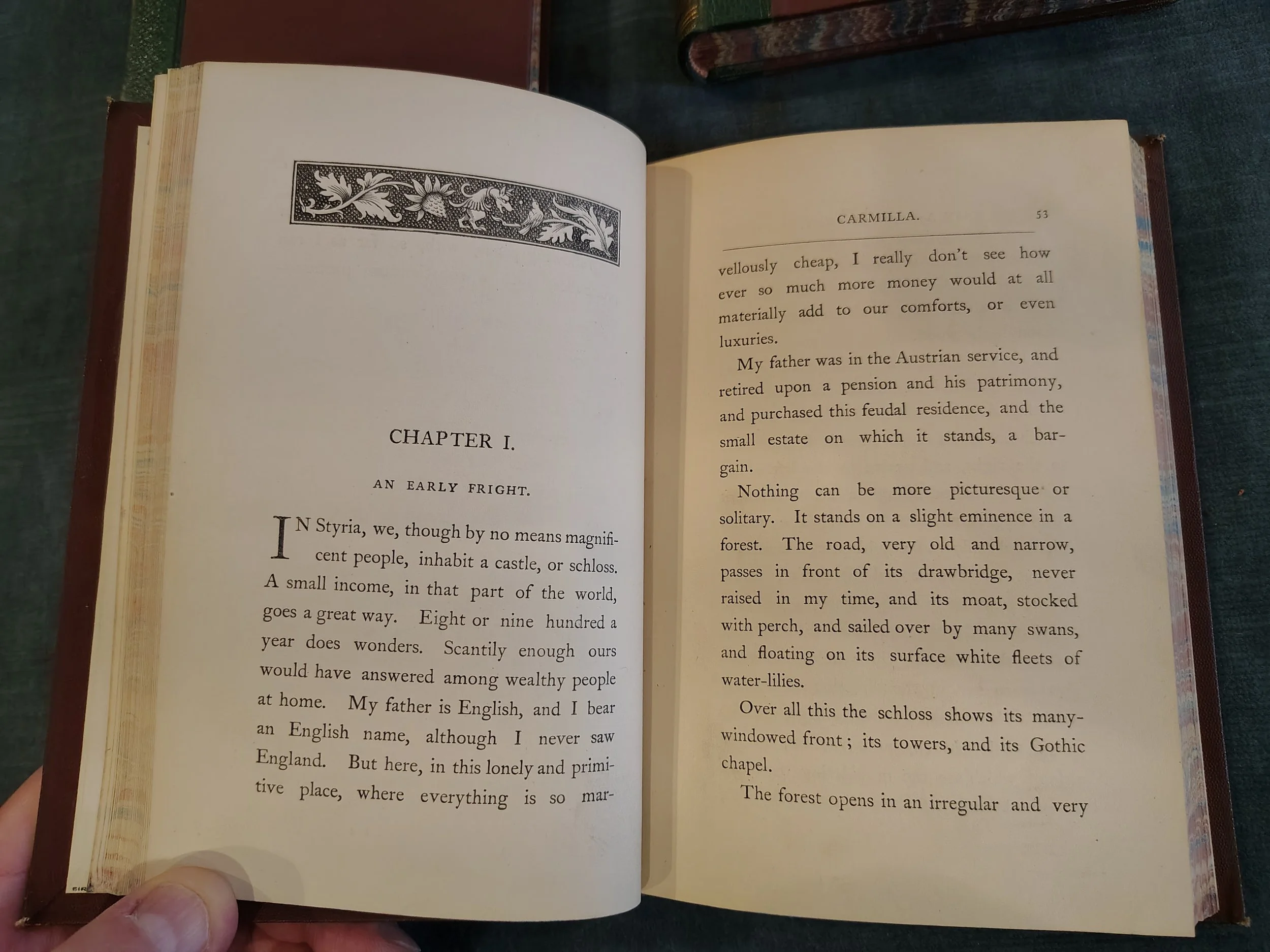
Joseph Sheridan Le Fanu (1814-1873), In a glass darkly. London: R. Bentley, 1872. Rosenbach Museum & Library, EL3 .L488i 872. Image credit Edward G. Pettit.
The vampires Carmilla, Lord Ruthven, and Dracula now all live in the East Library of the Rosenbach. We recently acquired J. Sheridan Le Fanu’s collection of tales, In a Glass Darkly (Richard Bentley, 1872), which includes the great vampire novella, Carmilla [EL3 .L488i 872]. Le Fanu was an enormously popular Dublin author in his time. His tales and novels, whether supernatural or criminal in subject, are frequently unsettling, gothic, and challenging to gender and psychological boundaries. Carmilla is all of this and more.
Carmilla’s most popular fictional vampire antecedents, John Polidori’s Lord Ruthven or James Malcolm Rhymer’s Varney the Vampire, were in the Byronic-aristocratic vein—corrupt, virile, satisfying their desire for dominance and power. With his Carmilla, Le Fanu maintained the aristocratic connection of the others (she is Countess Karnstein), but the vampire’s alluring femininity, and the lesbian overtones of her seduction of her victim, Laura, generate a sexually charged mood, as well as a burgeoning intimate companionship that stand in contrast to her predecessors.
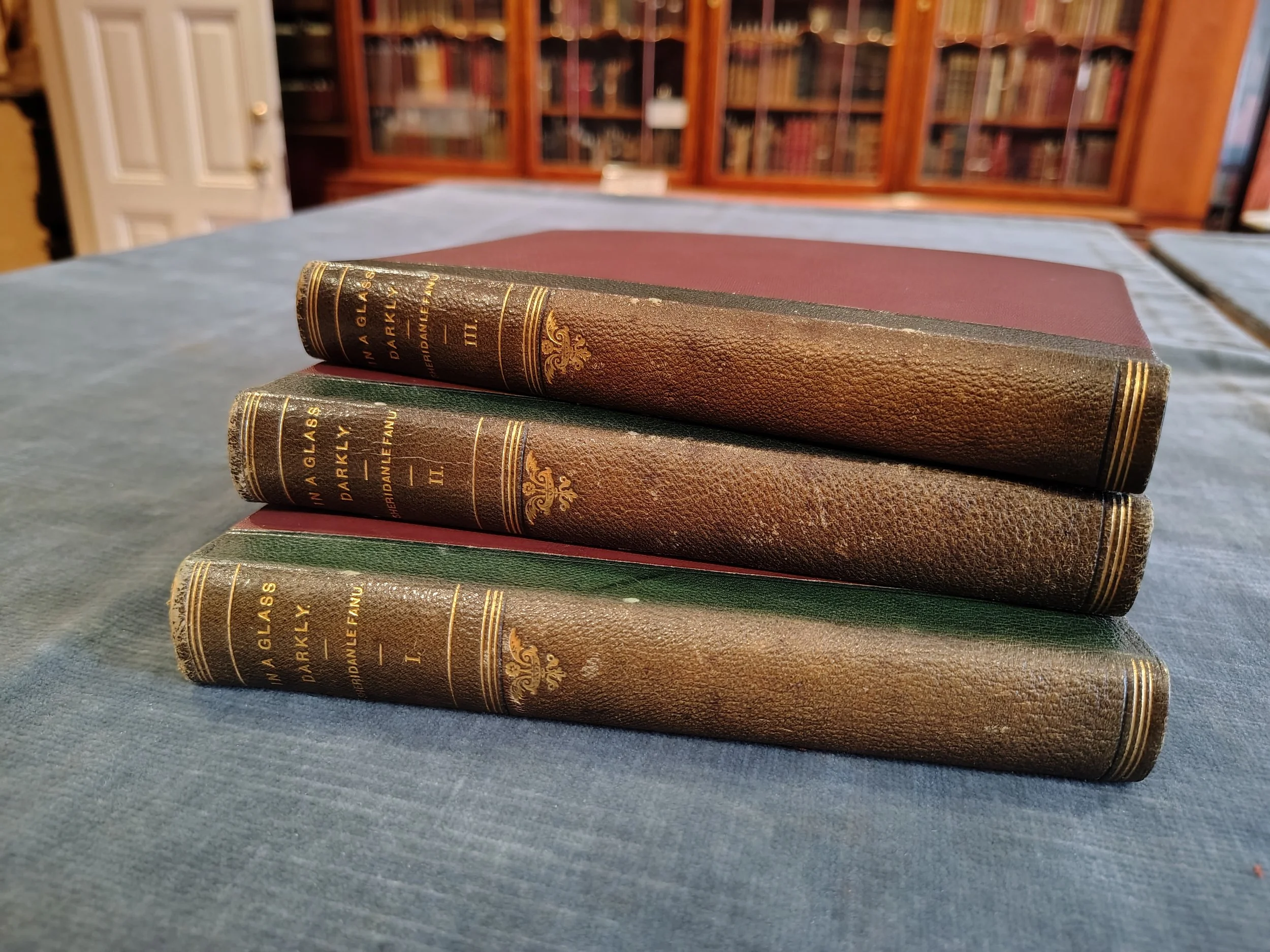
Joseph Sheridan Le Fanu (1814-1873), In a glass darkly. London: R. Bentley, 1872. Rosenbach Museum & Library, EL3 .L488i 872. Image credit Edward G. Pettit.
Carmilla was first serialized in the short-lived, London-based magazine, The Dark Blue, and written shortly before Le Fanu’s death in 1873. Le Fanu added Carmilla to four other stories —“Green Tea,” “The Familiar,” “Mr. Justice Harbottle,” and “The Room in the Dragon Volant” —to comprise his final book publication, In a Glass Darkly. None of the other stories deal with vampires, but “Green Tea” featuring a kind of occult detective, Dr. Martin Hesselius, who investigates the claims of a man haunted by a demonic monkey, became a horror anthology favorite. For In a Glass Darkly, Le Fanu used Hesselius as a framing device for the collection, writing a prologue for each story as if they were from the files of Hesselius’s investigations.
Bram Stoker grew up in Le Fanu’s Dublin and wrote theatre reviews for a newspaper co-owned by Le Fanu, but although Stoker greatly admired Le Fanu as a writer, it doesn’t appear that they ever met. After the death in 1858 of his wife, Charlotte, Le Fanu withdrew from society, becoming known as “The Invisible Prince.”
Stoker was greatly inspired by Carmilla when he came to write Dracula. Le Fanu’s story is set in a forest in Styria (a former duchy now found in modern day Austria and Slovenia). In Stoker’s Dracula: autograph manuscript notes and outline [EL3 .S874d MS], housed at the Rosenbach, we learn that Dracula’s castle was originally envisioned as taking place in in Styria but was later changed to Transylvania. The erotic overtones that protagonist, Jonathan Harker, experiences with the vampires in Dracula echo the similar scenes in Carmilla. There are also various naming echoes in the two books: Laura/Lucy, Van Helsing/Vordenburg, Rheinfeldt/Renfield, Karnstein/Carfax. And of course, Le Fanu’s Dr. Hesselius is a clear inspiration for Stoker’s Dr. Van Helsing, the polymath scientist obsessed with investigating the occult.
In the past few decades, interest in Carmilla has grown to the point where it has become the most taught vampire text in colleges. Carmilla is a story about matriarchy, not patriarchy. Compared to the frequent violent masculinity in Dracula, contemporary readers generally find refreshing the lesbian eroticism and distinctive take on the vampire/victim relationship.
So, the next time you visit the Rosenbach, perhaps you will hear the light step of Carmilla at the East Library door.
Anyone can make a research appointment at the Rosenbach to see our vampire collection. Click here for more information: https://www.rosenbach.org/make-research-appointment