
Collecting Signers of the Declaration - Virginia
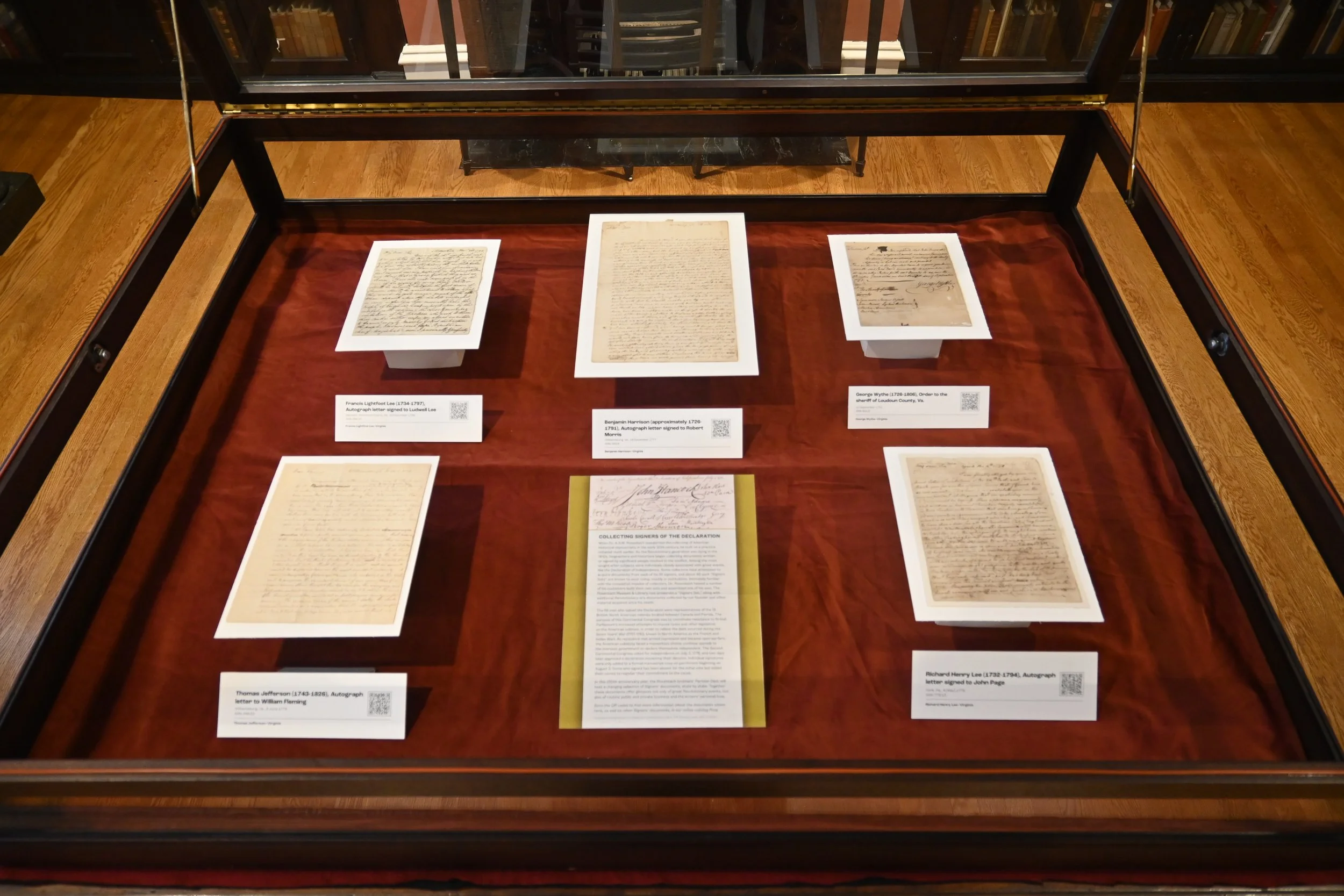
Rosenbach Partner Desk exhibition for September 2026, featuring signers of the Declaration of Independence from Virginia. Image credit David Rhys Owen
by Elizabeth Fuller, Librarian
When Dr. A.S.W. Rosenbach popularized the collecting of American historical manuscripts in the early 20th century, he built on a practice initiated much earlier. As the Revolutionary generation was dying in the 1810s, biographers and historians began collecting documents written or signed by significant people involved in the conflict. Among the most sought-after subjects were individuals closely associated with great events, like the Declaration of Independence. Some collectors have attempted to acquire documents from each of its 56 signers, and about 40 such “Signers Sets” are known to exist today, mostly in institutions. Intimately familiar with the completist impulse of collectors, Dr. Rosenbach helped a number of his customers build their own sets and assembled one of his own. The Rosenbach Museum & Library now preserves a “Signers Set,” along with additional Revolutionary-era documents collected by our founder and other material acquired since his death.
In this 250th anniversary year, the Rosenbach brothers’ Partner Desk will host a changing selection of Signers’ documents, state by state. Together these documents offer glimpses not only of great Revolutionary events, but also of routine public and private business and the writers’ personal lives.
These documents from five of the seven Virginia signers illustrate many aspects of their political and personal lives and national events before, during, and after the Revolution. Visit the website of the National Constitution Center for useful biographies of all 56 signers.
Salutation of Benjamin Harrison’s letter to Robert Morris. Image credit Bryn Michelson-Ziegler
Benjamin Harrison (approximately 1726-1791), Autograph letter signed to Robert Morris
Williamsburg, Va., 18 December 1777
AMs 363/9
Like many other wealthy Virginians, Harrison spent years in the colonial legislature before becoming a delegate to the Continental Congress, where he became friendly with Pennsylvania delegate Robert Morris, a wealthy merchant who managed much of the nation’s finances during the Revolution. In this letter, written shortly after he returned home to Virginia, Harrison tells Morris about the growing sentiment in Virginia (which was shared throughout the country) against “monopolists”, merchants who were assumed to be profiting unfairly from the unstable wartime economy. He also reports on rumors of the so-called Conway cabal, a presumed plot by military officers and politicians who lacked confidence in George Washington’s leadership of the Continental Army.
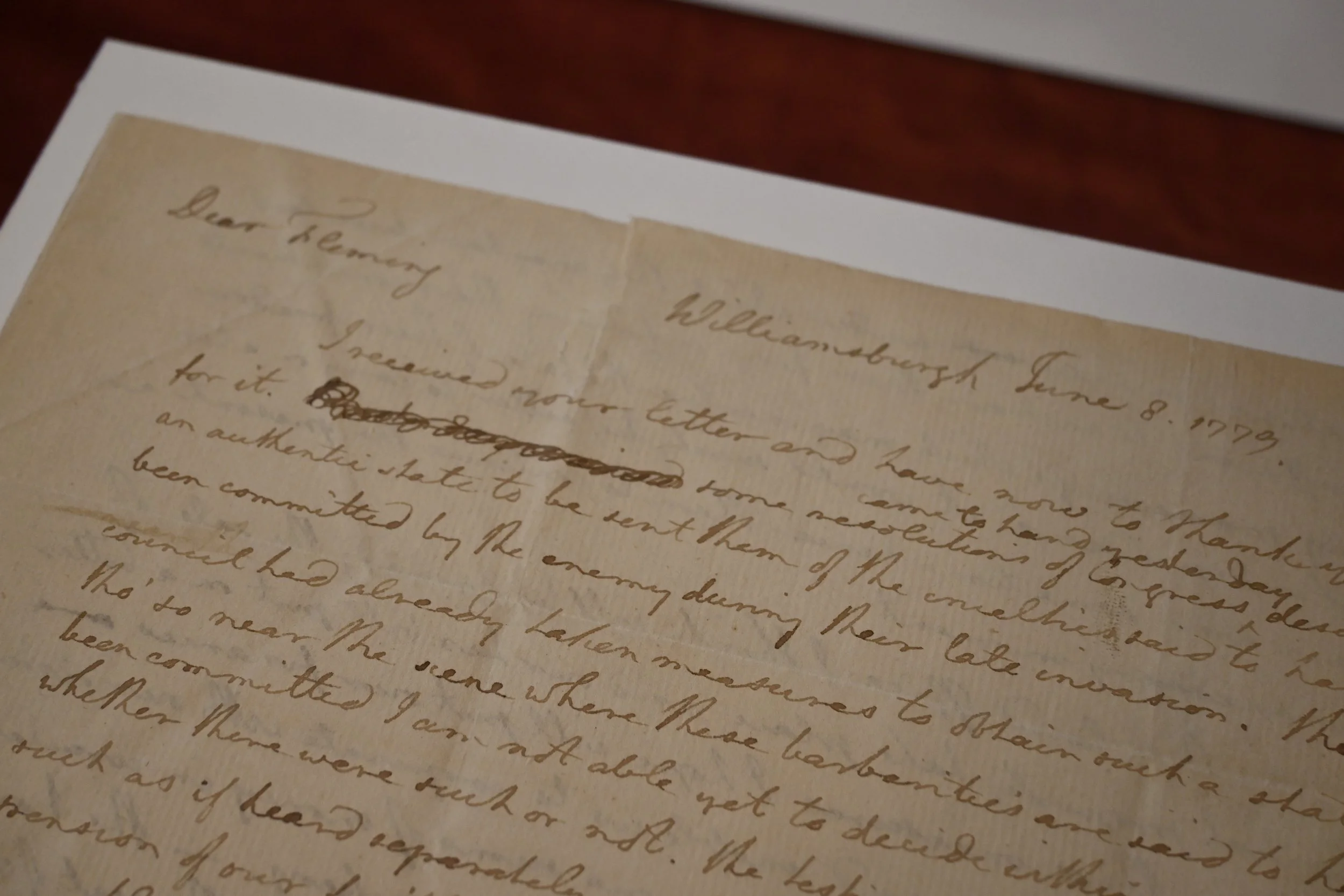
Salutation of Thomas Jefferson’s letter to William Fleming. Image credit David Rhys Owen
Thomas Jefferson (1743-1826), Autograph letter to William Fleming
Williamsburg, Va., 8 June 1779
AMs 449/23
Jefferson and William Fleming had been friends since they were students at the College of William and Mary, and later served together in the Virginia legislature. When this letter was written Fleming was a member of the Continental Congress and Jefferson had just begun his first term as governor of Virginia. After reporting on efforts to learn the truth about British atrocities during a recent attack on southeastern Virginia, Jefferson expresses his concern about strained relations with the United States’s new ally France, gives an account of recent actions of the Virginia government, and discusses military operations in western Pennsylvania and New York.
The Rosenbach has more than 30 other letters by Jefferson, including two to Fleming from their student days. Although this is the one that is formally part of the Signers Set, it isn’t signed. Given the sensitive nature of the contents and the danger of the times, Jefferson noted: “I put no name to this letter, because letters have miscarried, and if it goes safely you know the hand.”
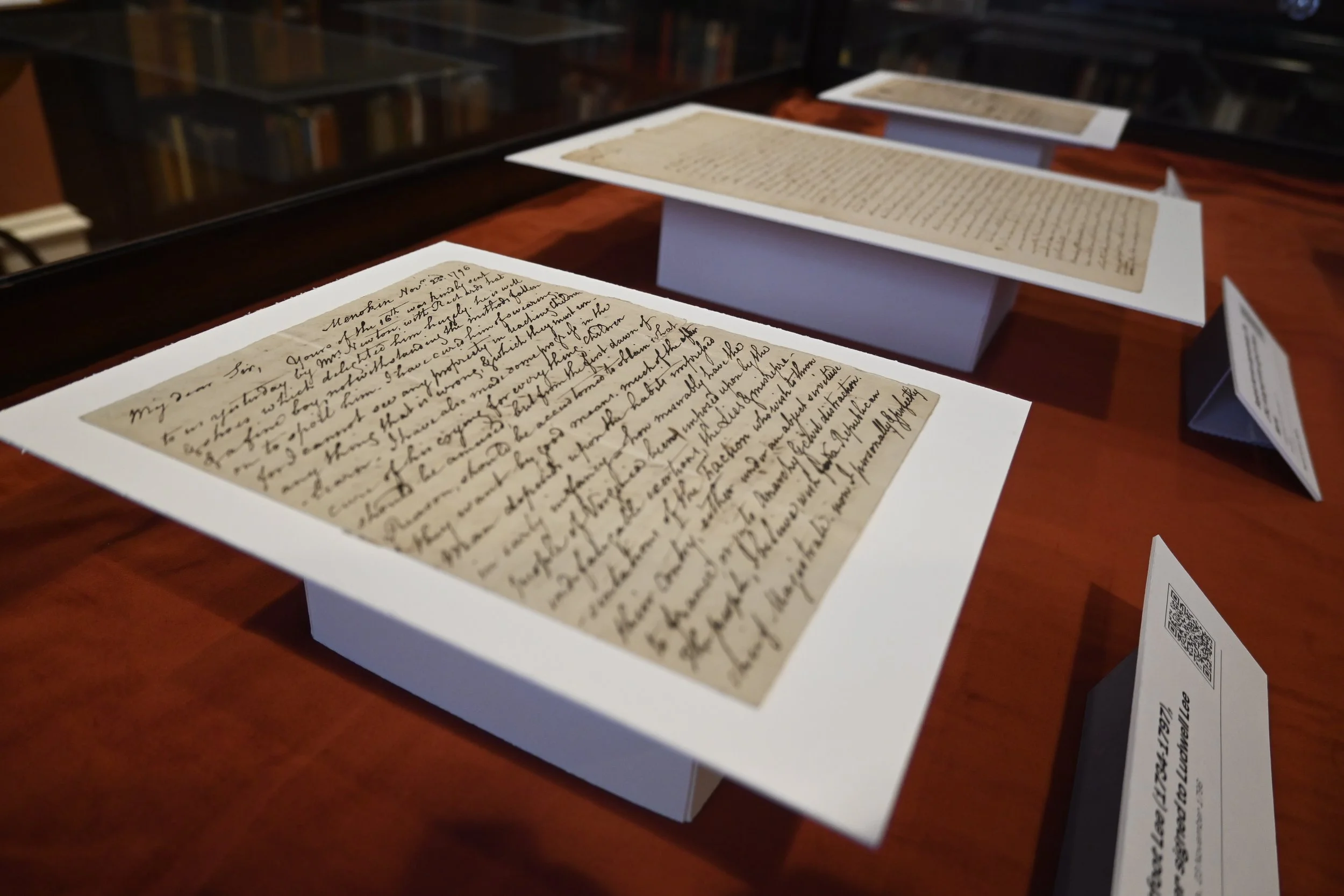
Autograph letter from Francis Lightfoot Lee to Ludwell Lee. Image credit David Rhys Owen
Francis Lightfoot Lee (1734-1797), Autograph letter signed to Ludwell Lee
Menokin, Richmond County, Va., 23 November 1796
AMs 392/10
Francis Lightfoot Lee, who like most of his brothers had been a member of the Virginia legislature before joining the Continental Congress, was unlike them known for his calm and philosophical temperament. He retired from public office when he left Congress in 1779, though he retained an interest in politics, as shown in this letter two decades later to his nephew Ludwell, Richard Henry’s son. It begins with news of Ludwell’s young son, also Richard Henry, who had gone to stay with Francis’s family after his mother died the year before. Francis reports that he has cured Richard (who is not yet two and a half) of swearing, and is working on teaching him not to cry for what he wants. Musing on how character is formed early in life seems to lead him to think about the unbecoming conduct of some partisans in the recent presidential election between John Adams and Thomas Jefferson. Although he knows both candidates well and admires them, he is less impressed with some of “the wretched characters Virginia delights to honor”, including its recently elected governor. After congratulating Ludwell on his own re-election as chair of the Virginia Senate, he closes by asking him to procure some citron for the Christmas mince pies (even though his wife says it is too expensive).
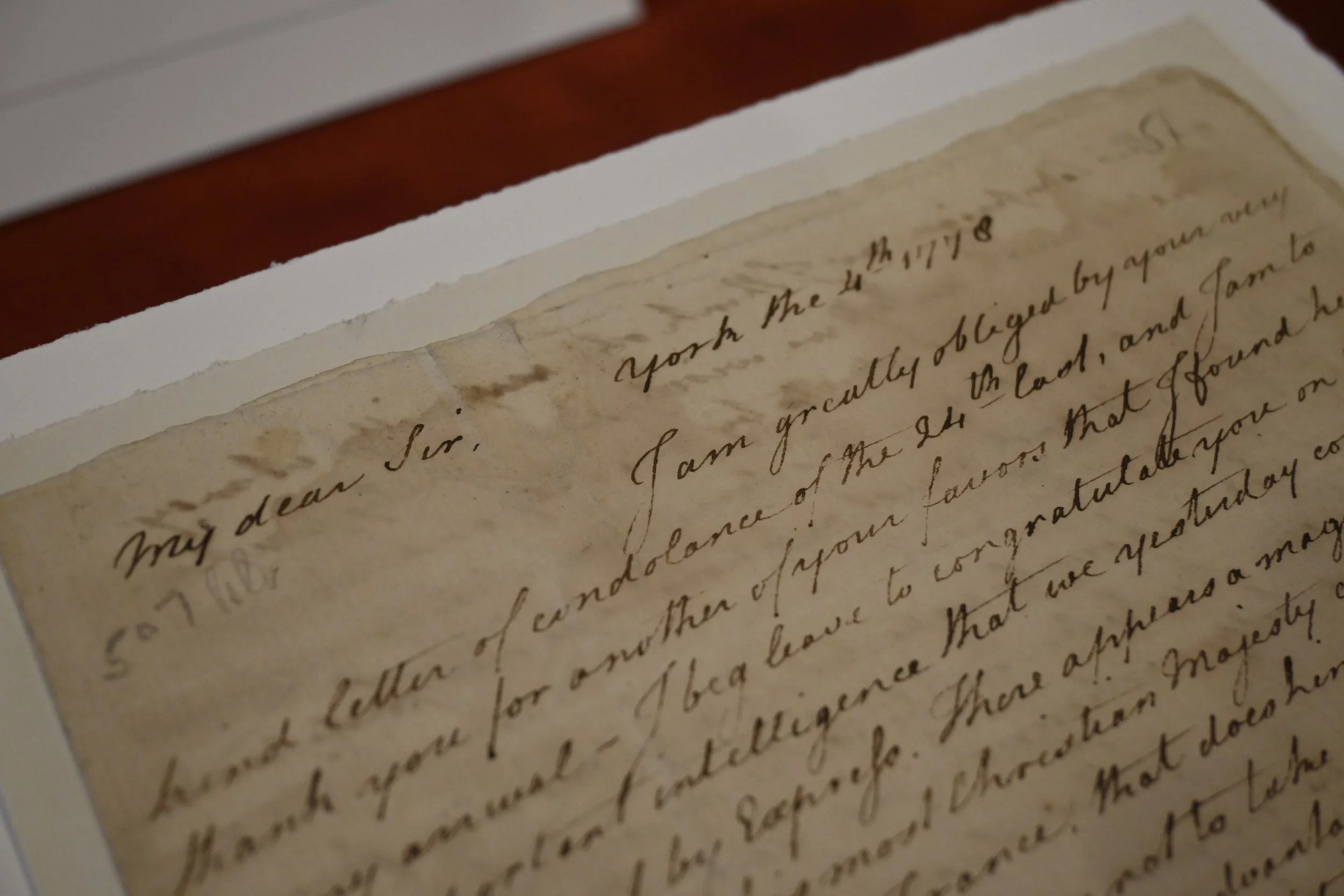
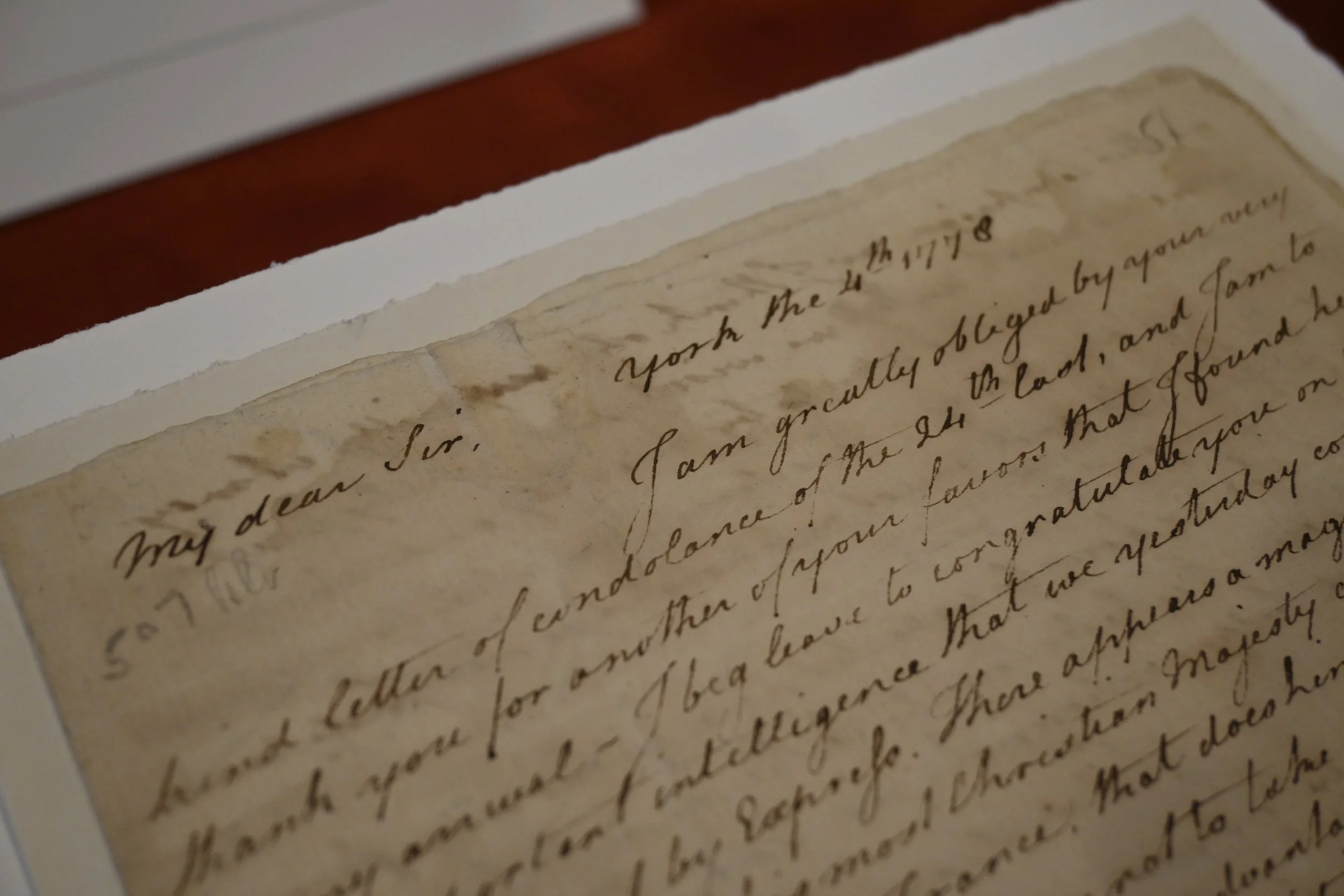
Salutation of Richard Henry Lee’s letter to John Page. Image credit Bryn Michelson-Ziegler
Richard Henry Lee (1732-1794), Autograph letter signed to John Page
York, Pa., 4 [May] 1778
AMs 776/13
Richard Henry Lee and his brother and fellow signer Francis Lightfoot Lee were members of one of Virginia’s most prominent and powerful families. Richard Henry had served in the Virginia legislature before and during the Revolution, and was an early advocate of American independence. He is best known as the author of the resolution for independence approved by Congress on July 2. At the time of his letter he was with Congress in York, Pennsylvania, where it had moved after Philadelphia was occupied by the British. He writes to the Lieutenant Governor of Virginia about his hope that the recently-signed alliance with France will encourage other European nations to ally and trade with the United States and force Britain to acknowledge its independence.
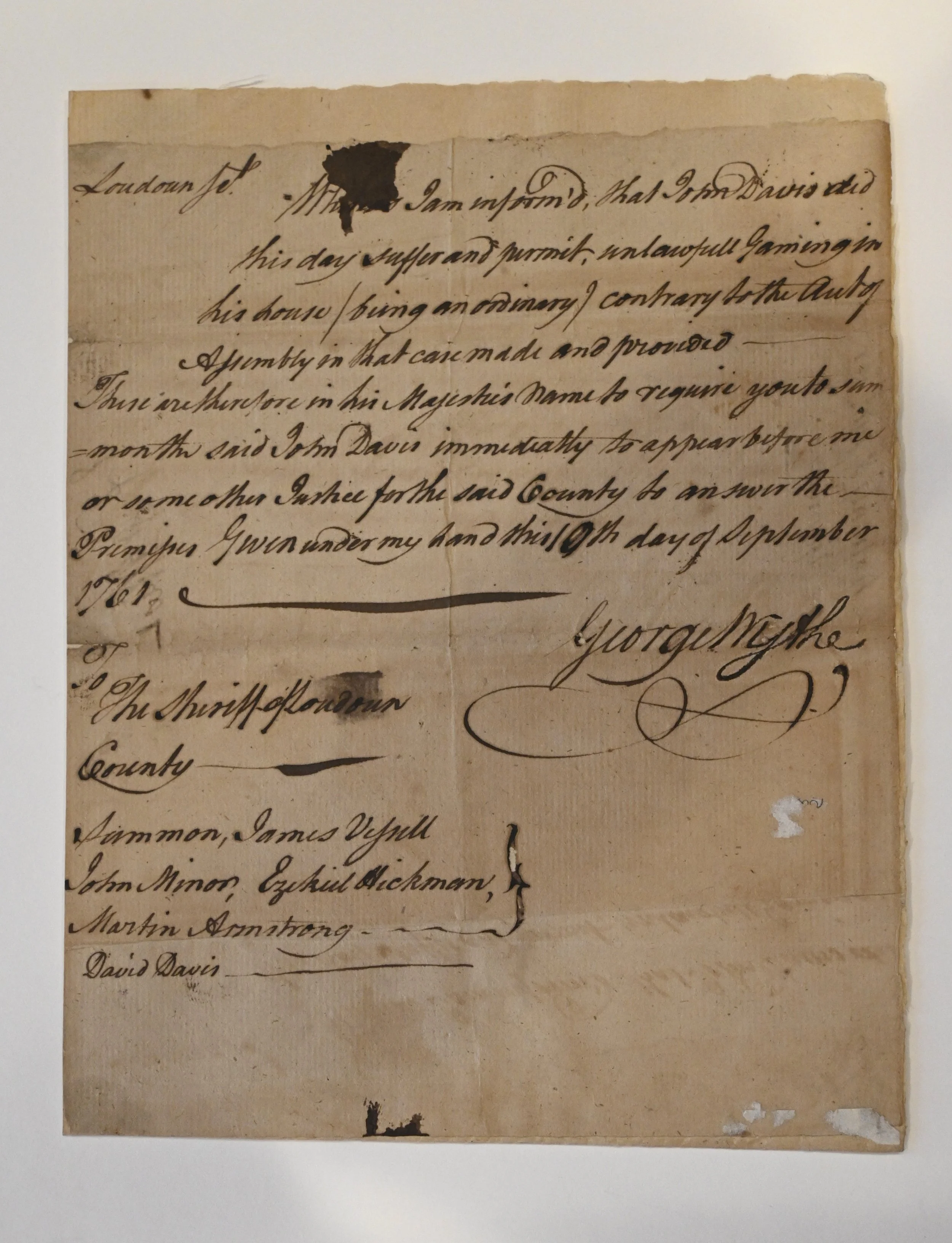
George Wythe’s order to the sheriff of Loudoun County, Va. Image credit David Rhys Owen
George Wythe (1726-1806), Order to the sheriff of Loudoun County, Va.
10 September 1761
AMs 801/2
One of the older members of Congress, Wythe was an experienced and well-regarded lawyer who had taught law to Thomas Jefferson and whose later students included John Marshall and Henry Clay. He was a judge for much of his career, and in addition to politically important and notorious cases he handled many routine ones like the one represented by this document, in which he orders a sheriff to summon a tavern keeper to court on charges of permitting illegal gambling on his premises.
Virginia singers in the Rosenbach’s holdings not included in this month’s display:
Carter Braxton (1736-1797), Letter signed to Alexander Montgomery
11 May 1788
AMs 807/12
Thomas Nelson (1738-1789), Autograph letter signed to Col. Davies
Richmond, Va., 30 July 1781
AMs 392/13
In October, the Rosenbach’s Partner Desk will showcase signers from North Carolina.