
Collecting Signers of the Declaration - Maryland
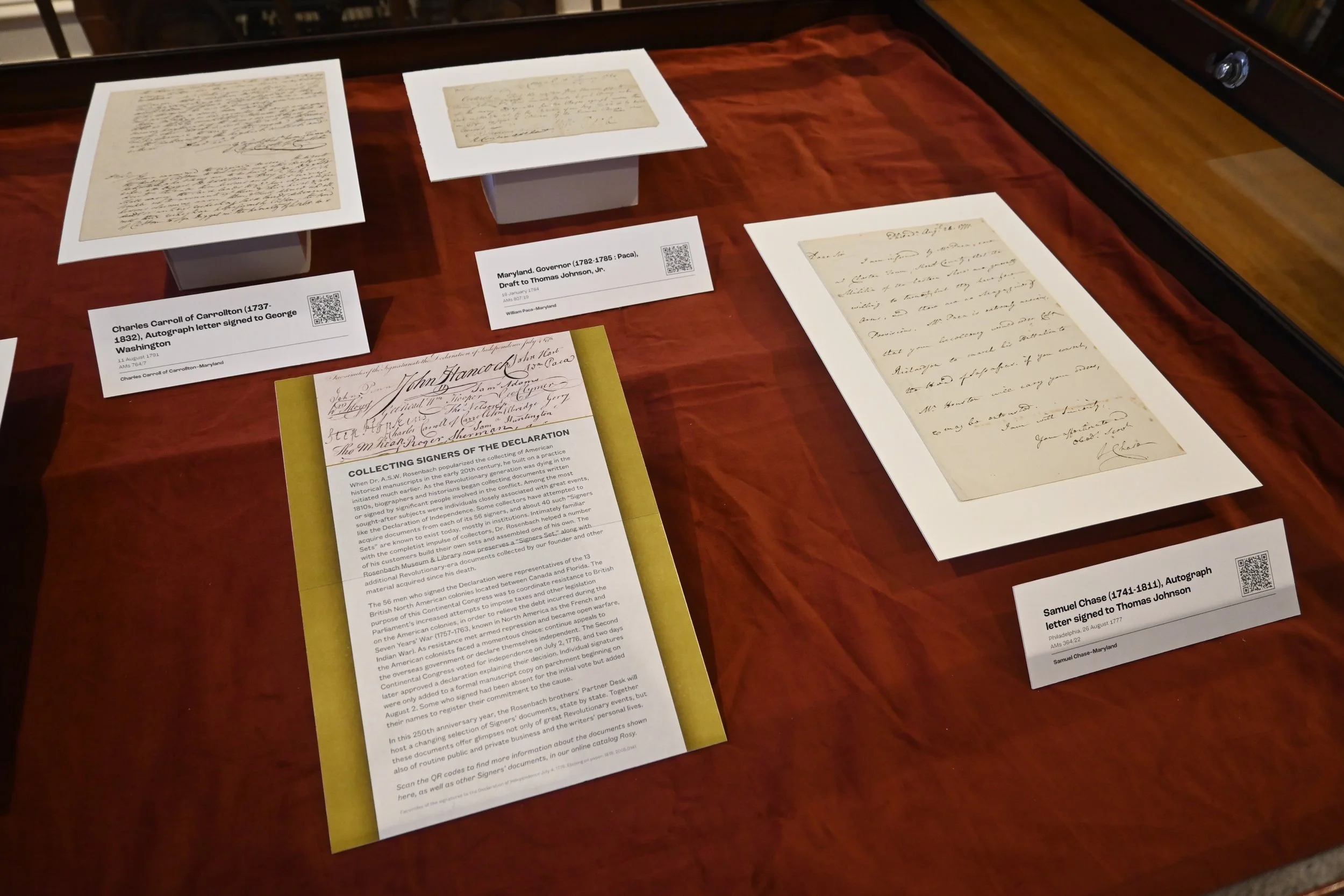
Rosenbach Partner Desk exhibition for August 2026, featuring signers of the Declaration of Independence from Maryland. Image credit Bryn Michelson-Ziegler
by Elizabeth Fuller, Librarian
When Dr. A.S.W. Rosenbach popularized the collecting of American historical manuscripts in the early 20th century, he built on a practice initiated much earlier. As the Revolutionary generation was dying in the 1810s, biographers and historians began collecting documents written or signed by significant people involved in the conflict. Among the most sought-after subjects were individuals closely associated with great events, like the Declaration of Independence. Some collectors have attempted to acquire documents from each of its 56 signers, and about 40 such “Signers Sets” are known to exist today, mostly in institutions. Intimately familiar with the completist impulse of collectors, Dr. Rosenbach helped a number of his customers build their own sets and assembled one of his own. The Rosenbach Museum & Library now preserves a “Signers Set,” along with additional Revolutionary-era documents collected by our founder and other material acquired since his death.
In this 250th anniversary year, the Rosenbach brothers’ Partner Desk will host a changing selection of Signers’ documents, state by state. Together these documents offer glimpses not only of great Revolutionary events, but also of routine public and private business and the writers’ personal lives.
These documents from the four Maryland signers illustrate many aspects of their political and personal lives during and after the Revolution, as well as their connections with each other. These include a fifth Maryland politician, Thomas Johnson (1732-1819), the first governor of the independent state. He served in the colonial Maryland legislature and the first Continental Congress with Samuel Chase, William Paca, and Thomas Stone (who had studied law in his office); and was governor when Charles Carroll was a member of the state senate. He is also mentioned in several of the documents here. Visit the website of the National Constitution Center for useful biographies of all 56 signers.
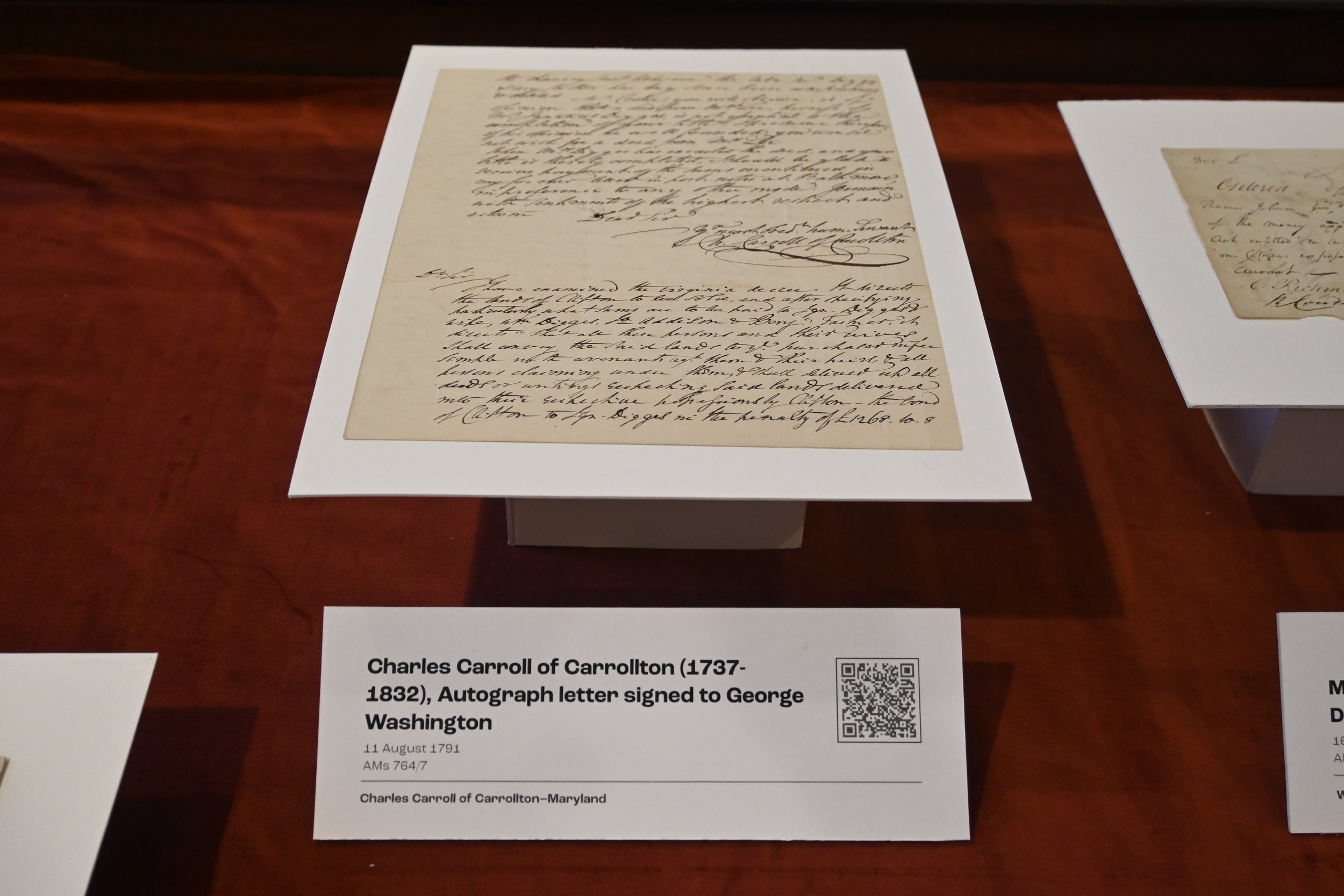
Autograph letter by Charles Carroll. Image credit Bryn Michelson-Ziegler
Charles Carroll of Carrollton (1737-1832), Autograph letter signed to George Washington
11 August 1791
AMs 764/7
Carroll was the wealthiest man in the colonies at the time of the Revolution, thanks to vast landholdings inherited from his father. Along with these he inherited a complicated legal dispute about the title to some land that George Washington had purchased in 1760 from one of Carroll’s father’s creditors. The elder Carroll was also involved in a suit with one of the other creditors, and would not release his claim to the land until that was settled. (As noted in the letter, this was on the advice of his lawyer, Thomas Johnson.) Although Washington began to develop the property (known as the River Farm portion of the Mount Vernon estate) and conduct agricultural experiments there, the title dispute dragged on until after both Carroll and the other creditor had died. Washington periodically continued efforts to clear the title with Carroll and later with his son. In this letter, more than thirty years later, the son finally declared that all disputes with the other creditor’s heirs had been settled, and he would release the title upon payment of a sum that had been previously mentioned. In a letter several weeks later Washington agreed to the payment, putting the case to rest at last.
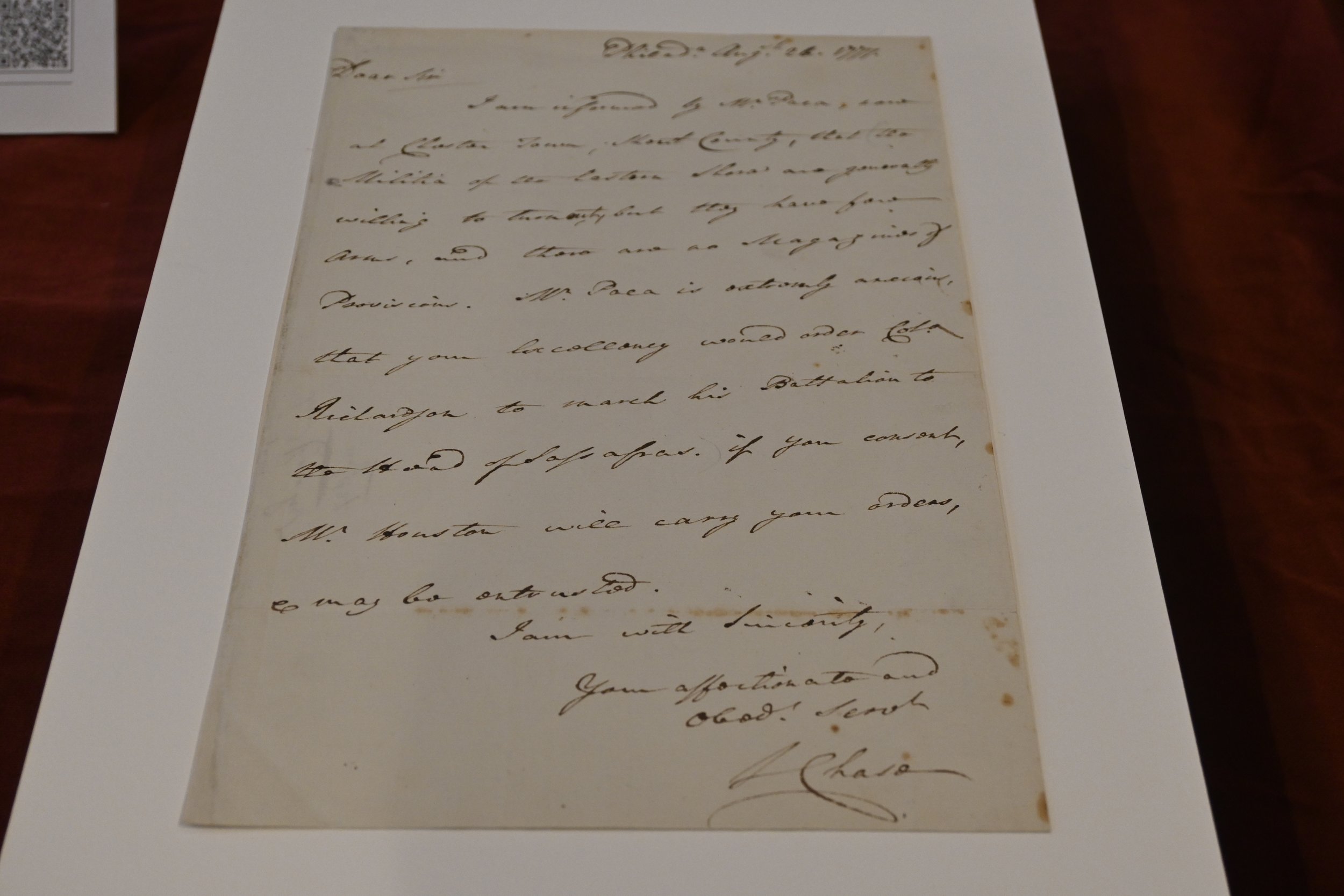
Autograph letter by Samuel Chase. Image credit Bryn Michelson-Ziegler
Samuel Chase (1741-1811), Autograph letter signed to Thomas Johnson
Philadelphia, 26 August 1777
AMs 364/22
Like many delegates to the Continental Congress, Chase and Willam Paca simultaneously held office in their home states. In this letter Chase passes to Maryland governor Thomas Johnson a report from Paca, who has met with militia officers on the state’s Eastern Shore that they are short of arms and ammunition and request reinforcements.
Chase had a long career as a judge and was appointed an associate justice of the Supreme Court by George Washington. In 1804 he became the first Supreme Court justice to be impeached, but as the impeachment was politically motivated and none of the charges reached the level of “high crimes and misdemeanors” required by the Constitution, he was acquitted.
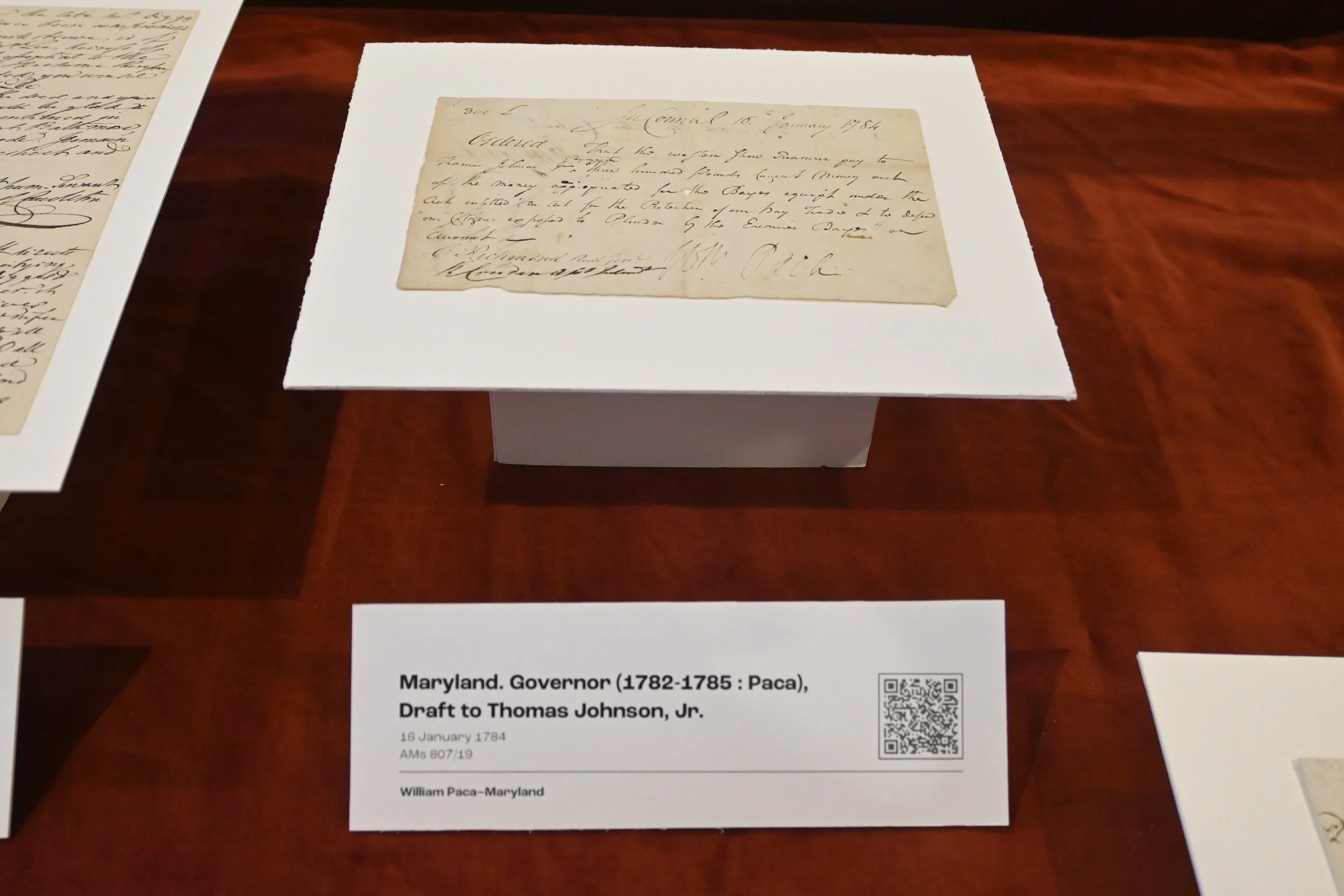
Document signed by William Paca. Image credit Bryn Michelson-Ziegler
Maryland. Governor (1782-1785 : Paca), Draft to Thomas Johnson, Jr.
16 January 1784
AMs 807/19
[William Paca]
As governor of Maryland, Paca orders the release of funds appropriated under a 1782 act that provided for armed barges to protect against British raids in the Chesapeake Bay. At the time of this document the Treaty of Paris, which recognized American independence, had been ratified but would not take effect for another five months, and the state was taking no chances. The Thomas Johnson Jr., Paymaster of the Barges, to whom the money is to be paid, held various other positions including Clerk and Secretary to the Maryland Council, but seems not to have been directly related to the governor of the same name.
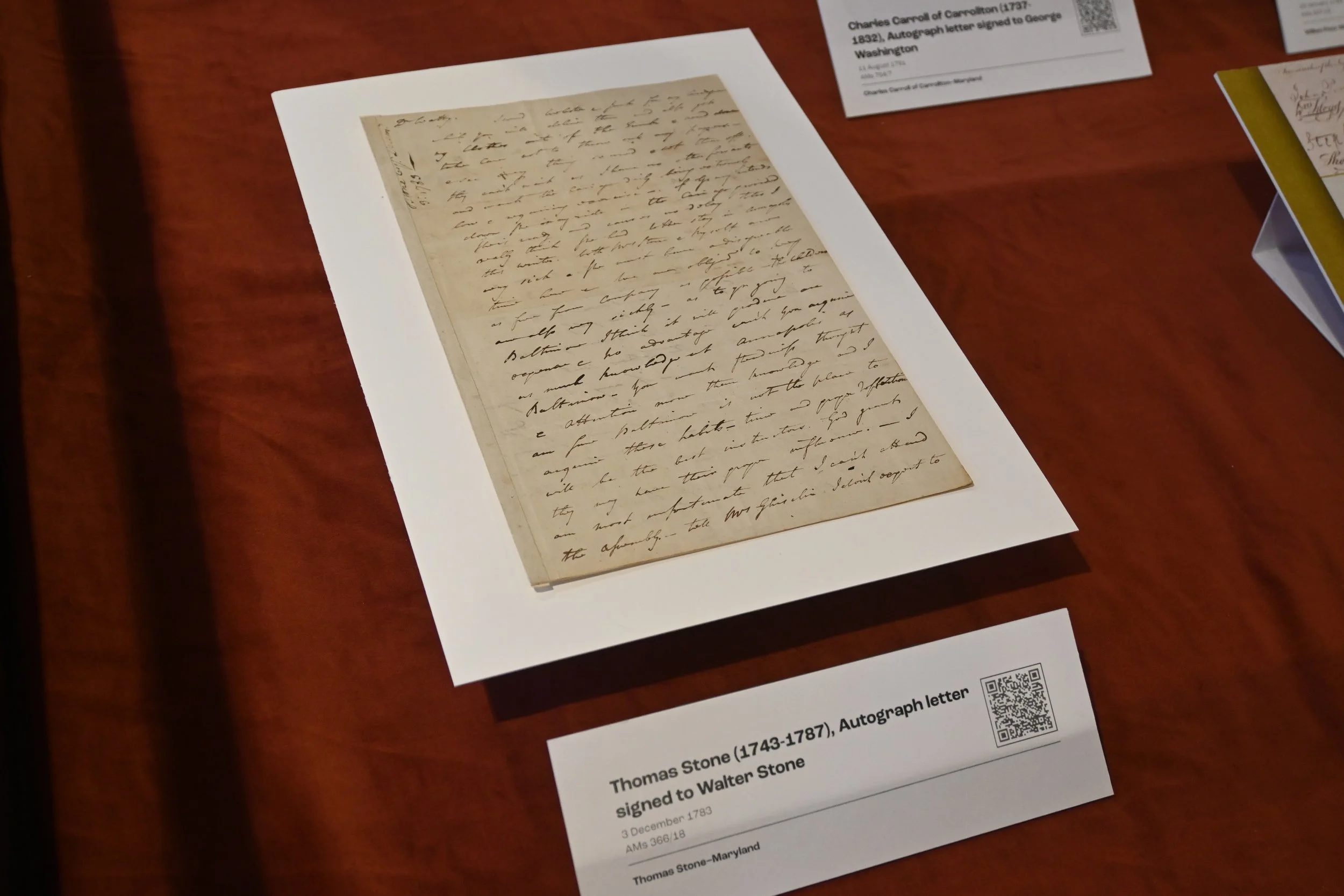
Autograph letter by Thomas Stone. Image credit Bryn Michelson-Ziegler
Thomas Stone (1743-1787), Autograph letter signed to Walter Stone
3 December 1783
AMs 366/18
Stone divided his time between his plantation in southern Maryland and practicing law and attending the legislature in Annapolis, where several of his many siblings lived. At the time of this letter, although he was a member of the Maryland senate and the U.S. Congress of the Confederation, which had just convened at Annapolis, Stone and his family were too ill to travel there. Here he asks his brother Walter to send a carriage, clothes, and medicine to the plantation in care of an enslaved servant. He also requests a number of pairs of “coarse ... stockings" for enslaved workers. Although Walter is more than thirty years old, Thomas, six years his senior, still takes the opportunity to lecture him about his plans to go to Baltimore, apparently to study: “I think it will produce ... no advantage. Can’t you acquire as much knowledge at Annapolis as Baltimore. You want steadiness thought & attention more than knowledge & I am sure Baltimore is not the place to acquire those habits. Time and proper reflection will be the best instructors. God grant they may have their proper influence.”
In September, the Rosenbach’s Partner Desk will showcase signers from Virginia.