
by Bryn Michelson-Ziegler, Associate Curator & Manager of Public Programs
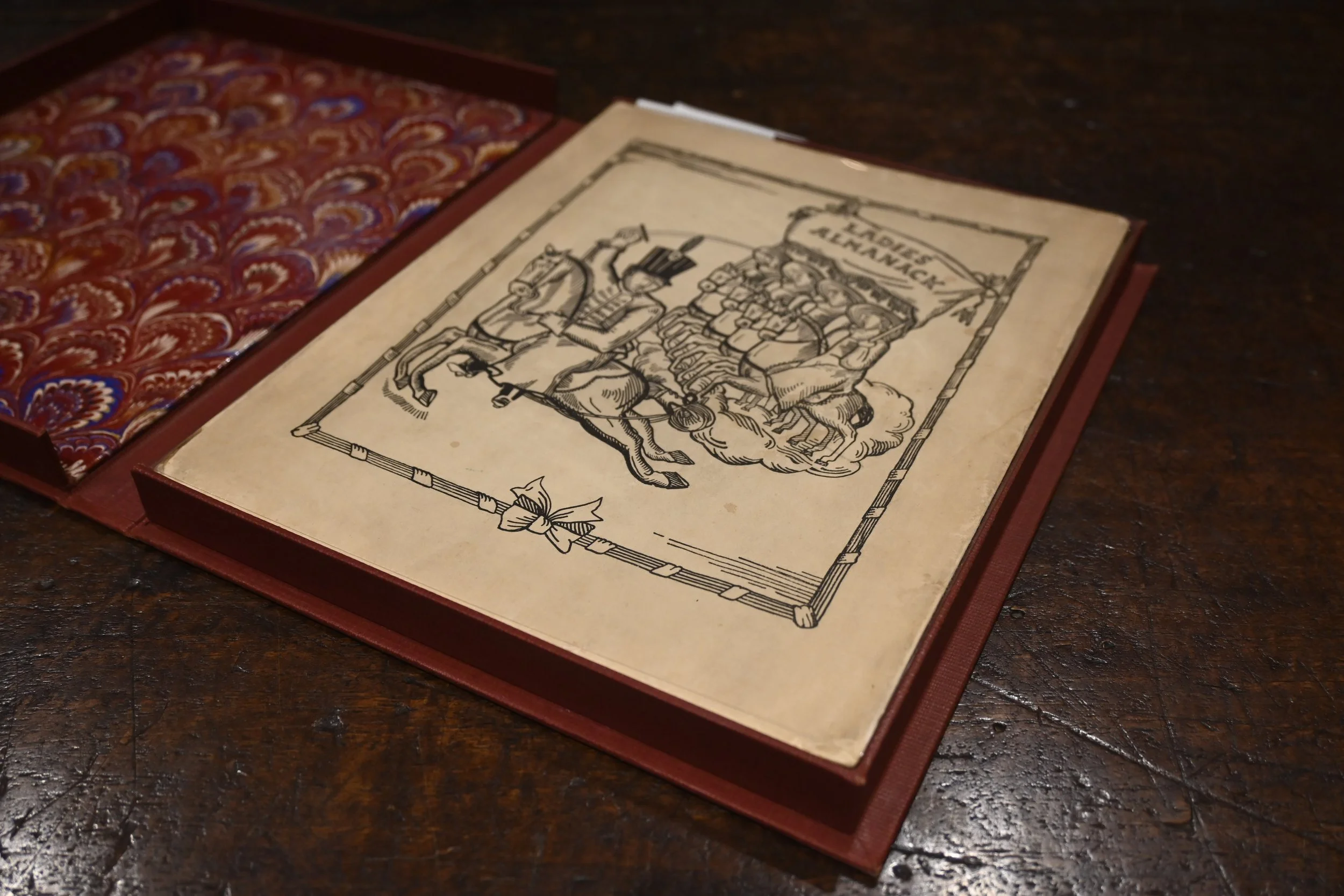
Djuna Barnes (1892-1982), Ladies Almanack. Paris : Printed for the author, and sold by Edward W. Titus, 4 rue Delambre, at the sign of the Black Manikin, 1928. Rosenbach Museum & Library, AL2 .B261l 928. Image credit Bryn Michelson-Ziegler
This summer, the Rosenbach welcomed two additions to our historic library. One is a trio of magazines from late 18th-century London, and the other a satirical novel published in Modernist Paris.
Why pair these disparate acquisitions together for a blog post? Because they are both examples of how the Rosenbach's collections can be richly interpreted through the Rosenbach Book Arts Center.
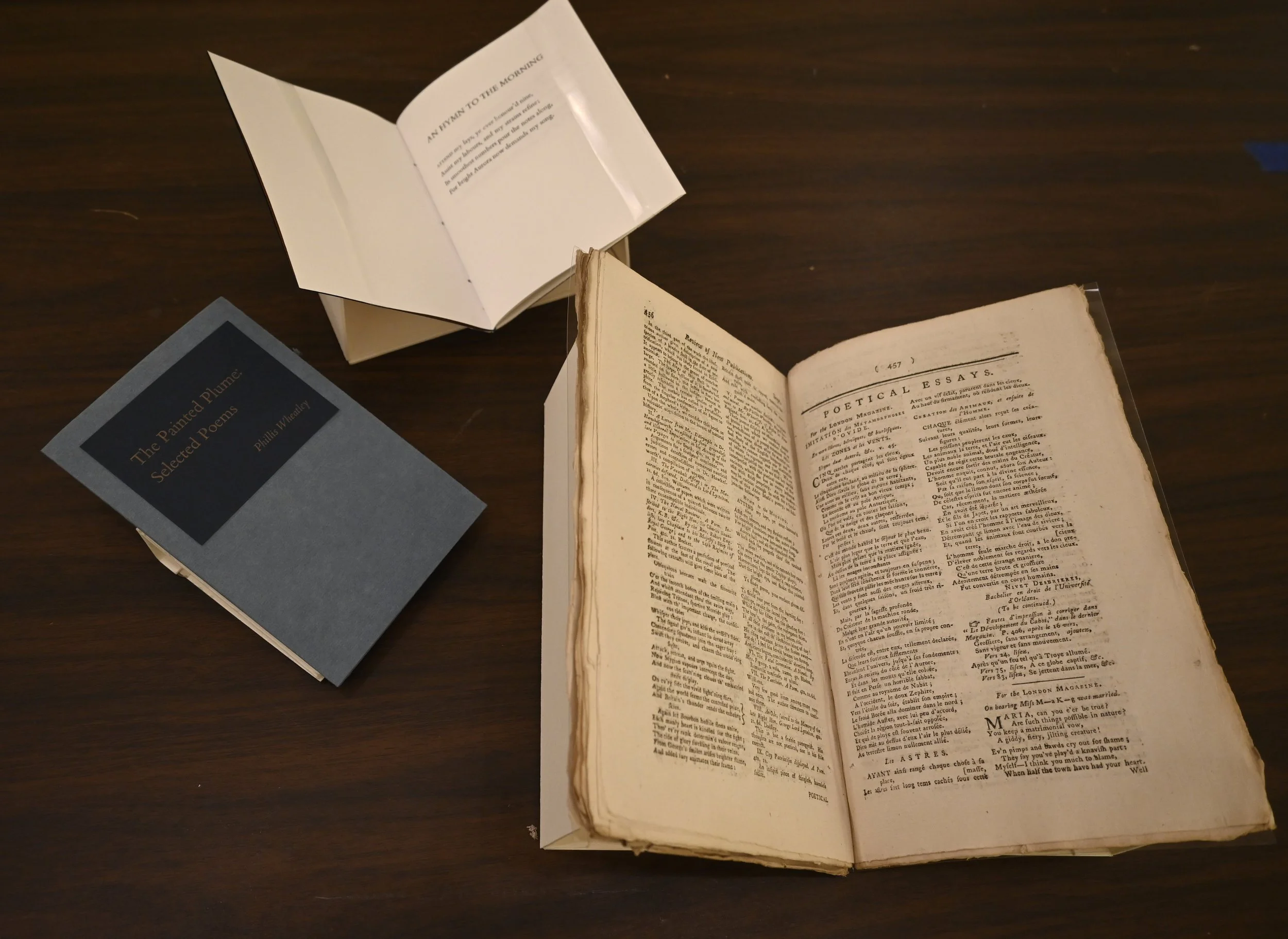
The London magazine, or, Gentleman's monthly intelligencer. London: Printed for R. Baldwin at the Rose in Pater Noster Row, September 1773. Rosenbach Museum & Library, EL2 .Z1l 1773-09. Image credit Bryn Michelson-Ziegler
Phillis Wheatley is one of the gems of the Rosenbach's rare book collection. Her 1773 Poems on Various Subjects, Religious and Moral [A 773p] was the first book of poetry published by an African American woman. It is notable not only for Phillis Wheatley's literary achievements, but also for its publication history: unable to publish in the American colonies as an enslaved African American woman, Wheatley traveled to London, where the Countess of Huntington financially supported the printing of Poems on Various Subjects. The London first edition, with its famous frontispiece engraving depicting Wheatley in the act of writing, featured in the inaugural installation of the Treasures from the Rosenbach's Collection: Literature of Great Britain & Ireland exhibition gallery.
Now, the Rosenbach can also share the earliest appearance in print of "Recollection" and "Hymn to the Morning," and the first British printing of "Farewell to America," three poems from Poems on Various Subjects. These poems appear in two issues of The London Magazine, or, Gentleman's Monthly Intelligencer [EL2 .Z1] and one issue of Every Man's Magazine, or, The Monthly Repository of Science, Instruction and Amusement [EL2 .Z1e 1773-07].
This past May, participants in a brand-new Rosenbach course explored Phillis Wheatley's publication journey by stepping into the role of the printer. In Intro to Letterpress: Printing Phillis Wheatley, attendees selected two poems to handset in metal type and print on the Rosenbach's handpress. They chose "Hymn to the Morning" and "To S. M. a Young African Painter, on seeing his works.” "S. M." refers to Scipio Moorhead, the enslaved artist who likely designed the frontispiece portrait of Wheatley.
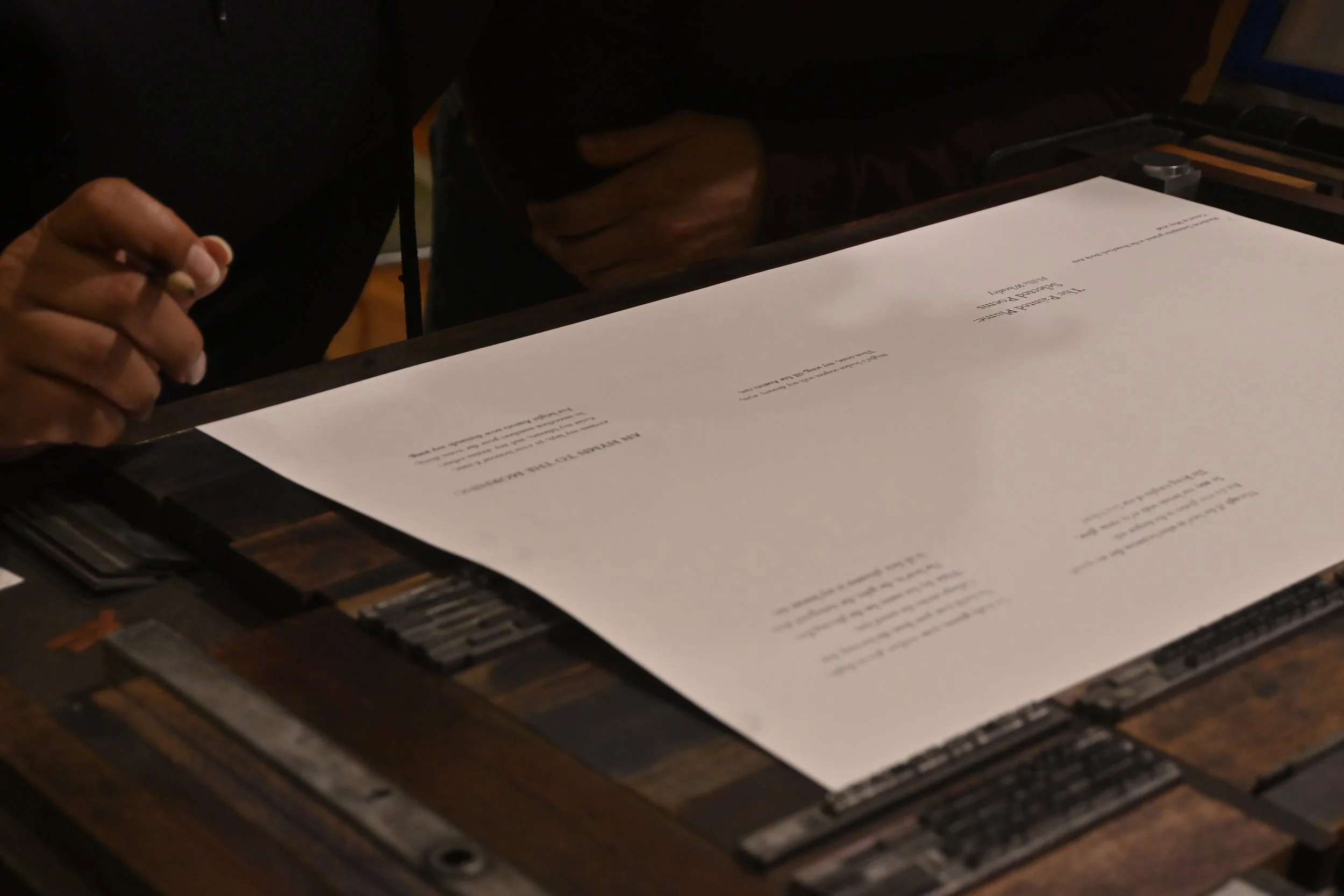
Intro to Letterpress: Printing Phillis Wheatley class proofing text on the bed of the press. May 2026. Image credit Bryn Michelson-Ziegler
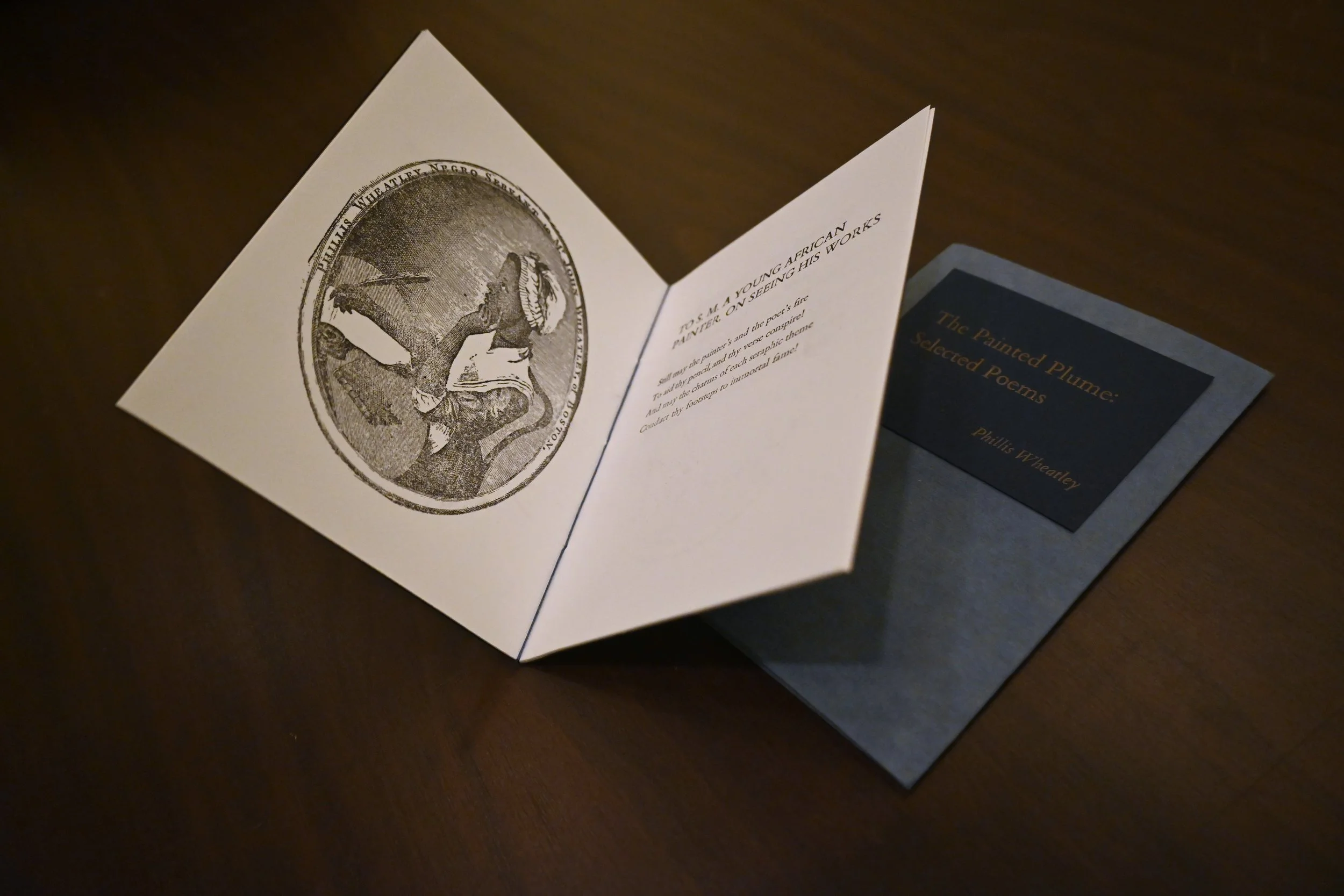
Recreation of the frontispiece of Poems on Various Subjects in The Painted Plume: Selected Poems. May 2026. Image credit Bryn Michelson-Ziegler
Starting November 12th, the first publication of "Hymn to the Morning" in the September 1773 issue of The London magazine will be displayed in Treasures: Literature of Great Britain & Ireland alongside "Hymn to the Morning" in The Painted Plume: Selected Poems, printed right here in the Rosenbach Book Arts Center.
♦♦♦
Published more than 150 years after Poems on Various Subjects, Djuna Barnes’s 1928 Ladies Almanack [AL2 .B261l 928] is certainly a thematic departure from Phillis Wheatley's considered verses.
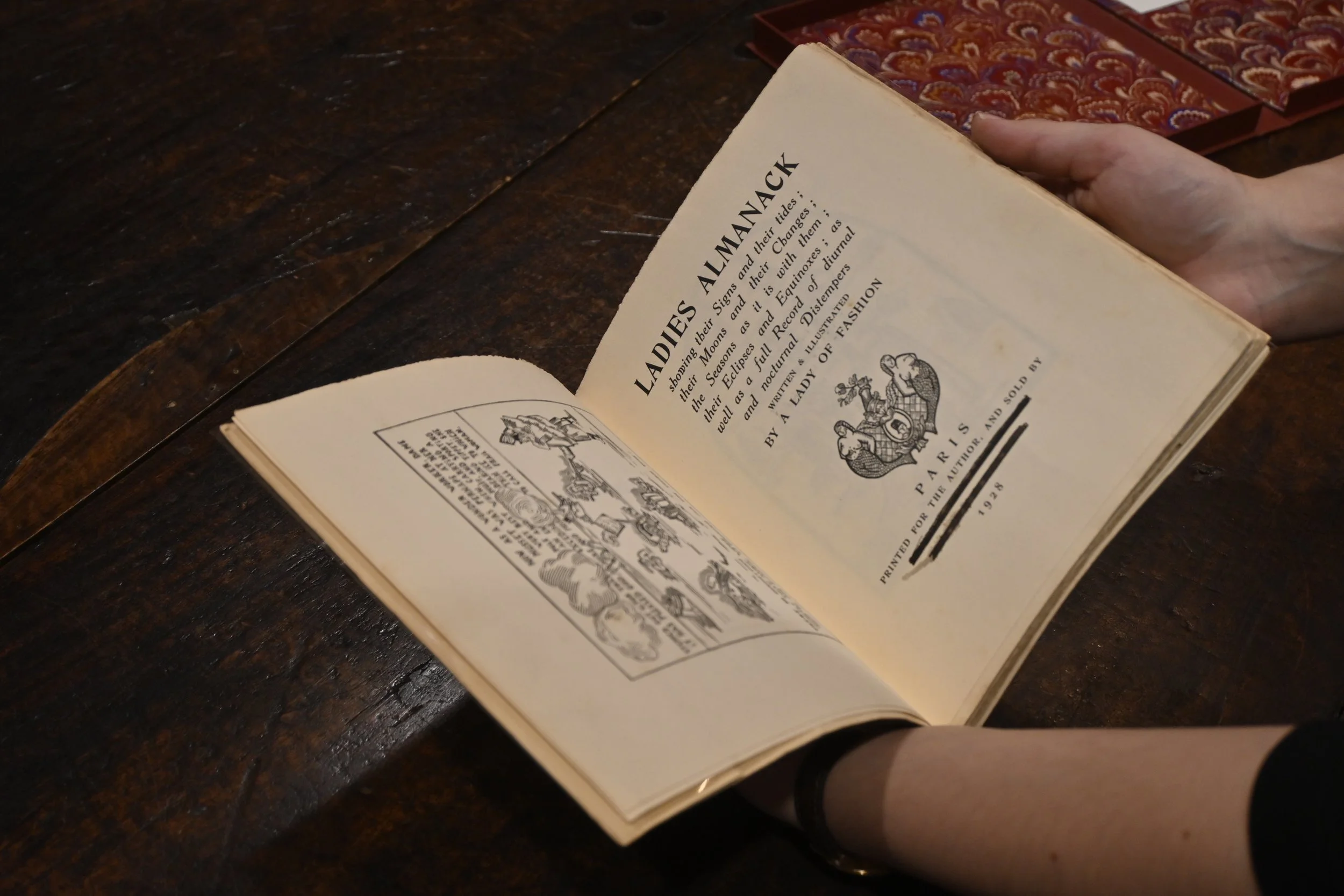
Djuna Barnes (1892-1982), Ladies Almanack. Paris : Printed for the author, and sold by Edward W. Titus, 4 rue Delambre, at the sign of the Black Manikin, 1928. Rosenbach Museum & Library, AL2 .B261l 928. Image credit Shoshana Bockol
The complete title of this book is Ladies Almanack: showing their Signs and their Tides; their Moons and their Changes; the Seasons as it is with them; their Eclipses and Equinoxes; as well as a full Record of diurnal and nocturnal Distempers, written & illustrated by a lady of fashion. The Rosenbach's newly acquired first edition copy was published anonymously, but was later inscribed from Barnes to the musician Chester Page.
Djuna Barnes is best known for the lesbian novel Nightwood, which she would publish nine years after Ladies Almanack. She was an associate of both the poet Marianne Moore and writer James Joyce, who figure prominently in the Rosenbach’s collections. For much of the 1920s Barnes lived in Paris, when it was a hub of Modernism and the home of a well-documented lesbian literary and artistic circle.
Ladies Almanack is a “roman a clef,” portraying real people and events under a veneer of fiction. Its story follows the adventurous Dame Evangeline Musset, a “Pioneer and a Menace.” Musset is a fictionalized Natalie Clifford Barney, who hosted legendary literary salons in Paris for more than six decades, and published love poems to women under her own name rather than anonymously or with a pseudonym. In Almanack, Barney’s avatar interacts with other veiled members of the queer Paris set, including parodies of author Radclyffe Hall, sculptor Lady Troubridge, and writer Mina Loy.
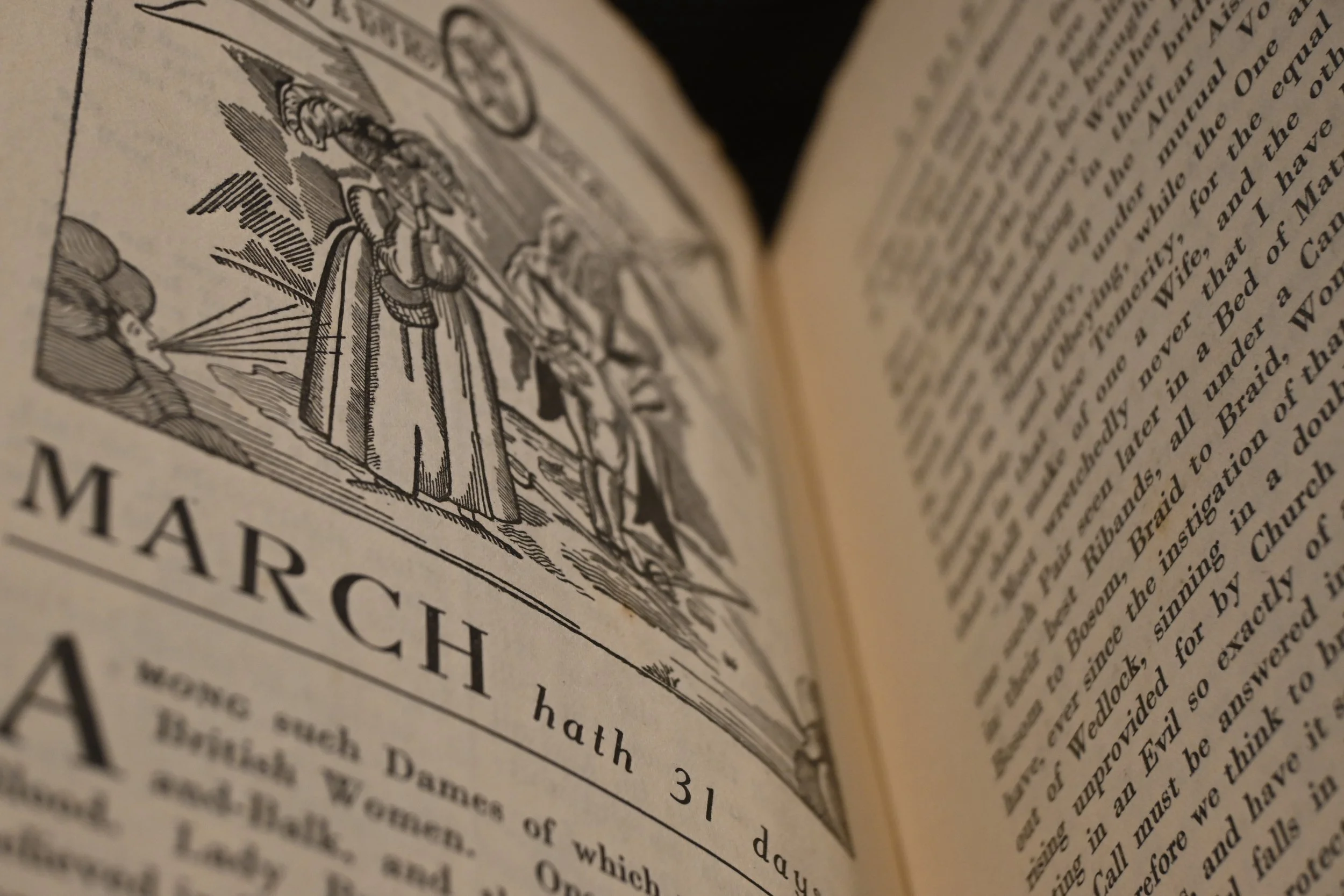
Djuna Barnes (1892-1982), Ladies Almanack. Paris : Printed for the author, and sold by Edward W. Titus, 4 rue Delambre, at the sign of the Black Manikin, 1928. Rosenbach Museum & Library, AL2 .B261l 928. Image credit Bryn Michelson-Ziegler
In addition to contributing to the Rosenbach's queer literary holdings, the printing of Ladies Almanack also has plenty to say. Though by 1928 printing technology had evolved into a world of steam-operated presses and photographic reproduction, Ladies Almanack was privately printed. Djuna Barnes designed and carved the woodcut illustrations herself, harkening back to the Restoration-era almanacs she modeled this project on.
Woodcut and other relief printing techniques remain one of the most popular methods of creative printmaking to this day. Here is an example of a carved block printed in the Rosenbach Book Arts Center. It was inspired, much like Djuna Barnes, by an illustration in a book printed centuries earlier.
While we haven't yet scheduled a course carving & printing custom almanac illustrations inspired by Djuna Barnes, it's only a matter of time!
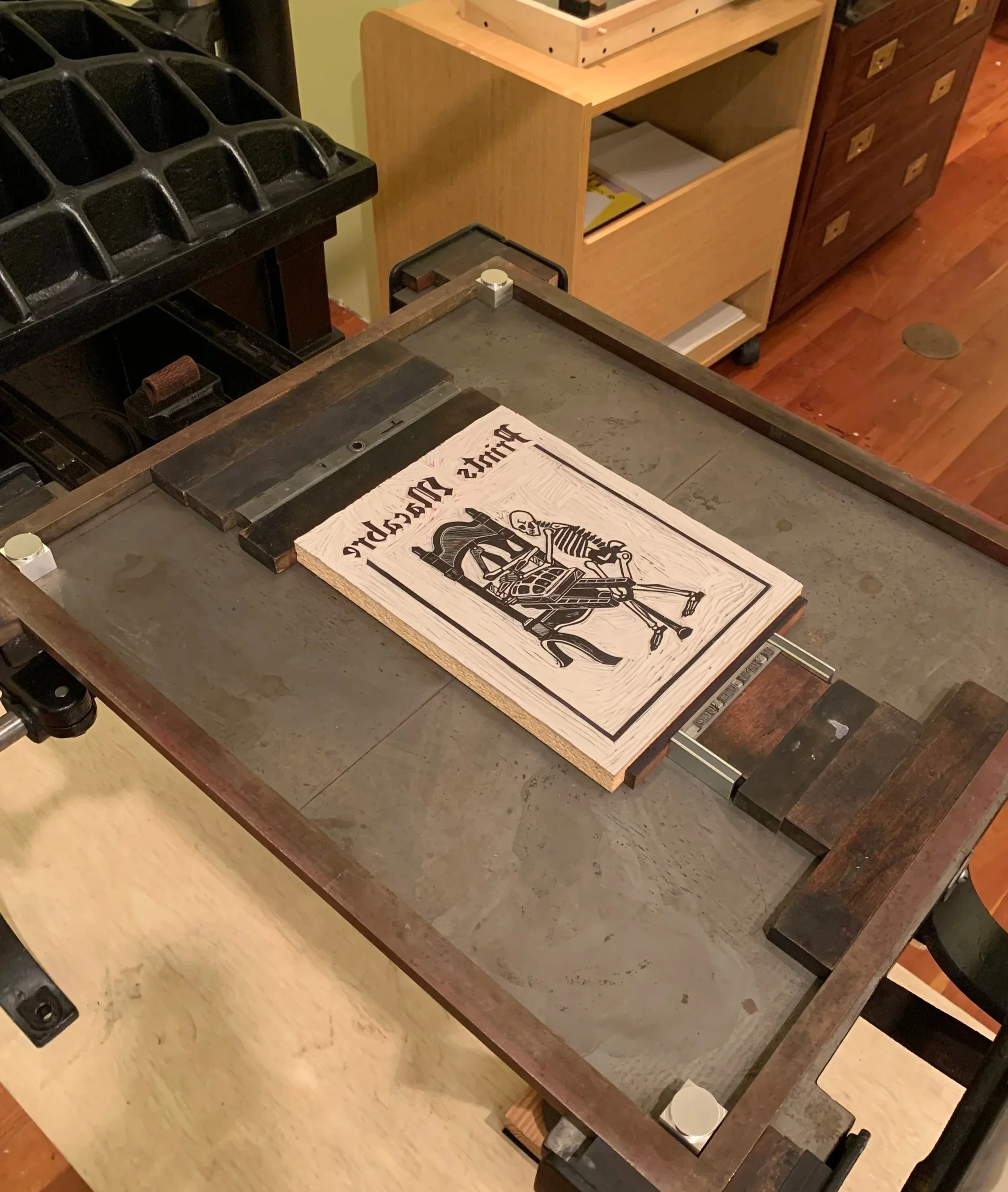
Print demonstration in the Rosenbach Book Arts Center, October 2025