
The Rosenbach Museum & Library’s Literary Garden
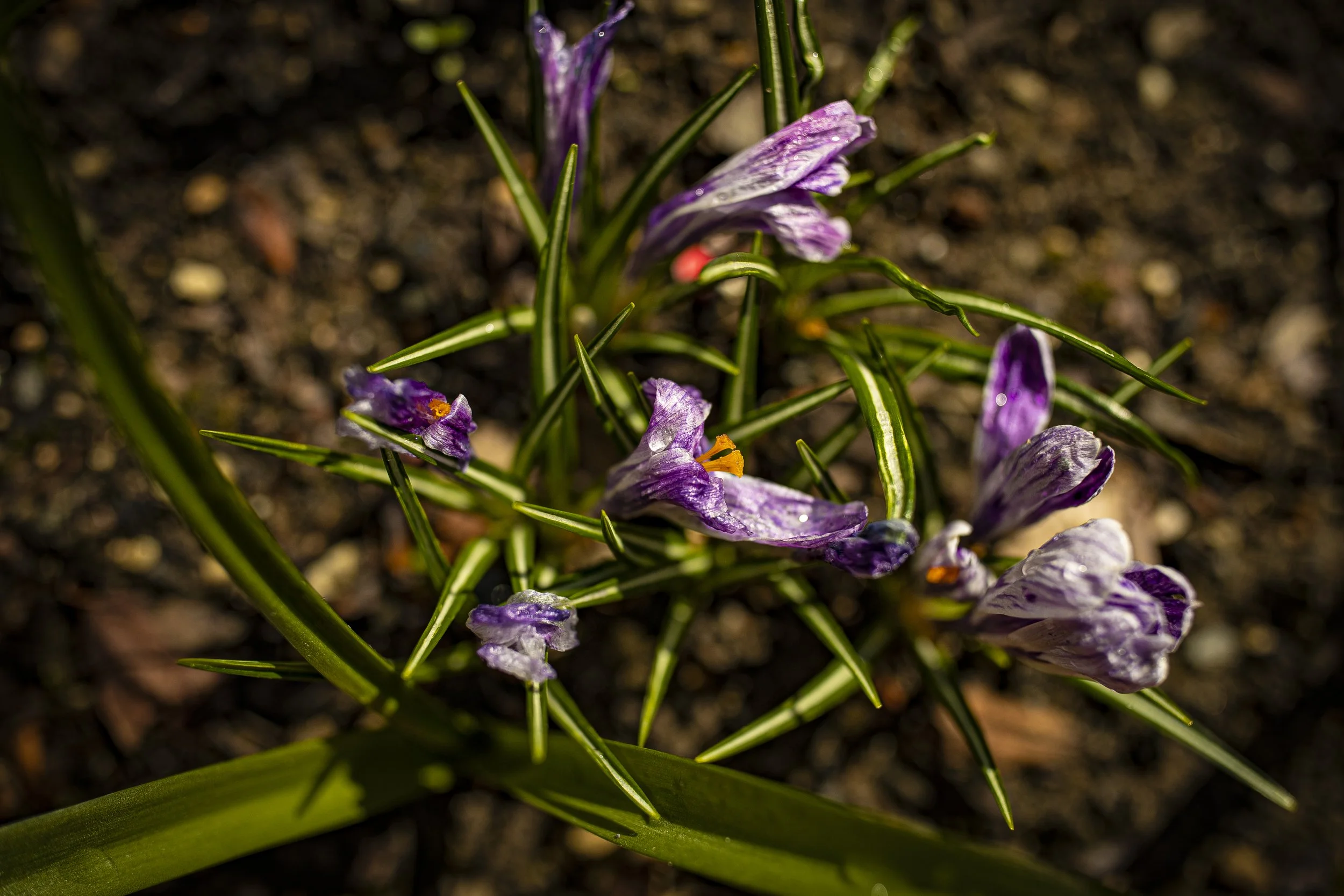
Image credit Ryan Brandenberg
For the Rosenbach brothers, this garden was an extension of the experience they offered to visitors inside their home. When their customers, friends and family visited the home and garden on Delancey Place, they were transported to another time and place via the brothers’ awe-inspiring collection of rare books and manuscripts. Over the years, many of the townhouses on the block transformed their gardens into garages, but the Rosenbach brothers kept their garden intact. We are thankful that they made that choice; today, the Rosenbach’s garden is the only one that remains on this block. The garden retains many of its original features, like the eighteenth or nineteenth-century copy of a Roman sarcophagus depicting Achilles at the court of King Lycomedes. But the real stars of the show are the plants. Every specimen in this garden appears in works from our collection; we have highlighted a handful of them in this guide. As you wander the garden paths, we hope you are transported to another world just as the Rosenbach brothers intended.
Juniper
Juniper, with its thorny branches and skin-irritating sap, has long symbolised protection. The Greek word for Juniper is “arkeuthos”, from the verb “arkéo”, which means “to repel the enemy” and was often planted near the home to protect the house from evil. In Italy and other parts of Europe, it is sometimes tucked into the cracks in a house to ward off diseases. The reckless sparrow from Marianne Moore’s “Virginia Britannia,” seemingly undeterred by the Juniper’s spikes, perches in the dew-soaked branches, having woken seven minutes earlier than the lark.
-accompanied edge are,
when compared with what the colonists
found here in tidewater Virginia, stark
luxuries. The mere brown hedge-sparrow, with reckless
ardor, unable to suppress his satisfaction in man’s trustworthy nearness,
even in the dark
flutes his ecstatic burst of joy-the caraway seed-
spotted sparrow perched in dew-drenched juniper
beside the window-ledge;
this little hedgesparrow
that wakes up seven minutes sooner than the lark.
Rosemary
Rosemary has long symbolized fidelity. In the Middle Ages, rosemary branches were dipped in gold and tied in bundles with ribbon for keepsakes given to wedding guests. Anne of Cleves wore twigs of rosemary in her circlet when she wed King Henry VIII. Emily Dickinson highlights the enduring nature of the plant when she compares eternity to the “ceaseless rosemary.”
Essential oils — are wrung —
The Attar from the Rose
Be not expressed by Suns — alone —
It is the gift of Screws.
The General Rose — decay —
But this — in Lady’s Drawer,
Makes Summer — When the lady lies
In Ceaseless Rosemary.
Rose
The rose often symbolizes love. But its beautiful blooms belie lurking thorns. So, the flower is also symbolic of the pain that often accompanies love. Juliet chooses to overlook the thorns in Romeo’s family history and instead luxuriates in the gentle aroma of the rose’s petals in her famous line from Romeo and Juliet.
What’s in a name? That which we call a rose
By any other name would smell as sweet.
And who could forget the argumentative roses in Lewis Carroll’s Alice’s Adventures in Wonderland?
A large rose-tree stood near the entrance of the garden: the roses growing on it were white, but there were three gardeners at it, busily painting them red. Alice thought this a very curious thing, and she went nearer to watch them, and just as she came up to them she heard one of them say, `Look out now, Five! Don't go splashing paint over me like that!' `I couldn't help it,' said Five, in a sulky tone; `Seven jogged my elbow.'
Thyme
The word thyme comes from the Greek word thymus, meaning "courage." It was said that thyme was born out of the tears of the most beautiful woman in the world, Helen of Troy, so it also symbolized elegance and style. In Medieval Europe, it became associated with Chivalry and affection. Shakespeare uses wild, blowing thyme as a character, along with violet, oxlips, woodbine and roses in the luscious garden which Oberon describes in Act II of Midsummer Night’s Dream.
I know a bank where the wild thyme blows,
Where oxlips and the nodding violet grows,
Quite over-canopied with luscious woodbine,
With sweet musk-roses and with eglantine:
There sleeps Titania sometime of the night,
Lull'd in these flowers with dances and delight
Daffodil
Emily Dickinson is so enchanted with her daffodils that she will only allow us to borrow rather than buy them, and even then, she offers to lend them to us for just an hour.
Perhaps you'd like to buy a flower,
But I could never sell-
If you would like to borrow,
Until the Daffodil
Unties her yellow Bonnet
Beneath the village door,
Until the Bees, from Clover rows
Their Hock, and Sherry, draw,
Why, I will lend until just then,
But not an hour more!
But in this poem, Dickinson seems a bit put off by the flower’s fashionable yellow gown:
I dared not meet the daffodils,
For fear their yellow gown
Would pierce me with a fashion
So foreign to my own.
Crocus
Crocus can symbolize joy and romance as well as rebirth due to its early springtime blooming. The color of the crocus can also affect its meaning; the purple flowers can signify pride, while the white blooms represent purity. In this line from the Book of Isaiah, the crocus’s gladness is so great that it shouts for joy:
The desert and the parched land will be glad; the wilderness will rejoice and blossom. Like the crocus, it will burst into bloom; it will rejoice and shout for joy.
One of the greatest strengths of the Rosenbach is its collection of Americana, including books and documents related to the settlement of the Americas. Early printing in the colonies is illustrated by examples such as the Eliot Indian Bible, the first complete Bible printed in the Western Hemisphere in 1661-1663. Significantly, it is printed not in English but in the Natick language. John Eliot, a minister, devised a system for writing the language and translated the entire Bible. Native Americans had an active part in producing this Bible. Job Nesuton was instrumental in helping Eliot to learn Natick, and another, James Printer, a Nipmuc, worked as apprentice to the printers.
Rather than illustrating this line from Isaiah with the more common Latin or English text, we chose to illustrate it with a page from Eliot’s bible.
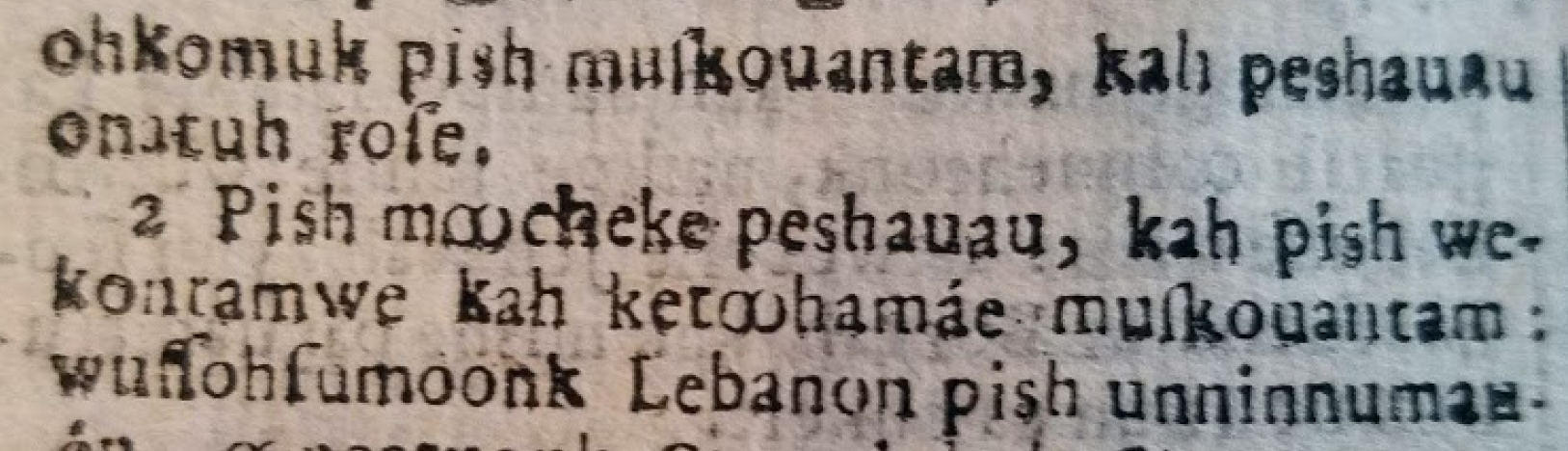
Mamvsse Wunneetupanatamwe Up-Biblum God Naneeswe Nukkone Testament Kah Wonk Wusku Testament. : Ne quoshkinnumuk nashpe Wuttinneumoh Christ noh asoowesit John Eliot. Cambridge [Mass.] : Printeuoop nashpe Samuel Green kah Marmaduke Johnson, 1663. A 663m
On the first line, you’ll see the word “peshauau” which means blossom. Eliot has directly translated that line. But in the fourth line, you’ll see the word “muskouantam” which means ripened corn, not crocus. It seems that Eliot, Nesuton and Printer decided that ripened corn would work better than crocus here. Given that crocuses are not native to North America, the Natick would likely not have been familiar with them.
Lily of the Valley
The lily of the valley is not actually related to the lily; it is part of the asparagus family. It symbolises a return of happiness and is also thought to bring luck in love. Leopold Bloom, the protagonist of James Joyce’s Ulysses was hoping for some luck in love, or at the very least some flirtation, when he began an extra-marital correspondence with Martha using the pseudonym Henry Flower.
One might not expect a masterpiece of Modernist literature to include flowery language, but in fact, flowers have an integral role in the text. It was not an accident that the protagonist's last name is Bloom. In the “Ithaca” episode, we get to see the grounds of Leopold’s imaginary cottage, which include:
As addenda, a tennis and fives court, a shrubbery, a glass summerhouse with tropical palms, equipped in the best botanical manner, a rockery with waterspray, a beehive arranged on humane principles, oval flowerbeds in rectangular grassplots set with eccentric ellipses of scarlet and chrome tulips, blue scillas, crocuses, polyanthus, sweet William, sweet pea, lily of the valley (bulbs obtainable from sir James W. Mackey (Limited) wholesale and retail seed and bulb merchants and nurserymen, agents for chemical manures, 23 Sackville street, upper), an orchard, kitchen garden and vinery protected against illegal trespassers by glasstopped mural enclosures, a lumbershed with padlock for various inventoried implements.
Holly
Holly, with its hard, pointed edges, often symbolises combativeness and pain. The tree has also been associated with trickery; the lovely red berries lure you in and distract you from the thorny leaves. For the Romans, the ruby berries were a sign of war and bloodshed. In Celtic Mythology, holly was sacred to the Druids who regarded the evergreen as a symbol of fertility and eternal life. Shakespeare invokes the life-affirming holly green, a symbol of life amidst the barren winter months that can inspire frivolity even with the cold wind blowing. In this song from As You Like It, Amiens paints us a picture of a winter where the sky is bitter, the holly is green, and the friendship is feigned.
Blow, blow, thou winter wind,
Thou art not so unkind
As man’s ingratitude;
Thy tooth is not so keen,
Because thou art not seen,
Although thy breath be rude.
Heigh-ho! sing, heigh-ho! unto the green holly:
Most friendship is feigning, most loving mere folly:
Then, heigh-ho, the holly!
This life is most jolly.
Freeze, freeze, thou bitter sky,
That dost not bite so nigh
As benefits forgot:
Though thou the waters warp,
Thy sting is not so sharp
As friend remembered not.
Heigh-ho! sing, heigh-ho! unto the green holly:
Most friendship is feigning, most loving mere folly:
Then, heigh-ho, the holly!
his life is most jolly.